Saturday, March 30, 2013

Milwaukee Real Estate Trends

The median sale price per unit for multifamily properties in the metro area has been rising for five straight months, climbing 4.4% during that time. Prior to that, sale prices fell 6.6% over a five-month period ending in May. Compared to last quarter, the average sale price per unit for multifamily properties rose by 3.7% to $19,967. During the past year, though, sale prices have dropped by 5.1%. The highest median price of the past three years was set in December 2009 at $58,059. In comparison, the median sale price is now 65.6% lower. However, the current price is 4.4% higher than the May 2012 figure, which was the three-year low.

The median sale price per square foot for office properties in the metro area has been falling for four straight months, dropping 7.9% during that time. Sale prices rose 9.9% earlier this year during a seven-month streak that ended in January. Sale prices per square foot for office properties dipped to $30.85, a 7.9% decrease compared with the end of the prior quarter. Similarly, over the previous year, sale prices have dropped by 13.2%. The metro area saw its median sale price fall to its three-year low this month. The previous low point was set last month at $32.41.


Median sale price per square foot for retail properties in the metro area is currently in a 15 month downward trend, but the rate of decline has slowed in the last month. At $43.32, sale prices per square foot for retail properties have decreased by 9.5% compared to the end of the prior quarter. Sale prices are also down over the previous 12 months, having declined by 35.5%. The metro area saw its median sale price fall to its three-year low this month. The previous low was $44.18, which was set last month.


Multifamily properties in the Milwaukee Metro Area are staying on the market longer than they did during the same time last year, and the change is greater than that at the state level. They now last 182 days on the market at the metro level, an increase of 10.8% year-over-year. In comparison, these buildings last 148 days at the state level, 13.8% less than last year. From the lowest point, which was set in January 2011, time on market has risen 38.3%.


Compared with a year earlier, office properties in the Milwaukee Metro Area are staying on the market longer, and the gap is greater at the metro level than at the state level. They now last 281 days on the market at the metro level, an increase of 12.5% year-over-year. Meanwhile, they stay on the market 253 days at the state level, down 15.6%. Compared with January 2010, when the time on market was at its lowest, these properties are now on the market 41.3% longer. The time that office properties stay on the market has risen 12.1% over the past three months.

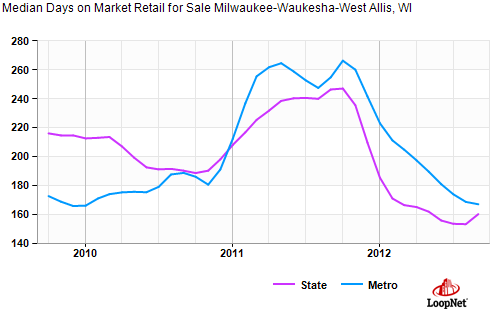
Retail properties in the Milwaukee Metro Area are turning over more quickly compared to last year, as the time on market dropped 34.4% to 167 days. During the same time period, the time on market for these properties at the state level has fallen even more as a percentage, by 35%, to 160. From October 2011, when the time on market was at its highest, it has fallen 37.3%.


Asking rates for office properties have fallen 1.8% to $14.28 per square foot over the past quarter. However, over the past year asking lease rate have risen 0.3%. Lease rates for office properties hit a three-year peak in March 2009 at $14.72 per square foot. In comparison, the current median asking price is down by 2.1%. On the other hand, the lowest asking lease rate in the past three years was seen in February 2011 at $13.96.

Asking lease rates for retail properties have gone up versus past quarter, rising 0.1% to $14.44 per square foot. But for the year asking rates have dropped 3.1%. Lease rates for retail properties reached a three-year high in July 2008 at $16.59 per square foot. The current median asking lease rate is 1.6% lower. On the other hand, the lowest asking lease rate in the past three years was seen in December 2005 at $14.21.

Friday, March 29, 2013

A Steaming Pile Of Boldness

The Journal Sentinel is back pushing Walker's venture capital slush fund, Legislature Should Establish A Fund For Venture Capital.
Wisconsin politicians continue to argue about how many jobs have been created on Gov. Scott Walker's watch - and even how to count those jobs. This was inevitable, of course, given the governor's promise that 250,000 jobs would be created during his first term.
But rather than argue over numbers, how about focusing on policies that might make a difference?
Yes, just forget about Walker's (completely ridiculous) promise of 250,000 jobs, which undoubtedly helped win him the election. We don't want to actually evaluate politicians on the things they've said.

The whole article is a well-worn regurgitation of cliches regarding the magic that is venture capital.
With job growth and income sluggish in the state, we continue to believe the best answer is unleashing good ideas that could be turned into young companies that will employ people. Research by the Ewing and Marion Kauffman Foundation a couple of years ago found that between 1977 and 2005, existing companies lost about 1 million jobs a year while new companies added an average of 3 million jobs. Since 2008, the pace of hiring is stronger in companies that are two years or younger, Kauffman found. 
Simply put, we need more entrepreneurs, and we need to figure out how to mentor them and invest in their ideas.
Yes, we need more entrepreneurs. We need more jobs. Bold insight.

The pace of hiring may be strong in young companies, but what they also fail to mention is that the pace of firing is also higher amongst younger companies.

The article then (to supposedly support a venture capital fund) points to UW-Madison's Research Park, and UW-Milwaukee's and the Medical College's increased research, which has created jobs. Yet, this seems like more of a substantiation for investment in our universities. Is the Journal implying we should spend public dollars for private benefit? Should we continue the process whereby our public sector provides tax credits, other funding, university R&D, and a host of other giveaways, in which private entities get to reap the majority of the rewards? Here's a novel idea, how about public investment with public rewards.
But young companies need a continuum of support - from the early going when the entrepreneur mortgages her house to get started to the first "angel" investors who take notice to the point where larger infusions of money are needed from venture capitalists. And in Wisconsin, there long has been a gulf between the typical angel investor round and the venture capital round.
What did companies do before venture capital?
Despite a good fourth quarter, Wisconsin attracted only $95 million last year, according to the MoneyTree Report by PricewaterhouseCoopers LLP and the National Venture Capital Association. Nationwide, venture capitalists invested $26.5 billion.
What is the average amount states attract? Where does Wisconsin rank among the states in attracting capital?

Another article from the Journal notes, "State companies pulled in more than $95 million during the full year, up 31% from 2011, when they raised about $73 million of venture capital...Nationally, venture capital investment declined for the first time in three years. Venture capitalists invested $26.5 billion in 3,698 deals in 2012, a 10% decrease in dollars from a year earlier."

So, nationally venture capital is declining, yet over the past year it increased 31% in Wisconsin. Seems like money has already decided Wisconsin is a decent investment, even without the State providing additional funding.

The Journal continued, "But while $25 million is a start, it's probably only a down payment. The state needs something closer to $150 million, perhaps funded over several budget cycles, to attract the interest of top venture capital funds. "If the state really wants to get to critical mass, then we're going to need more than $25 million," said Tom Still, president of the Wisconsin Technology Council and the Wisconsin Innovation Network. The "Be Bold Wisconsin Prosperity Strategy" report, which grew out of a series of economic summits around the state in 2010, called for an even larger commitment."

We need to put up at least $25 million and also some type of continuing commitment? If we applied the same amount to public works - infrastructure, green buildings, energy grid, sewage and water systems, etc. - wouldn't that just as efficiently and effectively ignite the economy and put people back to work? And, we wouldn't have to worry about the speculative nature and the whims of the private sector. Not to mention, we could actually ensure these were good paying jobs.

Finally, it seems rather odd that the Journal Sentinel and the Republican class-war criminals were so quick to talk about a Wisconsin's (phony) budget crisis, how we were broke, how public workers had bankrupted us and caused the recession. Yet, in their next breath, they cackle about spending on sport stadiums, venture capital, and numerous other ways of funneling public dollars to obscure private sector schemes. Yes, we're broke, until the power-brokers whom are already garnering most of society's gains decide they want more.

For Further Reading:
Casino Capitalism
Cut Out The (Private Sector) Middle Man
Deja Vu
Fund Fail
Haplessly Venturing
Risky Business
Something Venture, (Virtually) Nothing Gained
Venturing Aimlessly
Venturing Wisconsin's Money

Weekend Reading: Scott Walker Edition

Scott Walker Medicaid Decision Could Cost Wisconsin Employers $36 Million
Wisconsin Gets An "F" For Disclosing Its Spending
Scott Walker Budget Could Create Deficit In Next Biennium
Walker Loves Milwaukee? We're Not Feeling It
Wisconsin A Tax Haven For Businesses
Wisconsin Falls To 44th Nationally In Private-Sector Job Creation
Wisconsin ranked 44th out of the 50 states in private-sector job creation in the 12 months from September 2011 to September 2012. The state's position has deteriorated progressively from a revised rank of 41st in the previous 12-month period through June 2012; and from a rank of 37th in the 12 months through March 2012.

But wages in Wisconsin fell faster and harder than most of the nation. When ranked by the percentage change in all private-sector employment, Wisconsin average wages had the 45th-worst ranking out of 50 states.
In the manufacturing economy, where Wisconsin has a disproportionate share of its employment, Wisconsin's wages also dropped more than national wages did, ranking 46th in terms of the change from September 2011 to September 2012.

Income Inequality: 1 Inch to 5 Miles

Income Inequality: 1 Inch to 5 Miles
In 2011 entry into the top 10 percent, where all the gains took place, required an adjusted gross income of at least $110,651. The top 1 percent started at $366,623.
The top 1 percent enjoyed 81 percent of all the increased income since 2009. Just over half of the gains went to the top one-tenth of 1 percent, and 39 percent of the gains went to the top 1 percent of the top 1 percent.
Ponder that last fact for a moment -- the top 1 percent of the top 1 percent, those making at least $7.97 million in 2011, enjoyed 39 percent of all the income gains in America. In a nation of 158.4 million households, just 15,837 of them received 39 cents out of every dollar of increased income.
That disparity in income growth rates comes as the total federal tax burdens on those at the top have been slashed, compared with 1966, especially for the long-term capital gains that account for about a third of total income at the very top.

In 2011 the average income of the bottom 90 percent was just $59 more than in 1966 in real terms.

Back in 1966, the top 1 percent of the top 1 percent reported 1.3 percent of all pretax income. In 2011 that tiny number of American households saw their slice of pie more than triple, to 4.5 percent.

Between 1980 and 2005, more than 80 percent of the total increase in income went to the top 1 percent of American households.

Those at the top are pulling away from everyone else not because of hard work, but the shift of income from labor to capital and changes in federal income, gift, and estate tax rules.

Republicans, Or The Better Alternative

Why Does Anyone Still Take Paul Ryan Seriously?
Paul Ryan's House Budget Echoes Republican Vision From 2012

In A Stinging Post-Mortem, GOP Promises To Change

What they've really promised is to be more elusive and vague in their messaging, and more active in their marketing.
"The way we communicate our principles isn't resonating enough," said GOP Chairman Reince Priebus. 
See, Republicans don't want to change their racist, homophobic, business-pandering, class warfare, corrupt, regressive ways. They just want to reword their message so voters will think their sow's ear is a silk purse. Republicans have learned nothing.

House Progressive Have The Best Answer To Paul Ryan
The correct counterpart to the unbridled ambition of the Ryan budget isn’t the cautious plan released by the Senate Democrats. It’s the “Back to Work” budget released by the House Progressives.

Weekend Reading

The Most Expensive Tax Breaks
1. Employer Paid Health Insurance - Five year cost: $760 billion
2. Lower Rate For Capital Gains, Dividends - Five year cost: $616 billion
3. State And Local Tax Deductions - Five year cost: $431 billion
4. Mortgage interest deduction - Five year cost: $379 billion
5. Tax Free Medicare Benefits - Five year cost: $358 billion
6. Workplace Retirement Saving Plans - Five year cost: $336 billion
7. Earned Income Credit - Five year cost: $326 billion
8. Child Credit - Five year cost: $292 billion
Adding Up Just How Little We Actually Move
14 GOP Congressmen Against Borrowing, Have Big Debts Of Their Own
Workers Saving Too Little To Retire
Hate Paying Taxes? Try These States
Housing Has Been Booming! Construction Jobs Haven't. Here's Why.
Stop Subsidizing Wall Street

Monday, March 25, 2013

15 U.S. Cities' Emerging Downtowns: Milwaukee

Milwaukee, Wis.

The Milwaukee community first turned its sights to downtown in 1988 with the RiverWalk initiative. In the decades since, the city passed zoning changes to encourage developers to erect more housing in the area. In 2002, with the help of $45 million in government funding, the city dismantled the mile-long elevated Park East freeway and replaced it with a landscaped boulevard. According to the Congress for New Urbanism, per-acre land values within the freeway footprint had surged 180% by 2006 from 2001. Since 2000, the downtown population has increased by nearly 26% compared to the greater city of Milwaukee, which has experienced an overall decline. Jobs in the area increased by nearly 4% from 2000 to 2010, and the median income of downtown households has climbed by 38% since 2000, compared to 2% for the city overall, according to Milwaukee Downtown organization.

Cold Dead Hand

Tuesday, March 19, 2013

America's Coolest Small Towns: Elkhart Lake, Wisconsin

America's Coolest Small Towns, 2013

Elkhart Lake, Wisc.(Photo: Courtesy Elkhart Lake)
(Population: 967)

You might say Elkhart Lake runs on two speeds: adrenaline-pumping fast and good-ol'-days calm. Just outside of town, in the Kettle Moraine State Forest, speedsters can find Road America, a four-mile off-road race circuit built in the 1950s where racers have been known to pass the 200 mph mark. 

But back around the lake—crystal blue, spring-fed, cedar-lined, and 120-feet deep—the pace is decidedly more relaxed. At the three lakeside Victorian-era resorts, activities such as pontoon boating, wakeboarding, and summer bonfires will call to mind those long-lost memories of summer camp. 

Saturday, March 16, 2013

Brewing Up An Inflated Impact

Major League Baseball recently released a study claiming a large economic impact due to Miller Park. Distant Brewers Fans Have $263 Million Annual Economic Impact.

A link to the study is not included in the article, nor could I find a copy of the study on the Institute for Survey & Policy Research's website.

[Coincidentally, this comes alongside the push for a new Milwaukee basketball arena.]

For starters, the study claims over 45% of fans come from outside the five-county Milwaukee metropolitan area. Yet, as I wrote in April 2012, "The UWM-Center for Economic Development notes in a study of another one of the Milwaukee development community's white elephants (PabstCity), "No venue in Milwaukee draws anything close to 30 percent of its visitors from outside the region. The Calatrava, with all its national and international publicity and iconic status, draws substantially less than 30% of its visitors from outside Milwaukee. Events such as the Wisconsin State Fair and Summerfest draw close to that figure, but these are once a year “special events,” with state-wide and civic participation and sponsorship."

Another odd caveat mentioned in the article, "The study did not consider spending by fans within the five-county metropolitan area in summarizing the economic impact of Miller Park. The reason is something economists call the "substitution effect," or the argument that local fans would be spending their money on other entertainment if the Brewers were not here."

When we're trying to decipher the economic impact a sport facility has on a region, you want to make sure you don't consider how the spending patterns of the majority of attendees affect other businesses in the area. WTF?

Next, we find that, "In estimating economic contributions of fan spending, Leib said the UW-Milwaukee study team used a reasonable multiplier of 2.1, though he usually does not use a multiplier higher than 2. This means that for every $1 spent by a distant fan, the study multiplied it by 2.1, arriving at an impact of $2.10 in the regional economy.  This summarizes how many more times - 2.1 - that dollar is spent in the region, according to Leib."

So, multipliers are usually under 2, but in this case, for some unexplained reason, a higher multiplier was used. Hmmm, I wonder why. 

Dennis Coates and Brad Humphreys found, "The multiplier for spending on sports in a city may be substantially smaller than the multiplier on other forms of entertainment spending, perhaps the most plausible explanation. The majority of the revenues from professional sports go into salaries for players, managers, coaches, trainers, scouts and to income for the ownership. Most of these individuals, especially the more highly paid ones, do not live full time in the city where the games take place. Unlike the wages and salaries paid to employees of local restaurants, movie theaters, car dealerships, department stores, etc., the large salaries earned by players and coaches leak out of the local economy."

Here, again, we have the media proclaiming quantitative evidence of a substantial impact from sport stadiums by merely regurgitating the bullet points of the latest "study." But upon further inspection, this "study" can hardly be taken seriously.

It was also disappointing (although expected at this point) to see that the Journal Sentinel didn't even attempt to find a few counterpoints to interview for the article. Onward with the media-enabled corporate welfare bonanza.

Weekend Reading

Austerity Kills Government Jobs As Cuts To Budgets Loom
Corporate Wellness Programs: Not Quite The Cost Savers
The Fanatic, Fraudulent Mother Teresa
Lost Decade Not Over For 401(k)s, IRAs 
Morning Joe's Accuracy Deficit
Shocked, Shocked, Over Hospital Bills
The U.S. Economy Really Needs A $ 2 Trillion Stimulus
U.S. Power Grid Is Getting Pricier, Less Reliable
Voucher Madness

Same Old Party


Monday, March 11, 2013

Opaque & Premature: Meet Milwaukee County Government

The Journal Sentinel reports:
County Executive Chris Abele on Monday vetoed an attempt by the County Board to seek a state or independent audit of county government...
Some supervisors have called for a broader review of county government, saying a greater range of efficiency moves should be considered. 
Abele described the audit attempt as a delaying tactic.
A delaying tactic ... um, duh! It's been proposed that a whole department's workforce be part-timed and/or terminated. Most would prefer to either avoid or delay unemployment. And, as far as efficiencies or bang-for-the-buck savings go, there might be other, better options available. The kind of thing that could be discovered and quantified by performing an audit.

So, what's the rush? The audit may even support Board pay cuts, it could also reveal other efficiencies and/or needed improvements. What doesn't Abele want the public to see? Why does this idea need to be fast-tracked?

18 supervisors (making roughly $50,000 annually) and their staff cost $6.5 million per year, in a budget of over $1.3 billion, which is less than one percent of the total budget.

Friday, March 8, 2013

Income Mobility & Inequality

Gini index measures the extent to which the distribution of income or consumption expenditure among individuals or households within an economy deviates from a perfectly equal distribution. A Lorenz curve plots the cumulative percentages of total income received against the cumulative number of recipients, starting with the poorest individual or household. The Gini index measures the area between the Lorenz curve and a hypothetical line of absolute equality, expressed as a percentage of the maximum area under the line. Thus a Gini index of 0 represents perfect equality, while an index of 100 implies perfect inequality. [source]

Income inequality can be measured and compared using something called the Gini coefficient, a century-old formula that measures national economies on a scale from 0.00 to 0.50, with 0.50 being the most unequal. The Gini coefficient is reliable enough that the CIA world factbook uses it. Here's a map of their data, with the most unequal countries in red and the most equal in green...The U.S., in purple with a Gini coefficient of 0.450, ranks near the extreme end of the inequality scale. Looking for the other countries marked in purple gives you a quick sense of countries with comparable income inequality, and it's an unflattering list: Cameroon, Madagascar, Rwanda, Uganda, Ecuador. A number are currently embroiled in or just emerging from deeply destabilizing conflicts, some of them linked to income inequality: Mexico, Côte d'Ivoire, Sri Lanka, Nepal, Serbia. Perhaps most damning is China, significantly more equal than the U.S. with a Gini coefficient of 0.415. [source]

 The U.S Income Distribution & Income Mobility

6.35 Million Jobs Added In Last Three Years


Today’s report from the Bureau of Labor Statistics (BLS) shows that private sector businesses added 246,000 jobs in February. Total non-farm payroll employment rose by 236,000 jobs last month. The economy has now added private sector jobs every month for three straight years, and a total of 6.35 million jobs have been added over that period. [source]

Sunday, March 3, 2013

About The Residency Requirement Stifling Potential Job Applicants...

Huge Crowd Turns Out For MPS Teaching Jobs
School district officials estimate more than 1,000 job candidates turned out hoping to land one of the roughly 700 teaching job openings for the next school year in a district that recently bumped its starting teacher pay up from $37,721 to $41,000.

The Odd Couple: Scott Walker & Public Policy

The playbook is still the same, Scott Walker's Budget To Lower Income Tax Rates, Freeze Local Aid.

As suspected, Much Of The Savings From Scott Walker's Proposed Cut Would Go To The Top 20%.

How does Scott Walker plan on paying for this? Walker's Massive Borrowing Scheme.

Large tax cuts for the wealthy don't improve economic growth nor do they cause these same rich people to move to avoid such taxation. The Myth Of The Rich Who Flee From Taxes.

In fact, austerity - cutting budgets and spending, especially during our present sluggish economy- tends to make matters worse. Budget Cuts Seen As Risk To Growth Of The U.S. Economy.

So, what do we get for all this austerity, cutting, slashing, and freezing. Average Income Tax Cut Under Governor Walker Budget: $83.

Are these measures, at least, creating jobs? States' Private Sector Job-Creation Slowed, Census Data Shows.

Saturday, March 2, 2013

Boundless Republican Delusion

I continue to be amused by all of Scott Walker's talk of job creation. In a recent Journal Sentinel article, Walker drones on about his bold moves, his concern with economic development and job creation, how he wants everyone to get along, how he never points fingers, his opposition to the Milwaukee streetcar and an assault weapons ban, and how Milwaukee will eventually thank him for his visionary work.
"I'm a friend of the taxpayers, I'm a friend of the people, I'm a friend of the job creators," Walker said during a wide-ranging interview with Journal Sentinel editors and reporters. He added that even though he is not aligned politically with some city leaders, "in the end, the people in Milwaukee will fare better because of my tenure as governor, hands down."
He added, "I'd spend more time focusing on helping develop jobs and improving the (economic) climate, streamline the processes, as opposed to picking battles at either the state or federal level . . . finding ways to invest particularly in corridors where there is high unemployment."
Luckily, Patrick Curley, the Mayor's chief of staff, was able to respond:
Barrett did not respond to a request for comment, but Patrick Curley, his chief of staff, issued a statement. Curley said he was happy to hear the governor was in Milwaukee, adding that he hoped Walker had toured the Amani, Metcalfe Park and Washington Park neighborhoods. Those three north side neighborhoods have been hit hard by the foreclosure crisis and violent crime.
"There he would see neighborhoods hit hard by foreclosures, an issue he continues to ignore," Curley said. 
"It would have been great if he had gone a bit further north to see the old Tower Automotive site (where the Talgo train factory sits) because that's an area that we have invested millions in and would certainly appreciate an infusion of his promised Transform Milwaukee funds."
Yes, I'm sure Milwaukee is very happy that Walker has diverted federal funds for foreclosure to the general account so Walker can spend it as he wants rather than on what the money was intended for - foreclosures. Walker's refusal of other federal funding, which killed millions in investment and has caused the train manufacturer Talgo to leave town (and they're also suing the state), also doesn't bode well for jobs and economic development. And, don't forget the millions in state aid that has been stripped from Milwaukee in Walker's recent budgets. Sure, what better way to ignite growth than to cut the economic engine of the state - Milwaukee - off at the knees.

In Wisconsin, we've actually seen jobs leaving, millions in disinvestment, and some of the worst job growth among all the states. But, for Walker, this is streamlining processes and improving the economic climate and quality of life. Yes, because when the opposite of what you claimed was supposed to happen is happening, Walker thinks his plan is still on track, things are going as planned, and the people will be thankful. Republican delusion has no bounds.

Residency Requirements: Reading & Facts

In Milwaukee, city officials are expected to vigorously contest the governor's effort to end the city's 75-year-old residency law. 
Barrett said the effort to end the residency law and the freeze on state aid come at the same time as the city continues to struggle with the ongoing foreclosure crisis. The city is now the largest residential property owner in Milwaukee because of tax foreclosures and has hundreds of homes it says it must raze because they've become magnets for crime.
"There are many homeowners in parts of the city who are currently underwater in their mortgages," Barrett said. "And what this will do is put more downward pressure on property values in the city of Milwaukee." 
The city will argue that the ability of Wisconsin cities, towns and villages to determine their own affairs via home rule is outlined in the state Constitution and in state law. 
They also will be expected to cite a U.S. Supreme Court ruling from 1976 in which the high court upheld Philadelphia's residency rule. In that case, the court said the law did not violate the due process clause, the equal protection clause or the right to travel interstate.
The issue, at least for the mayor and other top officials, is an issue of local control and say that should appeal to Republicans. 
Moreover, the city has argued that the residency law has never impeded the city's ability to retain employees. According to city records, the voluntary separation rate in the city was 1.2% or 83 resignations in 2010. That's out of a city payroll of 6,846 part- and full-time workers. 
The city also is a magnet for candidates for the police and fire departments. Even with a residency law in place, the city received 5,743 applications for firefighter jobs in the most recent recruiting period and 3,691 applications for police officer.
How To Crush Milwaukee
As for those cities who ended the requirement, the survey found, Minneapolis repealed the requirement in 1999 and 70 percent of its employees now live outside the city. Detroit did so in 1999 and 45 percent now live outside the city. Baltimore repealed in 1995 and 65 percent now live outside the city. Huge numbers of government employees also left St. Louis and Washington D.C. after residency rules were relaxed. 
Based on these figures and the fact that in Milwaukee, 50 percent of its retired employees now now live outside the city, Milwaukee officials estimate that it would lose about half of its employees — some 8,700 middle class residents — to the suburbs. Compared to other residents, city employees are more likely to own their homes, homes that on average are worth 20 percent more in assessed value than those of other residents. 
The city, in short, would lose a big chunk of its middle class. Housing values and the property tax base could tumble as a result, and spending in the city could decline, hurting businesses and the city’s overall economy. The exodus could transform neighborhoods like Jackson Park, where many police live, or the areas near the airport or far Northwest Side, where many city employees live. 
Supporters of ending the residency requirement have argued this will enable the city to hire better employees. But city statistics show there are 42 applications for the average job. In its most recent recruitments, the city received 5,711 applications for the position of fire fighter and 3,569 for the position of police officer.
Walker in particular has argued that ending the residency requirement will help Milwaukee Public Schools to hire better teachers. But a 2006 study by the conservative Wisconsin Policy Research Institute found residency did not have a major impact: just five percent of the 4,699 teachers who had left MPS since 1992 did so because of the requirements. Even so, the Milwaukee School Board has passed a recent measure to address the issue, giving teachers hired for hard-to-fill positions up to two years to move into the city. 
The ability of Wisconsin municipalities to tinker with such rules and determine their local affairs is spelled out in the state constitution. Milwaukee’s employees have been subject to a residency requirement since 1938. Is Walker suggesting Milwaukee hasn’t been a great city for the last 75 years? And why would Republicans who support local control change their stance in this instance? 
Sykes and others have argue this is a matter of personal freedom. But these employees are free to seek other jobs at any time. And their unions have long had the option of taking less wage and benefits increases in return for ending residency, and declined. Twice in recent years the police and fire unions made a wage concession to end residency and the arbitrator (whom Republicans have often complained tend to favor unions) ruled that the offer was inadequate. 
Police and fire workers often grumble about property taxes in Milwaukee, which are higher than many surrounding suburbs. But the major reason for that is the wages and benefits they are paid, which accounts for 60 percent of the entire city operating budget.
Since unions are no longer recognized and collective bargaining a thing of the past, thanks to Walker's Act 10, and since other long-standing rules, it appears, are free to be thrown out the window, what's to keep the City from completely reworking police and firefighter pay? As the number of applicants for those positions illustrates, there are plenty of people willing to live in the City to obtain police and fire fighter jobs.

So, turnabout being fair play and all that, what better way to save money in the City budget than by cutting the largest cost, police and fire fighters pay packages. If a police officer, a fire fighter or any other public worker doesn't like the residency requirement, he or she is free to live in another location of his/her liking and to apply for a job somewhere else.

 [source]

In his first expansive comments on his plan, Walker rejected Barrett's charge that the governor was rewarding the Milwaukee Police Association and the Milwaukee Professional Firefighters Association Local 215 in return for their political support, saying he had favored ending residency rules when he served in the Assembly. However, as a candidate for county executive in 2002, Walker said he supported the county's residency requirement, though he said Sunday he did so because he felt the County Board wasn't going to change it. 
But Barrett said in a statement Sunday that the city was not facing the same issue MPS faces. "The city has thousands of individuals who apply to be city firefighters or police officers," Barrett said. "These applicants are screened, undergo written, physical and psychological testing. They are offered employment based on merit. If the governor believes that only city residents are eligible to apply for city employment, he is wrong. Individuals who apply for employment with the city are informed that, if offered employment, they will have to reside in the city. No one is hired based on where they live at the time a job offer is made." 
Barrett said no one's personal freedom was being violated. "People are free to apply for a job and are free to accept the job at the time an offer of employment is made," Barrett said. "If this is an oppression of freedom, then why do we get thousands of applications? The governor's rationale doesn't hold up and doesn't make sense."
Remember during Walker's campaigning, he pushed the idea of overpaid public employees. Public workers were a major cause of Wisconsin's (supposed) budget crisis. So, it seems odd when he now says, "Nobody who's a public servant has enough money to just walk away from their home. They're going to sell it. If they do choose to sell . . . they're going to want to cover the amount that they've invested, that they put into that home. So the argument that property values are just suddenly going to shift I don't think matches up with reality."

Got that? Now, to support his political payback to the police and fire unions, suddenly Walker believes public workers are too poor and underpaid to afford taking any type of loss in selling their homes.

For Further Reading:
Attack On Residency Continues Governor's "Divide & Conquer" Strategy

Weekend Reading: U.S Postal Service

Postal Service Is More Modern Than You Think
The Postal Service Outrage

Thursday, February 21, 2013

Ultra Rich Pulling Away From Everyone Else


In 2011, 4.48 percent of all income in the United States was captured by the top 0.01 percent of Americans — a group of less than 16,000 households (or “tax units” in IRS parlance). That’s actually down from a peak of 6.04 percent in 2007. Of the top 10 years for the top 0.01 percent, eight have come since 2000; the other two were 1928 and 1929, right before the Great Depression.
The average member of the top 0.01 percent made $23,679,531 in 2011; the cutoff for membership in the group was $7,969,900. That’s a good deal less than 2007, when the average member of the group made $38,016,760. For comparison, the average member of the bottom 90 percent made $30,437 in 2011 and $35,173 in 2007.
Until the 1970s, the bottom 90 percent had actually seen its income grow more than any other income group. The income gap was shrinking. But the ultra-rich quickly reversed that trend. In 2007, the top 0.01 percent had an average income almost seven times that of 1917; the average income of the bottom 90 percent had barely tripled. The country has grown more unequal, not less, since then.

The Mythological Skills Gap

Beyond the anecdotes of local employers, the Wisconsin and Milwaukee labor markets show no statistical evidence of a skills shortage:
Wages: If Wisconsin employers were encountering a shortage of skilled labor, wages would be going up, but in Wisconsin real wages have declined since 2000. By contrast, in states such as North Dakota and Wyoming, where there really is demand for and a shortage of skilled labor, caused by a boom in the energy sector, real wages have jumped by double digits since 2000. Wisconsin wage "growth" also lags the national rate, another sign that there is no labor shortage here. 
Hours: In contrast to states with tight labor markets such as North Dakota, there is no evidence that Wisconsin employers are adding hours to their existing workforce, to compensate for an alleged skilled labor shortage. Average weekly hours worked in Wisconsin are down 4.3 percent compared to 2000. 
Occupational Projections: Although promoters of the skills gap idea claim that the skills requirements of future jobs will vastly outstrip the skills and education of Wisconsin workers, occupational projections for the state reveal that 70 percent of projected openings through 2020 will be in jobs requiring a high school diploma or less. 
Underemployment and Workforce Overqualification: In reality, Wisconsin and Milwaukee suffer from the opposite of a skills gap: an economy that generates too few quality jobs and a labor market that is characterized by the underemployment and overqualification of skilled and educated workers. 25 percent of Milwaukee's retail salespersons hold college degrees (up from 11 percent in 2000); 60 percent of Wisconsin's parking lot attendants have had some post-secondary education. The "job gap" has created a skills mismatch of sorts in the Wisconsin and Milwaukee labor markets, but it is the inverse of the one commonly put forward: it is a mismatch of too many highly educated workers chasing too few "good jobs." 
Rising Human Capital: Contrary to skills gap rhetoric, educational attainment has increased dramatically in Wisconsin and Milwaukee over the past decades. Nearly 90 percent of Milwaukee's adult population holds a high school diploma (up from 50 percent in 1970), and 31 percent hold at least a bachelor's degree (up from 11 percent in 1970). Gains in UW-Milwaukee The Skills Gap and Unemployment in Wisconsin 6 educational attainment have occurred for all racial and ethnic groups. All data point to consistently rising human capital formation in Wisconsin and Milwaukee.

Sunday, February 17, 2013

Ratings Robbers

Investing In Infrastructure


The Impact Of Current Infrastructure Investment On America's Future
Other Reports

Walker's Revenue Plan - Sell Off The State

Walker Seeks Sale Of Power Plants
Gov. Scott Walker is seeking to sell off hundreds of millions of dollars in power plants or other state assets to help pay some of the borrowing he is proposing as part of his two-year $6.4 billion transportation plan unveiled Friday.
I'm sure this will work out as well as Walker's other privatization plans.

Walker Costing Wisconsin More

Taxpayers Pay More Under Walker Medicaid Plan
If the federal government keeps its current commitments, Gov. Scott Walker's plan for avoiding a full expansion of the BadgerCare program under the federal health care law would cost Wisconsin taxpayers roughly $250 million more through 2020, under preliminary estimates by the Legislature's nonpartisan budget office.
In addition to lower state costs, the full expansion of the Medicaid health program would also cover tens of thousands more people than the Republican governor's proposal...
"It's clear that Governor Walker has chosen an option that will cover fewer people and cost the state more in this budget and through 2020. His option would cost us a quarter of a billion dollars more (than a full expansion)," said Rep. Jon Richards (D-Milwaukee), who requested the memo...
The Fiscal Bureau estimated that a full Medicaid expansion would cost the state $67 million more through 2020 than it would to keep the state's current programs in place without change. Walker's proposal would cost the state $320 million more through 2020.

Saturday, February 16, 2013

America Updated

Republicans Punishing The Poor

Walker's Boondoggle Emporium

Jason Stein and Patrick Marley, of the Journal Sentinel, recently wrote, "Scott Walker wants to invest nearly $100 million to build a faster system to track jobs data, tie technical school and university funding to filling high-demand professions and require nearly 76,000 people to train for work to collect food stamps."

Don't we already have job tracking systems? Employment-wanted ads? Guidance counselors? Advisors? Internships? Consultants? Private headhunters? Employment centers? Or does this have more to do with Walker wanting to have his own [duplicitous] metric(s) for job tracking so he can [falsely] claim he is actually creating jobs?

Will professions (and the degrees related to such) deemed to not be "high demand" simply no longer be taught? Also, how can schools (and their curriculum) possibly predict the exact worker-skill needs of the mobile, evolving, ever-changing economy (and the many sectors and businesses in it)?

During this period of high unemployment, Walker really wants to get tough on food stamp users? Yes, this exorbitant gravy-train must stop. And, what exactly does he plan on training them for? If there were jobs available, they'd be working. Yet another solution looking for a problem.

Surely some training responsibility must fall onto the actual employer (as was common practice until the job training and workforce development shams were implemented in the 1980s). What ever happened to businesses training their own workers? Or, how about just telling the businesses to pay prevailing wage rates to attract workers to the jobs?

Walker's proposals (as highlighted by the article) sound seemingly laudable, but they are so vague that they are realistically just meaningless rhetoric.
For state universities, Walker is proposing awarding $20 million for programs that help the economy, develop a skilled workforce and make higher education more affordable...
Walker's budget would also seek to increase the number of doctors and dentists in Wisconsin.
Yes, an educated, skilled workforce is a good thing. And, more doctors and dentists sound good, too. But we actually need citizens with insurance and/or money who can actually go to a doctor or a dentist. Plus, this would also mean more students would need to be able to afford medical and dental school.

For a guy that supposedly wants smaller government, Walker sure does like creating new committees and/or departments. As part of his Wisconsin educational system overhaul, Walker would like to, "Create a four-person state Office of Skills Development to coordinate the scattered worker-training systems of the state and adapt them to the needs of employers."

How much better would the job prospects (and future) of Wisconsin be if Scott Walker hadn't refused over $800 million in funding for upgrading the Hiawatha train? Now, for needed upgrades to the line (plus possible Talgo lawsuit claims), rather than being covered by the $800+ million Federal grant, it could cost the State of Wisconsin over $100 million.
Taken together, state taxpayers' share of the Hiawatha capital costs that would have been covered by the federal grant could total as much as $99 million, significantly more than the $30 million they would have paid for 20 years of operating costs on the Milwaukee-to-Madison segment.
The platitudes and bromides Walker (and Republicans, in general) spews are just that, sweeping generalizations which are too loosely operationalized to be actionable and/or too idiotically simplistic to be taken seriously as well-planned, thoughtful proposals.

For Further Reading:
Government Spends More On Corporate Welfare Than Social Welfare
Employers Whose Workers and Their Dependents are Using State Health Insurance ProgramsWalmart Is The Largest Food Stamp Recipient

Weekend Reading: U.S Postal Service

Background On The $15.9 Billion Loss By The Postal Service
Do We Really Want To Live Without The Postal Service?
Why We Must Rescue The U.S. Postal Service From The Brink Of Death

Weekend Reading

The Hoax Of Entitlement Reform
How Effective Is The Safety Net?
Minnesota's Mining Not An Economic Panacea
No, Marco Rubio, Government Did Not Cause The Housing Crisis 
Privatizing Roads, Bridges, Schools and Energy Grids?
U.S. Corporations Squeezing Even More Money Out Of Employees

Weekend Reading: Sport Subsidies

Enjoy The Super Bowl! After All, You're Footing The Bill
Money-Wise, Stadiums & Super Bowls Don't Benefit Cities
The Sports-Industrial Complex Is Bleeding America Dry

Saturday, February 9, 2013

There Is No Alternative

Should we just go ahead and pencil in the Republicans (again) as being against aid for New Englanders, which will most assuredly be needed after the most recent storm?

'Behemoth' Storm Leaves 650K Without Power In New England

And, I'm sure this is one of those times where a certain "thing," which is happening as we speak, isn't the most opportune time to discuss said topic. Climate changing, not the time to talk about climate change. Rash of gun violence, not the time to talk about guns. Natural occurrences shutting down whole regions of a supposedly advanced nation, not the time to talk about those utilities, transportation systems, and other basic infrastructure.

It would be too easy, and simple, to just employ a large public works program to alleviate our unnecessarily high unemployment whilst simultaneously upgrading infrastructure, modernizing utilities, greening public buildings, improving public transportation entities and options, burying power lines, implementing more sustainable energy sources, and numerous other upgrades, long overdue in the U.S.  

Sadly though, no. Not going to happen.

Tax cuts to the rescue! 

Sigh.

State/Local Versus Private-Sector Workers

State/Local Versus Private Sector Workers 
Putting aside job security, the calculations show that state/local benefits nearly offset the private sector wage premium, but compensation in the public sector is 4 percent less than that in the private sector
Key findings:
  • State and local workers have a wage penalty of 9.5 percent.
  • Pension contributions and retiree health insurance help close the gap.
  • Total compensation for public sector workers is about 4 percent less than that in the private sector.
Update:

Just wondering why these studies (like the one above) - the ones where academics actually look at the numbers and report on such - rarely are discussed in the Milwaukee Journal Sentinel. Every anecdotal story and "gut" feeling was paraded out in their reporting during Scott Walker's vilifying of public workers. The claims of excessive pay, overly generous benefits, etc. This was all reported as a given, a known fact.

It was, and is, nothing of the sort. Studies refuted it then, and they still refute it now.

Public workers are a bargain. Private workers doing the same work would cost you (at least) 4% more.

'Sconi

Sunday, February 3, 2013

Beware Of The Economic Development Hucksters

It's really tough keeping track of all the debunked and disproven economic development ideas the power-brokers of Wisconsin keep trying to sell the public.

Delta Center Needs To Be Expanded Soon To Compete With Other Cities

The list of investment black-holes proposed for Wisconsin is growing - charter school expansion, venture capital, stadiums, convention centers, etc.

Heywood Sanders' research regarding convention centers has found:
To cities the lure of the convention business has long been the prospect of visitors emptying their wallets on meals, lodging, and entertainment, helping to rejuvenate ailing downtowns.

However, an examination of the convention business and city and state spending on host venues finds that:

The overall convention marketplace is declining in a manner that suggests that a recovery or turnaround is unlikely to yield much increased business for any given community, contrary to repeated industry projections. Moreover this decline began prior to the disruptions of 9-11 and is exacerbated by advances in communications technology. Currently, overall attendance at the 200 largest tradeshow events languishes at 1993 levels.

Nonetheless, localities, sometimes with state assistance, have continued a type of arms race with competing cities to host these events, investing massive amounts of capital in new convention center construction and expansion of existing facilities.Over the past decade alone, public capital spending on convention centers has doubled to $2.4 billion annually, increasing convention space by over 50 percent since 1990. Nationwide, 44 new or expanded convention centers are now in planning or construction.

Faced with increased competition, many cities spend more money on additional convention amenities, like publicly-financed hotels to serve as convention "headquarters." Another competitive response has been to offer deep discounts to tradeshow groups. Despite dedicated taxes to pay off the public bonds issued to build convention centers, many—including Washington, D.C and St. Louis—operate at a loss.
Ronald Wertz, writing for the Federal Reserve Bank of Minneapolis, discovered:
Current research indicates that stadiums and arenas have a particularly bad track record when it comes to delivering on promises of community economic windfalls...
"As market size decreases, the strength of that [economic development] argument becomes shaky," Kaatz said, mainly because smaller markets often do not draw a significant number of visitors from outside the region. Nonetheless, smaller markets continue to use the argument, which Kaatz said "is a reflection of the fact that the whole [convention center] phenomenon has been generated from larger cities, and the argument has filtered down to smaller cities."
A University of Wisconsin-Milwaukee (UWM) Center For Economic Development study explained:
Whatever the original economic folly of Miller Park and the Midwest Airlines Center, what’s done is done: both facilities exist and will certainly operate for the foreseeable future. For the purposes of this study, there is no point in reopening a historical debate about whether public dollars should have been spent on these facilities. However, down the road, as part of a city strategy to build a chimerical tourist industry in Milwaukee, taxpayers once again may be called upon to provide public funding for an expanded convention center, or perhaps a new arena for a local professional sports team. Such expenditures should be scrupulously avoided: tourism has been a losing economic development strategy for Milwaukee as a whole, and for the inner city, tourism investments have represented a huge “opportunity cost’ of funds that could have been invested in inner city economic renewal.
Marc Levine, UWM professor, wrote in the Journal Sentinel:
In that vein, consider Milwaukee's signature initiatives over the past decade: Miller Park, the Midwest Airlines convention center, the Grand Avenue mall make-over and the "Initiative for a Competitive Milwaukee."
All were heavily promoted by the MMAC and GMC, which lobbied for massive public spending on these projects chiefly on the grounds that they would be prodigious job generators. 
Well, the results are in - and Milwaukee's employment decline over the past decade speaks volumes on the job-generating efficacy of the business community's pet projects. 
What's more, these projects soaked up millions in public dollars that could have been devoted to more productive, employment-generating investments.

False Choice

The usual suspects are out stumping for expanding school choice and vouchers.

Instead Of Lifting Residency Requirement, Let's Expand School Choice

Walker Presses Case For Expanding School Choice
School choice includes voucher programs, in which the government helps pay for tuition at private schools, including religious schools.
Tough Decisions Lie Ahead For Wisconsin's School Voucher Program
Voucher advocates have long desired an increase to the $6,442 per-pupil allotment taxpayers spend on children in participating private schools; they want at least equal funding to public charter schools, which receive $7,775 per-pupil. MPS state aid is $7,723, but with local funding the per-pupil amount is closer to $10,000, according to MPS Chief Accountability and Efficiency Officer Bob DelGhingaro.
Bringing the voucher schools into an accountability system that systematically identifies and weeds out perennially low performers is something that has gotten more attention lately. The new state report card system for Wisconsin's public schools was not obligated to include the 112 private voucher schools, and the data systems those schools use (or in some cases, don't have) do not jibe with the systems used by public schools that report to the Department of Public Instruction.
If we actually look at the data, we find that there is little difference between voucher school students and Milwaukee Public School students. Researchers at the University of Arkansas found, "City property taxes go up for each student who uses a voucher, compared to what would be the case if that student went to MPS, while state income taxes go down, as do property taxes in most of the rest of the state."

Diane Ravitch, lead debunker of all things voucher-related, elaborated in The Myth of Charter Schools:
Known as the CREDO study, it evaluated student progress on math tests in half the nation’s five thousand charter schools and concluded that 17 percent were superior to a matched traditional public school; 37 percent were worse than the public school; and the remaining 46 percent had academic gains no different from that of a similar public school. The proportion of charters that get amazing results is far smaller than 17 percent.Why did Davis Guggenheim pay no attention to the charter schools that are run by incompetent leaders or corporations mainly concerned to make money? Why propound to an unknowing public the myth that charter schools are the answer to our educational woes, when the filmmaker knows that there are twice as many failing charters as there are successful ones? Why not give an honest accounting?
According to University of Washington economist Dan Goldhaber, about 60 percent of achievement is explained by nonschool factors, such as family income. So while teachers are the most important factor within schools, their effects pale in comparison with those of students’ backgrounds, families, and other factors beyond the control of schools and teachers. Teachers can have a profound effect on students, but it would be foolish to believe that teachers alone can undo the damage caused by poverty and its associated burdens...
It bears mentioning that nations with high-performing school systems—whether Korea, Singapore, Finland, or Japan—have succeeded not by privatizing their schools or closing those with low scores, but by strengthening the education profession. They also have less poverty than we do. Fewer than 5 percent of children in Finland live in poverty, as compared to 20 percent in the United States. Those who insist that poverty doesn’t matter, that only teachers matter, prefer to ignore such contrasts.
Most recently, Ravitch wrote in the Journal Sentinel:
Milwaukee's choice program is a failure. There are now three separate systems - the public schools, with about 80,000 students; the voucher schools, with about 23,000 students, and the charter schools, with about 20,000 students. There is very little difference among the three sectors in terms of student achievement...
19% of the students in the Milwaukee Public Schools have disabilities, compared to somewhere between 7% and 14.5% in the voucher schools.
It is inefficient to run three separate school systems. Not only does it triplicate costs, but it divides civic energy. All the people of Milwaukee should work together to build a school system that meets the needs of all the children. 
Twenty years of experience with choice in Milwaukee demonstrates that it is not effective or efficient to run three school systems. It does not meet the needs of children.
For Further Reading:
Vouching For Delusion
The Myth of The Milwaukee Miracle
Charter School Riddles

Weekend Reading

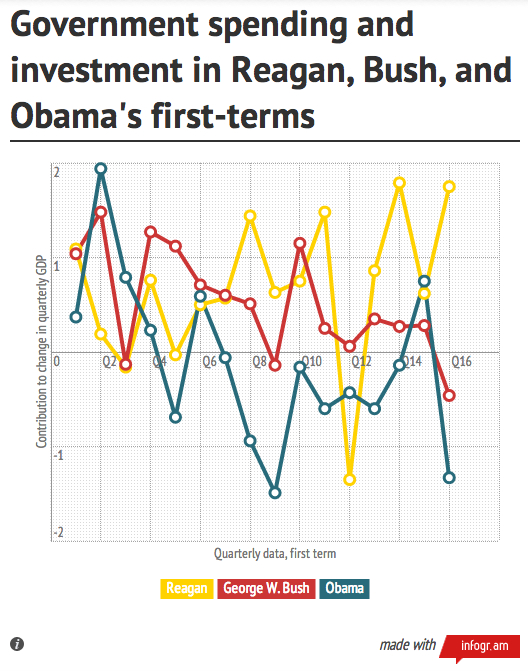
What If Obama Spent Like Reagan?