The real cost of Amazon
How Many Fewer Cops With A 10% Cut?
Republicans fought for local control over virus restrictions, now they’re fighting that local control
Why venture capital doesn’t build the things we really need
Oil And Gas Pipelines Look Like Increasingly Risky Bets
Beloit billionaire Diane Hendricks’ controversial charter school
McConnell's Wife's Family Business Appears on Trump Admin's List of Companies That Received Most PPP Money
The Study That Debunks Most Anti-Abortion Arguments
Showing posts with label venture capital. Show all posts
Showing posts with label venture capital. Show all posts
Tuesday, July 7, 2020


Wednesday, April 29, 2020
Midweek Reading
Injections of Bleach? Beams of Light? Trump Is Self-Destructing Before Our Eyes
'It's overhyped': Trump Mega-Donor Pushes to End Wisconsin's Stay-at-Home Order
The Junk Science of Robin Vos
The Pandemic Has Led to a Huge, Global Drop in Air Pollution
Stunning CNBC Anchor, Venture Capitalist says Let Hedge Funds Fail and Save Main Street
President’s Intelligence Briefing Book Repeatedly Cited Virus Threat
Tyson Foods Helped Create The Food Crisis It Now Warns Against
The Pandemic Shows What Cars Have Done to Cities
Scott Walker Loses Again
'It's overhyped': Trump Mega-Donor Pushes to End Wisconsin's Stay-at-Home Order
The Junk Science of Robin Vos
The Pandemic Has Led to a Huge, Global Drop in Air Pollution
Stunning CNBC Anchor, Venture Capitalist says Let Hedge Funds Fail and Save Main Street
President’s Intelligence Briefing Book Repeatedly Cited Virus Threat
Tyson Foods Helped Create The Food Crisis It Now Warns Against
The Pandemic Shows What Cars Have Done to Cities
Scott Walker Loses Again
Sunday, March 8, 2020
Sunday Reading
Popularity Of CBD Oil Vexes Regulators & Researchers
The Great Dismantling Of America's National Parks Is Under Way
Trump's Economy Is An Absolute Disaster For People And The Planet
Is Venture Capital Worth The Risk?
Can We Have Prosperity Without Growth?
Innovation, At University And In Industry
Union Density: Yet Another Low
Tax Incentives: The Losing Gamble States And Cities Keep Making
'Skills Gap' Arguments Overlook Collective Bargaining And Low Minimum Wages
Making Excuses For Unemployment: The Myth Of A "Skills Gap"
5 Companies Make Up 18% Of The S&P 500. Should Investors Care?
Bitcoin Is The Greatest Scam In History
The Wile E. Coyote Of Stadium Consulting Takes On Brewers' Stadium, Gets Crushed By Anvil
About That Miller Park Economic Impact
The Great Dismantling Of America's National Parks Is Under Way
Trump's Economy Is An Absolute Disaster For People And The Planet
Is Venture Capital Worth The Risk?
Can We Have Prosperity Without Growth?
Innovation, At University And In Industry
Union Density: Yet Another Low
Tax Incentives: The Losing Gamble States And Cities Keep Making
'Skills Gap' Arguments Overlook Collective Bargaining And Low Minimum Wages
Making Excuses For Unemployment: The Myth Of A "Skills Gap"
5 Companies Make Up 18% Of The S&P 500. Should Investors Care?
Bitcoin Is The Greatest Scam In History
The Wile E. Coyote Of Stadium Consulting Takes On Brewers' Stadium, Gets Crushed By Anvil
About That Miller Park Economic Impact
Saturday, December 8, 2018
Weekend Reading
Is Trump Country Really Better Off Under Trump? No. It's Falling Further Behind
The Scandinavian Style Of Capitalism
What Do We Actually Know About The Economy? (Wonkish)
How The Koch Brothers Are Killing Public Transit Projects Around The Country
A Stats-Based Look Behind The Venture Capital Curtain
Working Class People Are Underrepresented In Politics. The Problem isn't Voters.
P/E Ratios Are Misleading...Especially Right Now
America's Monopoly Problem In One Chart
America Has A Monopoly Problem - And It's Huge
The Scandinavian Style Of Capitalism
What Do We Actually Know About The Economy? (Wonkish)
How The Koch Brothers Are Killing Public Transit Projects Around The Country
A Stats-Based Look Behind The Venture Capital Curtain
Working Class People Are Underrepresented In Politics. The Problem isn't Voters.
P/E Ratios Are Misleading...Especially Right Now
America's Monopoly Problem In One Chart
America Has A Monopoly Problem - And It's Huge
Saturday, October 6, 2018
Weekend Reading
Voter Impersonations Very Rare, Studies Show
Property Taxes Increase Under Walker
Support For Kavanaugh Pattern Of Ron Johnson's Horrendous Record On Issues Of Sexual Assault, Sexual Harassment
Rewarding Corporations That Cut Jobs
How Liberals Could Declare War On Brett Kavanaugh's Supreme Court
Donald Trump And The Self-Made Sham
This Is How The Rich Steal From America
Milwaukee County Leaders Say They Will Seek A Fair Share Of State Tax Revenues
Lindsey Graham's Old Comments About Merrick Garland Come Back To Haunt Him
Wisconsin DOT Knowingly Paid Twice On Stretch Of Roadwork For Zoo Interchange
A Stats-Based Look Behind The Venture Capital Curtain
Property Taxes Increase Under Walker
Support For Kavanaugh Pattern Of Ron Johnson's Horrendous Record On Issues Of Sexual Assault, Sexual Harassment
Rewarding Corporations That Cut Jobs
How Liberals Could Declare War On Brett Kavanaugh's Supreme Court
Donald Trump And The Self-Made Sham
This Is How The Rich Steal From America
Milwaukee County Leaders Say They Will Seek A Fair Share Of State Tax Revenues
Lindsey Graham's Old Comments About Merrick Garland Come Back To Haunt Him
Wisconsin DOT Knowingly Paid Twice On Stretch Of Roadwork For Zoo Interchange
A Stats-Based Look Behind The Venture Capital Curtain
Sunday, July 10, 2016
If Only Slogans and Buzzwords Were Needed For Economic Growth
David Haynes, editorial page editor of the Journal Sentinel, opines a lengthy list of platitudes as a prescription for economic growth in the area. He holds up the Research Triangle in North Carolina as a best practices example or guiding post.
Josh Lerner, of Harvard, has found the number of exceptional venture capitalists is very small. Harold Bradley, of the Kaufmann Foundation, believes venture capitalists have plenty of money, but allocate it very inefficiently, and therefore should not be receiving additional public dollars with the hope of boosting a local economy. Bradley and Carl Schramm, in an article for Business Week, write that the current focus on fees has promoted start-up flipping rather than nurturing.
The Research Triangle area of North Carolina — with Durham, Raleigh and Chapel Hill at its vertices — has long turned good ideas into business enterprises. World class universities attract an enviable supply of talent. and a range of companies — from startups to Cisco, BASF and GlaxoSmithKline — keep that talent anchored. The Triangle has one of the highest levels of educational attainment in the nation.
The Milwaukee region is not the Research Triangle and shouldn't try to be. Southeastern Wisconsin has to call on its own strengths, starting with an economy forged by industry leaders such as Northwestern Mutual, Rockwell Automation, GE Healthcare and Fiserv as well as a growing research presence at its academic institutions.Marc Levine addressed this leap of faith in The False Promise of the Entrepreneurial University:
In short, university research parks are anything but sure-fire investments in urban or regional economic prosperity. Success is relatively uncommon, as Wallsten’s impact study makes clear. “Game-changing” success – the kind that remakes a regional economy—is even more rare, the product of unique historical factors, good luck, and timing. For example, the North Carolina Research Triangle Park’s oft-cited (and oft-emulated) success, “was built around its first-mover status in the field of science parks,” generous state and federal funding, and a uniquely patient multi-decade commitment by political leadership – and even with all those difficult-to-replicate factors in its favor, it took more than 30 years to see evidence of the cluster development attributed to the park (Weddle, 2007, 7). Universities that cavalierly pursue and oversell URPs as “transformational” economic development investments risk creating white elephants and misallocating millions of dollars that could be better invested bolstering the core missions of their institutions.Now, Haynes does say we shouldn't try to be the Research Triangle, but that we do need to foster more entrepreneurial activity, and then he uses numerous Research Triangle examples to illustrate the path we should emulate.
The region's poor entrepreneurial performance matters: Research has shown that new businesses account for nearly all net new job creation, according to the Kauffman Foundation, and they juice local economies by boosting competition and innovation. If a region isn't creating enough new companies, it will likely have sluggish growth.
A vibrant entrepreneurial ecosystem that supports people who want to take the leap from idea to business formation is one essential element of a strong ecosystem for business development. So is the support of business leadership in the community. These are deep strengths in the Research Triangle.Research has also shown that new businesses account for most job loss.
The claim that most net new jobs came from new firms conceals the fact that existing firms added tens of millions of jobs in this 25-year period. Of course existing firms also lost tens of millions of jobs. We can say that the net job creation for existing firms was zero, but if we did not have an environment that was conducive for the job adders to grow (how many jobs did Microsoft, Apple, and Intel create after their first 5 years of existence?), then existing firms would have lost tens of millions more jobs.And, of course, Haynes had to mention venture capital, another one of the economic-clubs pundits continually beat us with whenever they're trying to sell these unsupported ideas.
Josh Lerner, of Harvard, has found the number of exceptional venture capitalists is very small. Harold Bradley, of the Kaufmann Foundation, believes venture capitalists have plenty of money, but allocate it very inefficiently, and therefore should not be receiving additional public dollars with the hope of boosting a local economy. Bradley and Carl Schramm, in an article for Business Week, write that the current focus on fees has promoted start-up flipping rather than nurturing.
In 2013, The Legislature overwhelmingly voted Tuesday to provide $25 million in taxpayer money to start-up companies. And we all know the booming job creation the Scott Walker regime has presided over since then.
Haynes closes with, "That's thinking like an entrepreneur. And it's the kind of thinking we could use more of in Milwaukee."
Let's start with the fact that a lot of economic momentum for a city or region is impacted by state and federal policies. Scott Walker killing the train, which would have better connected businesses and citizens in the region, was definitely not thinking like an entrepreneur. That infrastructure investment would have improved efficiencies, bolstered existing businesses, encouraged start-ups and increased the attractiveness of the region as a place to work and live. It would have been an investment of more than a billion dollars into the economy. I think we would have seen quite a bit of venture capital, start-ups, entrepreneurial activity and the like with an injection of a billion dollars.
So, maybe when our leaders stop cutting off our nose to spite our face we can have a real discussion about what's best for job growth.
For Further Reading:
Another False Idol: Venture Capital
Starting Up More Trouble
Faulty Excuses
A Steaming Pile of Boldness
Venturing Aimlessly
Venturing Wisconsin's Money
Selling Entrepreneurialism
Starting-Up More Trouble
Haynes closes with, "That's thinking like an entrepreneur. And it's the kind of thinking we could use more of in Milwaukee."
Let's start with the fact that a lot of economic momentum for a city or region is impacted by state and federal policies. Scott Walker killing the train, which would have better connected businesses and citizens in the region, was definitely not thinking like an entrepreneur. That infrastructure investment would have improved efficiencies, bolstered existing businesses, encouraged start-ups and increased the attractiveness of the region as a place to work and live. It would have been an investment of more than a billion dollars into the economy. I think we would have seen quite a bit of venture capital, start-ups, entrepreneurial activity and the like with an injection of a billion dollars.
So, maybe when our leaders stop cutting off our nose to spite our face we can have a real discussion about what's best for job growth.
For Further Reading:
Another False Idol: Venture Capital
Starting Up More Trouble
Faulty Excuses
A Steaming Pile of Boldness
Venturing Aimlessly
Venturing Wisconsin's Money
Selling Entrepreneurialism
Starting-Up More Trouble
Saturday, July 20, 2013
Another False Idol: Venture Capital
There goes the Journal Sentinel again...continuing their never-ending venture capital boosterism.
As I've asked before, "Wisconsin ranks in the middle (25th) nationally in venture capital invested and, therefore, increasing venture capital must be a priority. There's no real discussion of the difference between the 25th ranking and the 10th ranking, nor any discussion of where the editors think Wisconsin should be. How big is venture capital in proportion to other investment options? Why must venture capital be the focused policy option?"
The Journal, and their co-conspirators, go on and on about venture capital, deregulation, anti-unionization, and even more vague measurements, like business climate, but none of these supposed panaceas are ever quantified.
Here is another area where actually looking at the data and what is already known regarding venture capital could go a long way in dispelling these myths and moving us toward truly good investments rather than this pie-in-the-sky cronyism.
Back in 2010 I wrote, "Josh Lerner, of Harvard, has found the number of exceptional venture capitalists is very small. Harold Bradley, of the Kaufmann Foundation, believes venture capitalists have plenty of money, but allocate it very inefficiently, and therefore should not be receiving additional public dollars with the hope of boosting a local economy. Bradley and Carl Schramm, in an article for Business Week, write that the current focus on fees has promoted start-up flipping rather than nurturing."
Plus, as I recently wrote, "Venture capital provides just two percent of the capital for new businesses. More than half of new businesses are gone within five years."
In an earlier post I summed up the Journal's venture capital cheerleading thusly, "Scott Walker and the Journal Sentinel want venture capital to be a centerpiece, a major investment, of our economic development playbook. This disregards the fact that venture capital, overall, has been a bad/subpar return on investment. And, when it has been successful, only a very select few were rewarded."
None of this points toward venture capital being a crucial part of moving Wisconsin business and job growth forward.
For Further Reading:
A Steaming Pile Of Boldness
Venturing Wisconsin's Money
As for Wisconsin, the state routinely pulls in less than 1% of all venture capital raised, and the numbers are so small that it's difficult to pull any insights from quarterly trends. In the first quarter, state companies raised $18.42 million of venture capital, the best showing to start the year since 2010.Has the Journal ever shown any type of link between employment, poverty, or any other economic indicators and a particular place's venture capital? You know, something like: as such-and-such place increased their amount of venture capital over the last decade, they have also shown an increase in employment and a decline in poverty...and this is also true for the other places attracting the most venture capital. I don't recall much analysis of any kind. They just simply keep repeating this storyline of how much we need more venture capital, yet I haven't really heard any convincing arguments as to why.
As I've asked before, "Wisconsin ranks in the middle (25th) nationally in venture capital invested and, therefore, increasing venture capital must be a priority. There's no real discussion of the difference between the 25th ranking and the 10th ranking, nor any discussion of where the editors think Wisconsin should be. How big is venture capital in proportion to other investment options? Why must venture capital be the focused policy option?"
The Journal, and their co-conspirators, go on and on about venture capital, deregulation, anti-unionization, and even more vague measurements, like business climate, but none of these supposed panaceas are ever quantified.
Here is another area where actually looking at the data and what is already known regarding venture capital could go a long way in dispelling these myths and moving us toward truly good investments rather than this pie-in-the-sky cronyism.
Back in 2010 I wrote, "Josh Lerner, of Harvard, has found the number of exceptional venture capitalists is very small. Harold Bradley, of the Kaufmann Foundation, believes venture capitalists have plenty of money, but allocate it very inefficiently, and therefore should not be receiving additional public dollars with the hope of boosting a local economy. Bradley and Carl Schramm, in an article for Business Week, write that the current focus on fees has promoted start-up flipping rather than nurturing."
Plus, as I recently wrote, "Venture capital provides just two percent of the capital for new businesses. More than half of new businesses are gone within five years."
In an earlier post I summed up the Journal's venture capital cheerleading thusly, "Scott Walker and the Journal Sentinel want venture capital to be a centerpiece, a major investment, of our economic development playbook. This disregards the fact that venture capital, overall, has been a bad/subpar return on investment. And, when it has been successful, only a very select few were rewarded."
None of this points toward venture capital being a crucial part of moving Wisconsin business and job growth forward.
For Further Reading:
A Steaming Pile Of Boldness
Venturing Wisconsin's Money
Wednesday, July 10, 2013
Government: The Mother Of (Much) Invention
The New York Times obituary for Douglas C. Englebart, identified as the “Computer Visionary Who Invented the Mouse,” is fascinating reading, in part because Englebart, an Oregon farm boy, was in many ways the father of modern networked computing. Beginning in the early 1960s, he put together a team of engineers and computer scientists, funded by the federal government, that developed a prototype for most of the computer tools we all take for granted today...
Mariana Mazzucato, a professor of economics at the University of Sussex, has been making the point very effectively in lectures and a new book, The Entrepreneurial State, that the real innovation engine in the global economy is not business, nor the market, but the government. A recent story about Mazzucato in Forbes cites her view that long-term, patient capital–provided by government–is the absolute prerequisite for breakthrough innovation.
“Her case study for myth-debunking is the iPhone, that icon of American corporate innovation. Each of its core technologies–capacitive sensors, solid-state memory, the click wheel, GPS, internet, cellular communications, Siri, microchips, touchscreen—came from research efforts and funding support of the U.S. government and military."
Friday, June 28, 2013
Starting-Up More Trouble
The cronyism and nefarious activities at the Wisconsin Economic Development Corporation weren't enough. Scott Walker and his Republican henchmen have found another avenue of misappropriation.
More than half of new businesses are gone within five years.
For Further Reading:
Something Ventured, (Virtually) Nothing Gained
A Steaming Pile Of Boldness
Venturing Aimlessly
Venturing Wisconsin's Money
The Legislature overwhelmingly voted Tuesday to provide $25 million in taxpayer money to start-up companies..."This is one more way that we move our economy forward," Walker said. ~ Senate, Assembly OK $25 Million For Start-Up FirmsVenture capital provides just two percent of the capital for new businesses.
More than half of new businesses are gone within five years.
For Further Reading:
Something Ventured, (Virtually) Nothing Gained
A Steaming Pile Of Boldness
Venturing Aimlessly
Venturing Wisconsin's Money
Saturday, April 6, 2013
Faulty Excuses
The Journal Sentinel recently reviewed Scott Walker's job creation record. The findings, as we've all seen, are quite disappointing. Yet, the Journal believes we shouldn't be pointing fingers or finding fault. They don't think such things matter. The Journal feels we should just "focus on policies that will help give the economy a boost over the long-term."
So, right off the bat, since it is the subheader to their article, if they're so concerned with boosting long-term economic prospects, why did the Journal support Scott Walker's refusal of nearly a billion dollars in federal aid for a train which, when completed, would have better connected a crucial economic mega-region - Minneapolis, Madison, Milwaukee and Chicago?
I guess if I were partially responsible for such an generation-altering economic blunder I wouldn't want to focus on fault, blame, or finger-pointing either.
Hilariously, the Journal believes the only two choices for fault are either: 1) it's Walker's fault or 2) it's the recall election organizers fault. No responsibility for the largest newspaper in the state? Nope. As the public keeper-of-record, the watchdog, our fourth estate, they have no responsibility in presenting truth, what works and what doesn't, what is right or wrong? Hmmm, how about it's mostly Walker's fault, but he couldn't have done all the damage he has without the support and endless articles, apologies and endorsements from the Journal Sentinel.
Their obfuscation tour continues, "But his political finger-pointing is pointless. Not that Walker doesn't deserve responsibility - he's the governor. But the problems facing the state's economy go far beyond the power of a single person to solve." This seems like a much different tone from the newspaper than when it was endorsing Walker during his campaigning. We were going to be "open for business" and the Journal agreed. But now that we're not open for business, the Journal feels its "pointless" for the public to remember who steered them wrong.
At this point the article veers off into the Journal 'buzz-words as policy' section. They talk of "entrepreneurial," "risk-takers," "research," and "venture capital." Here, again, they stump for a state-funded venture capital fund. Another Scott Walker-supported idea that has fizzled and proven unimpressive elsewhere. Again, ideas - whose were they? Were they successful? Right? Wrong? This will be another one of those ideas Walker and the Journal push for, but when it fails (doesn't produce anywhere near the results they expect), they would like us all to forget whose idea it was.
They point to an economic lethargy among upper Midwest states as an explanation for our poor performance. All these states have large manufacturing sectors, which have been underperforming, thus things are bad. Yet, as this chart from UW-Madison economist Menzie Chinn shows, our Midwest neighbor states have outperformed Wisconsin.

Next, the Journal goes back to another well-worn (false) explanation - structural unemployment - the skills mismatch. The Wisconsin unemployment rate is hovering around 7 percent. One percentage point of that may be structural, but the majority of our unemployment is not. And, this is normally the case, even in a recession (although structural unemployment may increase slightly toward the 1.5 percentage point range). Structural unemployment can exist, but it's not the majority of our unemployment, thus is does not explain, nor provide the prescription for, unemployment. UWM professor Marc Levine recently released his own study debunking this skills mismatch meme the Journal continually tries to push.
The Journal then points out that construction and its ancillary jobs are down and they imply they don't think they'll be coming back. Hello?! Housing bust? Great Recession? Now, I don't think they'll come back to the housing bubble numbers (that's why it's called a bubble), but they will no doubt recover and stabilize as the economy does the same. We'll always need windows, doors and construction.
"Should we hold Walker responsible? Of course. He's the one who promised that 250,000 private-sector jobs would be created during his first term - a pledge that he is far from fulfilling. But politicians always get too much blame when the economy is weak and too much credit when it is strong. We think that's the case here," the article hedges. Talk about having your cake and eating it, too. So, yeah, he's kinda responsible, but can he really do that much anyway? He's trying, that's all that matters. Lets just stick our collective head in the sand and move on. It almost seems this article merely used the 'whose to blame?' question as a springboard for a rant about pet projects and policy prescriptions favored by Walker and the Journal Sentinel.
Now, the Journal turns back to another of their favorite "development" ideas - venture capital. To believe such is a panacea, we must ignore, "Josh Lerner, of Harvard, has found the number of exceptional venture capitalists is very small. Harold Bradley, of the Kaufmann Foundation, believes venture capitalists have plenty of money, but allocate it very inefficiently, and therefore should not be receiving additional public dollars with the hope of boosting a local economy. Bradley and Carl Schramm, in an article for Business Week, write that the current focus on fees has promoted start-up flipping rather than nurturing." Scott Walker and the Journal Sentinel want venture capital to be a centerpiece, a major investment, of our economic development playbook. This disregards the fact that venture capital, overall, has been a bad/subpar return on investment. And, when it has been successful, only a very select few were rewarded.
Plus, we're just exiting an economic downturn caused by speculation and gambling - casino capitalism. We've seen how destructive this can be. Scott Walker, Alberta Darling, and the Journal Sentinel's answer to this is to double-down and speculate with venture capital (supported with public dollars).
The article closes with a buzz-word bonanza and one more debunked idea - young companies are the answer, they create new jobs. As I've written before, "The pace of hiring may be strong in young companies, but what they also fail to mention is that the pace of firing is also higher amongst younger companies."
So, whose fault is it anyway? It's largely Scott Walker's. But the Journal Sentinel also bears responsibility for supporting his election and for pushing his debunked ideas. And, all this does matter.
So, right off the bat, since it is the subheader to their article, if they're so concerned with boosting long-term economic prospects, why did the Journal support Scott Walker's refusal of nearly a billion dollars in federal aid for a train which, when completed, would have better connected a crucial economic mega-region - Minneapolis, Madison, Milwaukee and Chicago?
I guess if I were partially responsible for such an generation-altering economic blunder I wouldn't want to focus on fault, blame, or finger-pointing either.
Hilariously, the Journal believes the only two choices for fault are either: 1) it's Walker's fault or 2) it's the recall election organizers fault. No responsibility for the largest newspaper in the state? Nope. As the public keeper-of-record, the watchdog, our fourth estate, they have no responsibility in presenting truth, what works and what doesn't, what is right or wrong? Hmmm, how about it's mostly Walker's fault, but he couldn't have done all the damage he has without the support and endless articles, apologies and endorsements from the Journal Sentinel.
Their obfuscation tour continues, "But his political finger-pointing is pointless. Not that Walker doesn't deserve responsibility - he's the governor. But the problems facing the state's economy go far beyond the power of a single person to solve." This seems like a much different tone from the newspaper than when it was endorsing Walker during his campaigning. We were going to be "open for business" and the Journal agreed. But now that we're not open for business, the Journal feels its "pointless" for the public to remember who steered them wrong.
At this point the article veers off into the Journal 'buzz-words as policy' section. They talk of "entrepreneurial," "risk-takers," "research," and "venture capital." Here, again, they stump for a state-funded venture capital fund. Another Scott Walker-supported idea that has fizzled and proven unimpressive elsewhere. Again, ideas - whose were they? Were they successful? Right? Wrong? This will be another one of those ideas Walker and the Journal push for, but when it fails (doesn't produce anywhere near the results they expect), they would like us all to forget whose idea it was.
They point to an economic lethargy among upper Midwest states as an explanation for our poor performance. All these states have large manufacturing sectors, which have been underperforming, thus things are bad. Yet, as this chart from UW-Madison economist Menzie Chinn shows, our Midwest neighbor states have outperformed Wisconsin.
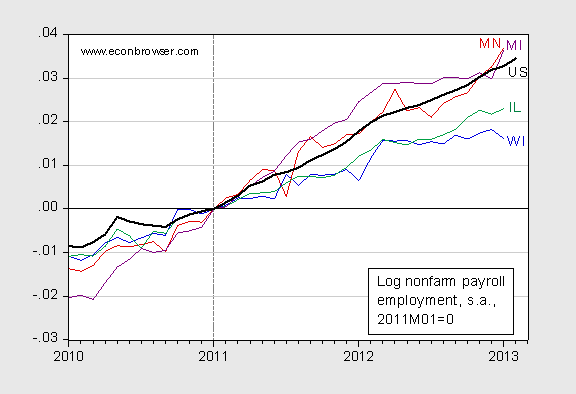
Next, the Journal goes back to another well-worn (false) explanation - structural unemployment - the skills mismatch. The Wisconsin unemployment rate is hovering around 7 percent. One percentage point of that may be structural, but the majority of our unemployment is not. And, this is normally the case, even in a recession (although structural unemployment may increase slightly toward the 1.5 percentage point range). Structural unemployment can exist, but it's not the majority of our unemployment, thus is does not explain, nor provide the prescription for, unemployment. UWM professor Marc Levine recently released his own study debunking this skills mismatch meme the Journal continually tries to push.
The Journal then points out that construction and its ancillary jobs are down and they imply they don't think they'll be coming back. Hello?! Housing bust? Great Recession? Now, I don't think they'll come back to the housing bubble numbers (that's why it's called a bubble), but they will no doubt recover and stabilize as the economy does the same. We'll always need windows, doors and construction.
"Should we hold Walker responsible? Of course. He's the one who promised that 250,000 private-sector jobs would be created during his first term - a pledge that he is far from fulfilling. But politicians always get too much blame when the economy is weak and too much credit when it is strong. We think that's the case here," the article hedges. Talk about having your cake and eating it, too. So, yeah, he's kinda responsible, but can he really do that much anyway? He's trying, that's all that matters. Lets just stick our collective head in the sand and move on. It almost seems this article merely used the 'whose to blame?' question as a springboard for a rant about pet projects and policy prescriptions favored by Walker and the Journal Sentinel.
Now, the Journal turns back to another of their favorite "development" ideas - venture capital. To believe such is a panacea, we must ignore, "Josh Lerner, of Harvard, has found the number of exceptional venture capitalists is very small. Harold Bradley, of the Kaufmann Foundation, believes venture capitalists have plenty of money, but allocate it very inefficiently, and therefore should not be receiving additional public dollars with the hope of boosting a local economy. Bradley and Carl Schramm, in an article for Business Week, write that the current focus on fees has promoted start-up flipping rather than nurturing." Scott Walker and the Journal Sentinel want venture capital to be a centerpiece, a major investment, of our economic development playbook. This disregards the fact that venture capital, overall, has been a bad/subpar return on investment. And, when it has been successful, only a very select few were rewarded.
Plus, we're just exiting an economic downturn caused by speculation and gambling - casino capitalism. We've seen how destructive this can be. Scott Walker, Alberta Darling, and the Journal Sentinel's answer to this is to double-down and speculate with venture capital (supported with public dollars).
The article closes with a buzz-word bonanza and one more debunked idea - young companies are the answer, they create new jobs. As I've written before, "The pace of hiring may be strong in young companies, but what they also fail to mention is that the pace of firing is also higher amongst younger companies."
So, whose fault is it anyway? It's largely Scott Walker's. But the Journal Sentinel also bears responsibility for supporting his election and for pushing his debunked ideas. And, all this does matter.
Friday, March 29, 2013
A Steaming Pile Of Boldness
The Journal Sentinel is back pushing Walker's venture capital slush fund, Legislature Should Establish A Fund For Venture Capital.
Wisconsin politicians continue to argue about how many jobs have been created on Gov. Scott Walker's watch - and even how to count those jobs. This was inevitable, of course, given the governor's promise that 250,000 jobs would be created during his first term.
But rather than argue over numbers, how about focusing on policies that might make a difference?Yes, just forget about Walker's (completely ridiculous) promise of 250,000 jobs, which undoubtedly helped win him the election. We don't want to actually evaluate politicians on the things they've said.
The whole article is a well-worn regurgitation of cliches regarding the magic that is venture capital.
With job growth and income sluggish in the state, we continue to believe the best answer is unleashing good ideas that could be turned into young companies that will employ people. Research by the Ewing and Marion Kauffman Foundation a couple of years ago found that between 1977 and 2005, existing companies lost about 1 million jobs a year while new companies added an average of 3 million jobs. Since 2008, the pace of hiring is stronger in companies that are two years or younger, Kauffman found.
Simply put, we need more entrepreneurs, and we need to figure out how to mentor them and invest in their ideas.Yes, we need more entrepreneurs. We need more jobs. Bold insight.
The pace of hiring may be strong in young companies, but what they also fail to mention is that the pace of firing is also higher amongst younger companies.
The article then (to supposedly support a venture capital fund) points to UW-Madison's Research Park, and UW-Milwaukee's and the Medical College's increased research, which has created jobs. Yet, this seems like more of a substantiation for investment in our universities. Is the Journal implying we should spend public dollars for private benefit? Should we continue the process whereby our public sector provides tax credits, other funding, university R&D, and a host of other giveaways, in which private entities get to reap the majority of the rewards? Here's a novel idea, how about public investment with public rewards.
But young companies need a continuum of support - from the early going when the entrepreneur mortgages her house to get started to the first "angel" investors who take notice to the point where larger infusions of money are needed from venture capitalists. And in Wisconsin, there long has been a gulf between the typical angel investor round and the venture capital round.What did companies do before venture capital?
Despite a good fourth quarter, Wisconsin attracted only $95 million last year, according to the MoneyTree Report by PricewaterhouseCoopers LLP and the National Venture Capital Association. Nationwide, venture capitalists invested $26.5 billion.What is the average amount states attract? Where does Wisconsin rank among the states in attracting capital?
Another article from the Journal notes, "State companies pulled in more than $95 million during the full year, up 31% from 2011, when they raised about $73 million of venture capital...Nationally, venture capital investment declined for the first time in three years. Venture capitalists invested $26.5 billion in 3,698 deals in 2012, a 10% decrease in dollars from a year earlier."
So, nationally venture capital is declining, yet over the past year it increased 31% in Wisconsin. Seems like money has already decided Wisconsin is a decent investment, even without the State providing additional funding.
The Journal continued, "But while $25 million is a start, it's probably only a down payment. The state needs something closer to $150 million, perhaps funded over several budget cycles, to attract the interest of top venture capital funds. "If the state really wants to get to critical mass, then we're going to need more than $25 million," said Tom Still, president of the Wisconsin Technology Council and the Wisconsin Innovation Network. The "Be Bold Wisconsin Prosperity Strategy" report, which grew out of a series of economic summits around the state in 2010, called for an even larger commitment."
We need to put up at least $25 million and also some type of continuing commitment? If we applied the same amount to public works - infrastructure, green buildings, energy grid, sewage and water systems, etc. - wouldn't that just as efficiently and effectively ignite the economy and put people back to work? And, we wouldn't have to worry about the speculative nature and the whims of the private sector. Not to mention, we could actually ensure these were good paying jobs.
Finally, it seems rather odd that the Journal Sentinel and the Republican class-war criminals were so quick to talk about a Wisconsin's (phony) budget crisis, how we were broke, how public workers had bankrupted us and caused the recession. Yet, in their next breath, they cackle about spending on sport stadiums, venture capital, and numerous other ways of funneling public dollars to obscure private sector schemes. Yes, we're broke, until the power-brokers whom are already garnering most of society's gains decide they want more.
For Further Reading:
Casino Capitalism
Cut Out The (Private Sector) Middle Man
Deja Vu
Fund Fail
Haplessly Venturing
Risky Business
Something Venture, (Virtually) Nothing Gained
Venturing Aimlessly
Venturing Wisconsin's Money
Thursday, October 18, 2012
From The Department Of I-Told-You-So
Back in February 2011, I warned about the nefarious implications of Scott Walker's plan to turn the public Department of Commerce into the semi-private Wisconsin Economic Development Corporation.
I have been critiquing it ever since. My most recent screed, as of July 2012, Walker's Untraceable Slush Fund, pretty much called it.
As the Journal Sentinel notes, Walker promises dramatic moves to correct loan oversight problems at WEDC.
"The Milwaukee Journal Sentinel reported Wednesday that since its creation in July 2011, the Wisconsin Economic Development Corp. failed to track whether 99 businesses were repaying a total of $8 million in past-due loans - or 16% of the agency's $51 million loan portfolio."
These types of redevelopment initiatives (privatization, tax credits, subsidies, etc.) are actually studied by academics. As cities and states try these different supposed catalysts, social scientists are measuring the results. This is where the "best practices" guides come from. And, where the "things to avoid" recommendations come from. That is, if one is willing to actually read the reports.
Whether public or private investment, certain questions must be addressed and answered with any initiative. Especially when public dollars are at stake, most would ask: What's the return on investment? How many jobs have been created? What's the cost per job created? Were there noticeable income gains in the area due to the initiative? Etc.
Good Jobs First actually published The Risks of Privatizing State Economic Development Agencies in January 2011. But Wisconsin did it nonetheless.
The same was found for film industry tax credits, yet we still do those.
Similarly unimpressive results were discovered for venture capital, nevertheless we are still pursing this mirage.
It's well past time to stop buying this snakeoil.
Update:
Here comes the Journal Sentinel to Scott Walker's rescue; putting the proverbial lipstick on this Walker pig.
WEDC: A good idea, but so far, poorly executed.
This [the WEDC] is another one of these supposed game-changers where the evidence indicates it is not a good idea. But the Journal wants it to be, so it must be. We just need to accept it.
Maybe if the Journal actually did the heavy lifting before getting behind all these harebrained ideas they wouldn't have to spend so much space qualifying, contorting, and making excuses. And, heaven forbid, maybe they'd actually provide some insightful policy analysis, rather than just practicing sycophantic boosterism for Scott Walker.
I have been critiquing it ever since. My most recent screed, as of July 2012, Walker's Untraceable Slush Fund, pretty much called it.
As the Journal Sentinel notes, Walker promises dramatic moves to correct loan oversight problems at WEDC.
"The Milwaukee Journal Sentinel reported Wednesday that since its creation in July 2011, the Wisconsin Economic Development Corp. failed to track whether 99 businesses were repaying a total of $8 million in past-due loans - or 16% of the agency's $51 million loan portfolio."
These types of redevelopment initiatives (privatization, tax credits, subsidies, etc.) are actually studied by academics. As cities and states try these different supposed catalysts, social scientists are measuring the results. This is where the "best practices" guides come from. And, where the "things to avoid" recommendations come from. That is, if one is willing to actually read the reports.
Whether public or private investment, certain questions must be addressed and answered with any initiative. Especially when public dollars are at stake, most would ask: What's the return on investment? How many jobs have been created? What's the cost per job created? Were there noticeable income gains in the area due to the initiative? Etc.
Good Jobs First actually published The Risks of Privatizing State Economic Development Agencies in January 2011. But Wisconsin did it nonetheless.
The same was found for film industry tax credits, yet we still do those.
Similarly unimpressive results were discovered for venture capital, nevertheless we are still pursing this mirage.
It's well past time to stop buying this snakeoil.
Update:
Here comes the Journal Sentinel to Scott Walker's rescue; putting the proverbial lipstick on this Walker pig.
WEDC: A good idea, but so far, poorly executed.
This [the WEDC] is another one of these supposed game-changers where the evidence indicates it is not a good idea. But the Journal wants it to be, so it must be. We just need to accept it.
Maybe if the Journal actually did the heavy lifting before getting behind all these harebrained ideas they wouldn't have to spend so much space qualifying, contorting, and making excuses. And, heaven forbid, maybe they'd actually provide some insightful policy analysis, rather than just practicing sycophantic boosterism for Scott Walker.
Sunday, August 26, 2012
Something Ventured, (Virtually) Nothing Gained
Walker, groups try again for venture capital bill
Why? Why is this venture capital bill so important to Scott Walker?
Why must Republicans continue pursuing policies (supply-side economics, venture capital, etc.) which we know do not get the return on investment to make them worthwhile?
Well, we know the answer to that, too. It's an obscure route for funneling money to cronies using public dollars.
Those who have looked into venture capital performance have found, "The latest research seems to indicate that ship has already sailed. And, when the industry was supposedly booming, it was only a select few venture capitalists whom were making most of the gains."
And, as I previously wrote, "Josh Lerner, of Harvard, has found the number of exceptional venture capitalists is very small. Harold Bradley, of the Kaufmann Foundation, believes venture capitalists have plenty of money, but allocate it very inefficiently, and therefore should not be receiving additional public dollars with the hope of boosting a local economy. Bradley and Carl Schramm, in an article for Business Week, write that the current focus on fees has promoted start-up flipping rather than nurturing."
Can we stop wasting money on Republican cronies in the name of public policy?
Nothing in life is perfectly efficient, so if we're going to be making investments as a society, I'd rather it be going to the poor, elderly, children, special needs, or everyday workers...not the already well-to-do and fiscally fortunate.
Why? Why is this venture capital bill so important to Scott Walker?
Why must Republicans continue pursuing policies (supply-side economics, venture capital, etc.) which we know do not get the return on investment to make them worthwhile?
Well, we know the answer to that, too. It's an obscure route for funneling money to cronies using public dollars.
Those who have looked into venture capital performance have found, "The latest research seems to indicate that ship has already sailed. And, when the industry was supposedly booming, it was only a select few venture capitalists whom were making most of the gains."
And, as I previously wrote, "Josh Lerner, of Harvard, has found the number of exceptional venture capitalists is very small. Harold Bradley, of the Kaufmann Foundation, believes venture capitalists have plenty of money, but allocate it very inefficiently, and therefore should not be receiving additional public dollars with the hope of boosting a local economy. Bradley and Carl Schramm, in an article for Business Week, write that the current focus on fees has promoted start-up flipping rather than nurturing."
Can we stop wasting money on Republican cronies in the name of public policy?
Nothing in life is perfectly efficient, so if we're going to be making investments as a society, I'd rather it be going to the poor, elderly, children, special needs, or everyday workers...not the already well-to-do and fiscally fortunate.
Saturday, May 12, 2012
Venturing Wisconsin's Money
One of Scott Walker's big ideas for igniting the Wisconsin economy is getting us more heavily involved in venture capital.
Yet the latest research seems to indicate that ship has already sailed. And, when the industry was supposedly booming, it was only a select few venture capitalists whom were making most of the gains.
Saturday, April 28, 2012
Weekend Reading
Conservative Silent About Romney-Alinsky Link
The Founding Father Backed Health Insurance Mandates
Inequality 101: The Picket Fence & The Staircase
The Old, White, Rich Men Who Are Buying This Election
Out Of Control Medicare Spending? Maybe Not
Venture Capital Is Sucking (Your Money)
Want To Cut Health Care Costs? Start Here
What Mitt Romney Learned From His Dad
The Founding Father Backed Health Insurance Mandates
Inequality 101: The Picket Fence & The Staircase
The Old, White, Rich Men Who Are Buying This Election
Out Of Control Medicare Spending? Maybe Not
Venture Capital Is Sucking (Your Money)
Want To Cut Health Care Costs? Start Here
What Mitt Romney Learned From His Dad
Tuesday, January 31, 2012
Saturday, January 28, 2012
Saturday, January 21, 2012

Saturday, December 31, 2011
The Wisconsin Casino
The privatization/commercialization/casino-ization of Wisconsin public dollars continues.
WHEDA to invest $7 million.
We're broke?
WHEDA to invest $7 million.
We're broke?
Subscribe to:
Posts (Atom)