Showing posts with label real estate. Show all posts

Monday, July 29, 2024

Really Frickin' Petty (RFP)

New Land blasts city development office shortly before downtown site award

It’s a shame when things don’t go your way. But for those who are supposed to be the bastions of free market competitiveness, there seems to be a lot of dependency on the public sector. And when contracts aren’t awarded, some of these private entities lash out, point fingers, and cry the blues. 

This criticism is laughable considering development companies are the ones who continually beat the market drum all the while insisting cities and states fork over millions to help fund their projects. And then if they don’t get their way, and a pile of cash, something is wrong with the process. 

The Business Journal article notes:

New Land's criticisms of the city's development department extend beyond the Marcus Center parking structure project: Gokhman says the department has "chronic problems" and "deep dysfunction" that are "stifling development"

This coming from a company that has been awarded similar projects in the past. The company was also involved in foreclosure proceedings in the not-so-distant past. What's that old saying about glass houses? Funny how private developers believe they should be able to dictate what a city’s development department does.  

Regarding another often-used development handout, the article details, “Tax incremental financing is a tool local governments can use to pay for new developments that are expected to grow the tax base by using future property taxes those developments generate to help repay the city's investment in those projects.” What they leave out is that this financing was intended to serve blighted areas, not locations where development is already thriving. 

The Journal article quotes another developer:

"When you do put out an RFP, you have to be ready, willing and able to make the commitment to help make it successful," said Bob Monnat of Milwaukee development firm Mandel Group Inc. "None of these larger RFP sites have anywhere of a chance of creating the kind of outcome that everyone would like to see unless there's some major participation on the part of the city to help get it over the hump."

Talk about entitlement. Developers seem to believe the City should alleviate all risk from the project, while the private developers get to walk away with all the profits. What a partnership!

Aren’t some of these concepts what the free market is supposed to be all about? Isn’t this part of the conservative mythology we’ve heard over the last many decades about the private sector, job creators, the wise surveyors of the market? So why do they even need the inefficient, mismanaged, inconsistent, misleading, and dysfunctional public sector?

A big problem for New Land’s Gokhman seems to be that the City Development Department took longer than expected. I’m sure that developers never take longer than expected. They’re always on time and everything they propose is seen through to completion. [Sigh. Eye roll.]

Seems odd to have such an issue with not being awarded this site, but then to also state:

New Land supports Johnson’s vision of growing Milwaukee and believes the city's current zoning code and DCD's urban planning team are "one of the best in the country," Gokhman said. 

But then Mr. Gokhman continued:

He cites the downtown Fourth and Wisconsin site near the Baird Center and the former Army Reserve site in the city's Bay View neighborhood — which both remain undeveloped after years of discussion — as key examples of failure.

"No one at DCD loses their job if development doesn’t occur," Gokhman said. "There’s no accountability." 

So, unless every city site is maximally developed, by the city, someone has failed? Seems there is a lot of contradictory ideas and sour grapes going on here. Let’s not forget - failure happens. Everything doesn’t work out as planned in life. [As an example, see the above discussion of Mr. Gokhman’s company's foreclosure activities.] 

City development is booming. Newer offices, hotels, apartments, retail, etc. have steadily been built over the last few decades. Milwaukee has seen downtown development unlike anything since WWII. But the City should throw more money at private developers because a few sites have yet to be developed? Or should the City allow itself to be bullied by developers attempting to rake them over the coals in the media? I don't think either of these would be policy or process improvements. 

These developers' public whining is just a big bushel of bitter, sour grapes.

Sunday, August 11, 2019

Privatizing The Profits, Socializing The Loses

There the "free" marketeers go again. Milwaukee real estate execs question Housing Authority's high-rise plan.

So, the City is booming. Development, jobs, tourism, new businesses...things are looking up.

As usual, when things start to gentrify, certain people are priced out of the market...yet those workers are still necessary for the booming economy to exist.

Enter affordable housing. Another policy answer to a society that doesn't pay a living-wage. If you're not going to pay a downtown-wage for a downtown-worker, public policy steps in to subsidize and correct the market.

It's as much a subsidy to the employer as it is to the worker. By subsidizing the housing of these workers, the government is allowing the employer to pay below-market wages.

Also, as usual, and wanting to have it both ways, local developers are complaining when the government steps in to correct the market. The Milwaukee Business Journal reported, "The Housing Authority in April introduced its plan, which calls for spending up to $150 million on a high-rise tower with 350 apartments, a mix of market-rate and affordable units."

Tim Gokhman, director of New Land Enterprises, told the Business Journal:
He said if the city has figured out how to generate a profit from a high-rise to subsidize affordable units, “teach the rest of the market how those profits can be attained.”
Because the profits aren't high enough for private developers, because the returns on investment aren't elevated enough, because the government won't just give them the money to do it, private developers are complaining when the government enters the market to provide needed housing for citizens. (Privateers complain when the government does any of the many things the magic "free" market won't do.)

Developers can't have it both ways. They can't claim they're the experts - the "free" market and the private actors have all the answers and will provide as long as the government stays out of the way. But then, in the very next breath, they come to the public for giveaways, tax breaks and other hand-outs they claim the need for their projects.

If the public has to give tax cuts, subsidies and incentives to private actors to get them to do something, why shouldn't the public entity just complete the project?

The private sector does some things well. But it's time we re-realize the same can be said for the public sector.

Wednesday, March 13, 2019

End Welfare...Unless It's For Me

The conservative, free market, anti-socialism boosters sure do love welfare and market-intervention when it benefits them.

Amount of cash provided to developers by Wisconsin communities limited by Evers' budget proposal.
Evers' budget plan includes a provision targeting communities which provide financing help for commercial developments through tax incremental financing districts...

The governor's 2019-'21 budget proposal, released Thursday night, would limit cash grants for developers to 20 percent of a tax financing district's project costs.
One of the private sector shills whined,
It "would undo years of bipartisan work to create the most important, and really the only tool Wisconsin municipalities have to spur economic development and create jobs," said Jim Villa, chief executive officer of the Wisconsin chapter of NAIOP, formerly known as the National Association of Industrial and Office Properties.
As I wrote in a previous post, “Another much touted, yet becoming ever more so destructive, policy tool is tax incremental financing (TIF). These were initially established to bring investment to blighted, low-income areas. But nowadays, more states are loosening their eligibility requirements and allowing affluent areas to reap the benefits. TIFs allow a municipality to issue a bond to pay for part of the costs of the new development. The property tax revenue generated by the development is then used to pay off the bonds. Some municipalities also allow sales tax increments, where the sales tax generated by the new development can be diverted to redevelopment costs.”

In essence, using taxpayer money (cheap credit from a municipality) to finance speculative development where the rewards benefit the usual cast of characters at the expense of the community at large.

And, to claim this is the only tool municipalities have to spur economic development and create jobs, is complete horseshit.  By providing good public transportation options, broadband access, modern water and electrical infrastructure, and adequately funding public education, the public sector can spur economic development and create jobs. 

This is just the gravy train crying because someone is trying to cut off some of their corporate welfare.  

Governor Tony Evers merely wants to bring back some of the original intent and more accountability to tax incremental financing.

Wednesday, June 1, 2016

Bursting Bubbles

Real Estate Bubble Explained by Economist Tuesday, February 14, 2006
The term real estate bubble, it is widely known to articles describing the theory of real estate prices going up or rising. Mark Eppli, finance at Marquette University, says that the consumers shouldn't worry. 
He said "I have no problem saying that there is not a real estate bubble. By looking at the short-term, medium-tern and long-term, I think the market isn't going to have a fall out," he adds "I look at the numbers and that's where I get my evidence from," ...
Eppli says while the real estate bubble isn't about to burst, not all is perfect when it comes to the housing market, he said that new homes were overbuilt so the supply right now outstrips the demand, but quickly added "I think that will work itself out. I know there's a lot of concern about it, but it's not something that is going to break the market." 
Marquette's Eppli named president of national real estate organization Wednesday, June 1, 2016
A Marquette University professor of finance with a national profile in commercial real estate has been elected president of the Real Estate Research Institute, the university announced Wednesday. 
Mark Eppli, Ph.D., professor of finance and Robert B. Bell Chair in Real Estate at Marquette, will lead the national nonprofit organization that funds top-tier research on real estate investment performance and market fundamentals for the commercial real estate industry. 
Eppli directs Marquette's Top 10 nationally ranked Center for Real Estate and also was recently named a NAIOP Distinguished Fellow. NAIOP is the leading trade association for commercial real estate professionals. 
"Dr. Eppli represents what's best about Marquette business faculty," said Brian Till, Keyes Dean of Business Administration at the university. "He's a highly engaged scholar and teacher who lends his deep expertise to the broader academic and business communities." 
Let's hope, for the sake of the economy, the Real Estate Research Institute, NAIOP and "what's best about Marquette business faculty," Eppli's scholarly engagement and research has exponentially improved since 2006.

Saturday, March 30, 2013

Milwaukee Real Estate Trends

The median sale price per unit for multifamily properties in the metro area has been rising for five straight months, climbing 4.4% during that time. Prior to that, sale prices fell 6.6% over a five-month period ending in May. Compared to last quarter, the average sale price per unit for multifamily properties rose by 3.7% to $19,967. During the past year, though, sale prices have dropped by 5.1%. The highest median price of the past three years was set in December 2009 at $58,059. In comparison, the median sale price is now 65.6% lower. However, the current price is 4.4% higher than the May 2012 figure, which was the three-year low.

The median sale price per square foot for office properties in the metro area has been falling for four straight months, dropping 7.9% during that time. Sale prices rose 9.9% earlier this year during a seven-month streak that ended in January. Sale prices per square foot for office properties dipped to $30.85, a 7.9% decrease compared with the end of the prior quarter. Similarly, over the previous year, sale prices have dropped by 13.2%. The metro area saw its median sale price fall to its three-year low this month. The previous low point was set last month at $32.41.


Median sale price per square foot for retail properties in the metro area is currently in a 15 month downward trend, but the rate of decline has slowed in the last month. At $43.32, sale prices per square foot for retail properties have decreased by 9.5% compared to the end of the prior quarter. Sale prices are also down over the previous 12 months, having declined by 35.5%. The metro area saw its median sale price fall to its three-year low this month. The previous low was $44.18, which was set last month.


Multifamily properties in the Milwaukee Metro Area are staying on the market longer than they did during the same time last year, and the change is greater than that at the state level. They now last 182 days on the market at the metro level, an increase of 10.8% year-over-year. In comparison, these buildings last 148 days at the state level, 13.8% less than last year. From the lowest point, which was set in January 2011, time on market has risen 38.3%.


Compared with a year earlier, office properties in the Milwaukee Metro Area are staying on the market longer, and the gap is greater at the metro level than at the state level. They now last 281 days on the market at the metro level, an increase of 12.5% year-over-year. Meanwhile, they stay on the market 253 days at the state level, down 15.6%. Compared with January 2010, when the time on market was at its lowest, these properties are now on the market 41.3% longer. The time that office properties stay on the market has risen 12.1% over the past three months.

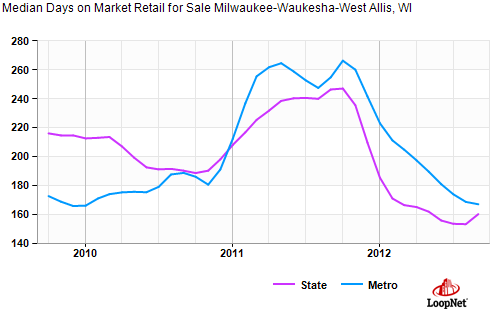
Retail properties in the Milwaukee Metro Area are turning over more quickly compared to last year, as the time on market dropped 34.4% to 167 days. During the same time period, the time on market for these properties at the state level has fallen even more as a percentage, by 35%, to 160. From October 2011, when the time on market was at its highest, it has fallen 37.3%.


Asking rates for office properties have fallen 1.8% to $14.28 per square foot over the past quarter. However, over the past year asking lease rate have risen 0.3%. Lease rates for office properties hit a three-year peak in March 2009 at $14.72 per square foot. In comparison, the current median asking price is down by 2.1%. On the other hand, the lowest asking lease rate in the past three years was seen in February 2011 at $13.96.

Asking lease rates for retail properties have gone up versus past quarter, rising 0.1% to $14.44 per square foot. But for the year asking rates have dropped 3.1%. Lease rates for retail properties reached a three-year high in July 2008 at $16.59 per square foot. The current median asking lease rate is 1.6% lower. On the other hand, the lowest asking lease rate in the past three years was seen in December 2005 at $14.21.

Sunday, January 13, 2013

Residency Requirements

Much (in the last year) talk about ending the residency requirement for City of Milwaukee (especially for police and firefighters) has been bandied about. Primarily by persons whose motives, and interest in this topic, are unclear. The residency requirement has been in place since 1930. Why is the state interfering with a City of Milwaukee employment policy?

Recently, Gary Kraeger, a Wind Lake appraiser, weighed in - The Principles Of The Residency Rule. He opines, "Milwaukee is everyone's business in the state, especially since Milwaukee is very dependent on state money [state aid to Milwaukee has actually plummeted]... On a third hand, Milwaukee is the fourth-poorest big city in America [not sure where this number comes from, Kraeger doesn't say], at last word, and I suspect it might move up a bit if we dump the residency rule. In which case, I expect Milwaukee to need even more of our money. On another hand, it sounds sensible that if you want taxpayers to pay your salary in a community, you should be one of them. In that way, if your compensation benefits from high taxation, at least you're pulling the cart, too. Also, normally you care more about the community you live in."

Kraeger states, "On principle, however, the residency rule should be lifted and lifted by Milwaukee itself." Um, yeah, so if it should be up to Milwaukee, why are so many people outside of Milwaukee concerning themselves with Milwaukee governance?

"The biggest hand of all is the principle of freedom," claims Kraeger. When it comes down to it, Americans should be able to do what they want, when they want, and where they want. No rules, no questions.

Kraeger continues on describing how removing the requirement could hurt property values in the City. So, he has laid out numerous economic examples of why the residency requirement is in place. Numerous reasons why it should be there. But he then concludes that it should be ended. Why? Freedom.

If the ultimate rationale for an argument one poses is "freedom," one really doesn't have much of an argument or a rationale.

The residency requirement is a pretty simple, straight-forward policy - as a public worker, you should live in the city that employs you. The economic idea of "leakage" is addressed by such a policy. Much of the dollars earned by these public employees will be spent back within the community. Which also addresses the economic multiplier effect - money earned and spent in the same area, thus percolating and rippling throughout the local economy, over and over. As opposed to City of Milwaukee tax dollars funding a Milwaukee Police Officer who now lives in Waukesha and spends most of his/her money there.

There are 2,697 City of Milwaukee fire and police employees. The average police employee earns $65,649; for fire it's $67,554. This a potential $177 million dollars of earnings "leaking" out of the city, including property taxes, sales taxes, and other spending.

The possible loss of property taxes, spending at local businesses, and neighborhood stability are more than sufficient reasons for maintaining the requirement. The economics behind the requirement make it a no-brainer.

Governing is a set of rules. If you want to live or participate in certain communities you have to follow their rules. Some subdivisions make homeowners have 5-acre lots. Others require certain facades or materials be similar amongst the homes. If you don't like those rules, you go somewhere else. That's freedom. Freedom isn't doing away with things one doesn't like.

Saturday, February 25, 2012

Milwaukee Real Estate

Multifamily Property Sales Prices

"Sale prices for multifamily properties in the metro area appear to have a seasonal cycle to them. The highs in the cycle tend to occur around October and the lows come around April. Over the past year sale prices have fallen 49% to $20,552 per unit. The highest median price of the past three years was set in December 2009 at $58,059. In comparison, the median sale price is now 64.6% lower. However, the current price is 3% higher than the three-year-low of $19,950, which was set in November 2011. This month marks the third straight month of growing median sale price for the metro multifamily properties."

Office Property Sales Prices

"For office properties, the average sale price per square foot has risen to $37.81, a 1.4% increase compared to the end of last quarter. However, this is not a trend for the year, as sale prices have dipped by 26.1%. Despite being down for the year, the median sale price per square foot for office properties in the metro area has been rising for that past seven months. Over the past three years, the median sale price was at its highest in March 2009 at $89.33. The current median sale price is 57.7% lower. However, the current price is 11% higher than the three-year-low set in July 2011."

Retail Property Sales Prices

"At $60.71, sale prices per square foot for retail properties have decreased by 3.3% compared to the end of the prior quarter. Likewise, sale prices have dipped for the year, showing a 25.5% decrease. The median sale price of metro retail properties has been declining for seven consecutive months. When the streak began in July 2011, the median price was $71.62. The median price for the metro area hit its three-year low this month. The previous low was $62.76, set last month."

Office Property Asking Rent

"Lease rates for office properties have risen 0.9% versus the end of last quarter to $14.45 per square foot. Asking lease rates have risen 2.9% on the year. In March 2009, the lease rates for office properties were at their highest in the past three years at $14.72 per square foot. The current median asking lease rate is 1.8% lower. The lowest asking lease rate in the past three years was $13.96 set in February 2011."

Retail Property Asking Rent

"The average asking lease rate for retail properties in the metro area for the month was $14.53 per square foot. This represents a decrease of 3.3% year-over-year as well as a decrease of 0.4% compared to the end of the fourth quarter of 2011. This month, asking rates for retail properties have fallen to a new three-year low. The previous three-year low was last month at $14.59."

[Source: Loopnet]

Tuesday, December 20, 2011

U.S. Real Estate

Commercial Real Estate Prices for United States


Delinquency Rate On Loans Secured By Real Estate, All Commercial Banks


Loans Secured By Real Estate, All Commercial Banks 


Owners' Equity in Household Real Estate - Net Worth - Balance Sheet of Households and Nonprofit Organizations 


Real Estate - Assets - Balance Sheet of Households and Nonprofit Organizations


Saturday, September 17, 2011

The Bubble's Remains

According to Calculated Risk, "The value of household real estate has fallen $6.6 trillion from the peak - and is still falling in 2011."


We need more than $775- and $500-billion stimulus initiatives to get the economy back on track.

Thursday, October 21, 2010

An Obtuse & Deceptive Accounting

If a lie is repeated often enough, Republicans hope it becomes the truth.

Republicans are bringing Community Reinvestment Act (CRA) myths back from the dead. Ron Johnson, in an ever-increasingly extremely right-wing and non-sensical senatorial campaign, is claiming the CRA (passed in 1977) is responsible for our current recession.

Th Journal recently gave ink to Johnson's (and the Republican's) already debunked hypothesis. The Journal at least included some voices with a counterpoint to this unfounded CRA-caused-recession fantasy of Johnson's. But, with a title like "Johnson said the seeds of recession began with 1977 law," I think we know the message the Journal really wants readers to take away.

Yet Ned Gramlich, of the Federal Reserve, found, "Banks have made many low- and moderate-income mortgages to fulfill their CRA obligations, they have found fault rates pleasantly low, and they generally charge low mortgage rates. Thirty years later, CRA has become very good business." Russel Kroszner, also of the Federal Reserve, states, "Contrary to the assertions of critics, the evidence does not support the view that the CRA contributed in any substantial way to the crisis in the subprime mortgage market."

A responsible news organization would have had the studies and the numbers available to educate Johnson and squash out his ridiculous charge. Instead it's their usual he-said with a passing, milquetoast counterfactual and no real discussion or data in between. Eric Alterman and George Zornick reveal, "In the 15 most populous metropolitan areas, 84.3 percent of the subprime loans in 2006 were made by financial institutions not governed by CRA."

The Journal Sentinel even notes, in the article, "The federal law [CRA] applied only to depository institutions, not private, unregulated mortgage lenders." So, you'd think they'd then give you the number of loans issued by private lenders versus those subject to CRA. You know, some actual evidence one way or the other, proving or disproving the claim.

As Paul Krugman explained, "The Community Reinvestment Act of 1977 was irrelevant to the subprime boom, which was overwhelmingly driven by loan originators not subject to the Act."

"The CRA applies only to banks and savings institutions. It does not apply to credit unions, independent mortgage companies, or investment banks," details Ellen Seidman.

Neil Bhutta and Glenn B. Canner discovered, "The small share of subprime lending in 2005 and 2006 that can be linked to the CRA suggests it is very unlikely the CRA could have played a substantial role in the subprime crisis."

It's a scary thing when someone is so ideological as to just run with the misinformation of their party and not do the heavy lifting (the actual research). Ron Johnson is just throwing out well-worn Republican talking points and seeing what sticks, hoping to scare people into voting for him. I don't know about you, but I want a senator that actually reads the bills and makes an informed decision. I don't want someone who just goes with their gut or with the polling. And, when Johnson won't even take questions from his local newspaper, you know something is amiss.

Wisconsin deserves better. Vote Russ Feingold.

For Further Reading:

Sunday, February 14, 2010

More Corporate Tax Evasion

Edward Lump [what a fitting name], president and CEO of the Wisconsin Restaurant Association, in a recent Journal Sentinel article, rants against a proposed Wisconsin bill which he feels will threaten small business.

He throws out some small business stats, regurgitating the discredited idea whereby small business will save the day. "Small business employs more than 53% of Wisconsin's workforce and creates 75% of new jobs nationally," Lump claims without reference.

And then there is this dubious and confused claim, "Now more than ever, Wisconsin needs government that recognizes small business is a vital part of the local economy, not a bank from which it can withdraw seemingly endless funds. Instead of creating new taxes, shouldn't we look for ways to cut taxes so businesses can add jobs?"

Wisconsin government doesn't recognize the importance of small business? Where's the proof for this claim? Because small businesses are required to pay taxes, that supports the notion that Wisconsin doesn't appreciate small businesses role in our economy? Even if we cut taxes and save a small business, let's say, $5,000-annually, does Mr. Lump think that would really ignite a hiring flurry?

If that were the case, we'd never have recessions, nor would we ever experience anything other than full employment...since we've been cutting taxes since the '80s. Shouldn't the miracle market, combined with the elimination of so much taxation, have produced a Utopian wonderland by now?

But we know this 'full employment, stable economy' scenario has not been the result of the tax cut frenzy we've seen over the past few decades. So how can these hucksters, with a straight face, always claim cutting taxes is the answer.

Now we get to the bill - Assembly Bill 215 - which has made Mr. Lump so limp. The bill regards the valuation of billboards for assessment purposes and property taxation. Lump sees this as a threat to all small businesses. That's quite the leap of paranoid irrationality. [I found it very odd there were no citations nor even the name of the bill Mr. Lump finds so vexing in his article. But then one would be able to go read the bill and see the tenuousness of Mr. Lump's claims...and there would be no reason to print his article.]

He completely leaves out an explanation as to why valuation of billboards is an issue. He doesn't mention that if billboard owners pay their fair share of taxes on their property, the rest of us pay a little less. And, somehow, "There is nothing that would prevent cities from applying the same rules to other small businesses, such as restaurants."

The bill applies to, "...permits issued, leasehold interests, or other intangibles with regard to the outdoor off−premises advertising sign. In this subsection, “off−premises advertising sign” means a sign that does not advertise the business or activity that occurs on the site where the sign is located."

The State already has the ability to tax. If they wanted to tax restaurants more, they would. To paint this legislation as some type of nefarious, backdoor bill aimed at (in a very roundabout way) a tax increase on all businesses is fantasy. Again, if the state wanted to increase taxes on business they could. They wouldn't want the arduous legal battles involved in such assembly bills just for the fun of it.

To support his paranoia, Lump equates billboard valuation with valuing liquor and hunting licenses. He sarcastically squawks, "How would the value of a liquor license be determined? Would the assessment take into account the myriad variables that affect the profitability of a licensed establishment, or would it be one-size-fits-all? ... Think about how ridiculous it would be for the state to tax you on the "value" of your hunting permit...Or on the "value" of the deer you could potentially take home, whether you actually get a deer or not. Who knows what other licenses cities will decide to tax, once the state gives them this power?"

A billboard's value is in the income stream it can generate by exposing whatever it's advertising to more and more people. The reason for the bill - more specific legal language to capture the true value of billboards - is because they are quite different from the much simpler licenses Mr. Lump incorrectly, and purposefully misleadingly, tries to compare them to.

A hunting license doesn't produce an income stream to it's holder. It allows them to shoot a deer (catch a fish, etc.). A liquor license allows its holder to ship, manufacture, and import liquor. The hunter will pay taxes when he has the butcher process his deer. The liquor will be taxed when it is sold. These are direct links along the chain of commerce for these two examples which can be traced and taxed accordingly. When Clear Channel, CBS Outdoor, or Lamar (a few of the largest billboard companies) obtain an outdoor advertising permit for $175, this cost nowhere near reflects the income stream these companies expect to profit from such advertising.

As Dennis Hathaway comments at the Scenic America Blog, "The billboard companies fight tooth and nail against tax assessments that account for the value of anything other than the structure itself, but if one of their billboards has to be removed for a highway widening or other public works project, they will seek millions in compensation based on the value of the sign as a 'revenue' generator. This is a classic case of wanting it both ways, and hopefully governments will point that out in defending against these inevitable lawsuits."

And, maybe both of the fees on hunting and liquor licenses are too cheap, also. Granted, there is a point where costs become too prohibitive and potential users will stop buying the licenses. With the current value of billboards abysmally low (compared to their true market value), we're nowhere near the tipping point. Even with an increase in the taxes billboard owners will pay, not one of them will stop advertising on billboards...because they are all making more than enough money to justify the cost.

Just shut up and pay your fair share in taxes. So residents, workers, home-owners, and those not as fortunate can pay less.

Saturday, April 25, 2009

Equitable Development

Two excellent articles on economic development - what it should and should not be:

Big, Empty Boxes

Developing Jobs or Developing Real Estate?