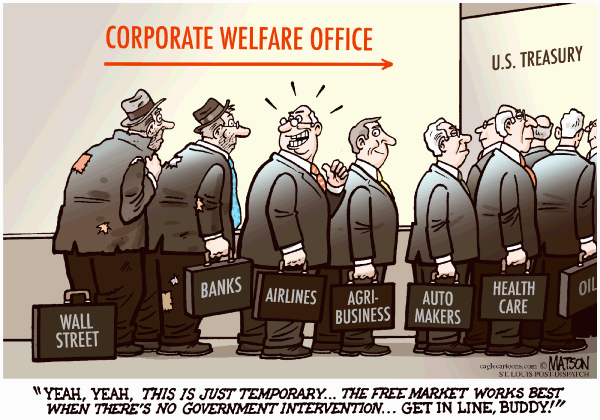
The U.S. is not a high-tax country. Our wages are low. We have extreme income inequality. And, our infrastructure is crumbling. Yet, we keep voting dipshits into office whom continue to cut taxes for the wealthy and big corporations.

[source]
Capital gains taxes are a type of double taxation, and investment income taxes are among the most economically damaging forms of taxation.Yes, taxing people for making money off of other money is so mean.
Also, the attempt to raise taxes on carried interest is the first step toward the long-held progressive goal of taxing investment income at the higher rates at which wages are taxed.So, inherited wealth, which is often simply reinvested to achieve capital gains, should be taxed at a lower rate than income earned by people whom are actually working, building and doing something?
Proponents of raising taxes on carried interest often talk about tax parity and fairness, but note they never want to reduce wage income tax rates to the lower capital gains rate in order to achieve this. That's because the goal for most of those targeting private equity is to raise taxes on net in order to grow the size of government.No. You can't reduce income taxes to lower the capital gains rate because we wouldn't be able to fund government. It's not about growing the size of government. It's about living in a civilized society with a working and equitable infrastructure. We need Social Security, Medicare, roads, bridges, trains, airports, fire fighters, police, parks, museums, universities, a military, and on and on. It's about paying the bills to assure our quality of life.
The belief that keeping the tax burden as low as possible promotes economic growth is supported by a large body of research.Again. NO! Research, and the U.S.'s experience since the 80s, indicates the exact opposite of what the authors claim. Low rates have lead to slower growth, increasing income inequality and rising deficits.
...the desire to lower the tax rate on capital income as stemming from a desire to reduce "double taxation." The logic of this argument is that profits are taxed at the corporate level, so when they are taxed again at the individual level when they are paid out as dividends or lead to capital gains, this amounts to "double taxation."
The problem with this logic is that the government gives individuals something of enormous value when it allows them to create a corporation as a legal entity. A corporation enjoys a wide range of privileges that these people would not have as individuals, most importantly that it allows them limited liability. This means that the individuals who own shares in the corporation are not liable for any harm the corporation may do beyond the value of their shares.
We know that limited liability and other benefits of corporate status have great value because people choose to incorporate. They would not do so, and save themselves from having to pay the corporate income tax, if they didn't think the value of corporate status exceeded the burden of the tax. In this sense, the corporate income tax is a 100 percent voluntary tax, people opt to pay it in order to get the benefits of limited liability.
There is one other point that would have been useful to include in this discussion. Taxes affect the before-tax distribution of income insofar as they allow for a lucrative tax avoidance industry. To a large extent the private equity industry, which has created rich people like Mitt Romney and Peter Peterson, is about devising ways to raise corporate profits through tax avoidance. This is an important cost associated with having an excessively complex tax code. That is an important point that is always necessary to keep in mind in any discussion of the tax code.The economic havoc that has been the Scott Walker administration is in part due to the fact that they have followed the playbook of the Healys and Gleasons of the world. Political apparatchiks whose proclamations have been debunked long ago. They can keep repeating their dead ideas (which has been going on for decades now), but we don't have to keep listening to it.
The American corporate tax system is badly broken. Some corporations pay more than a third of their profits in federal income taxes, while other equally profitable firms pay nothing at all. On average, corporations pay just 12.6 percent of their profits in federal income taxes, according to a recent study by the U.S. Government Accountability Office.
Corporate and political leaders keep telling us that cutting corporate tax rates will create jobs.
Our examination of the evidence found no relationship between cutting tax rates on corporate profits and job growth.
We examined the job creation track record of 60 large, profitable U.S. corporations (from a list of 280 Fortune 500 companies) with the highest and lowest effective tax rates between 2008 and 2010 and found:
• 22 of the 30 corporations that paid the highest tax rates (30 percent or more) on their reported profits created almost 200,000 jobs between 2008 and 2012. Only eight of the 30 firms paying high tax rates reported reducing the number of employees between 2008 and 2012.
• The 30 profitable corporations that paid little or no taxes over three years collectively shed 51,289 jobs; half of these low-tax firms created some jobs, and half shed jobs between 2008 and 2012.
• Lowe’s, the nation’s second-largest home improvement store, paid over 36 percent in taxes on reported profits of $9 billion between 2008 and 2010, and hired an additional 28,820 employees between 2008 and 2012.
• Verizon, the nation’s largest wireless provider, reported $32 billion in U.S. profits between 2008 and 2010, yet received tax refunds totaling $951 million and reduced the number of employees by almost 56,000 between 2008 and 2012.
In 2004, when a temporary “tax holiday” on offshore profits was put in place, 58 firms brought $218 billion in profits back to the U.S. under the program, for a savings of $64 billion on their taxes. In the following two years, those 58 firms eliminated 600,000 jobs.
In 2012, U.S. corporations reported earning nearly $1.8 trillion in profits. Had they paid the 35 percent tax rate on those profits, total corporate tax receipts would have been $630 billion (rather than the $242 billion they actually paid), and the deficit would have been reduced by nearly a third.
Today, large U.S. corporations report more than $1 trillion in cash or liquid assets. They have the funds to invest in new jobs, should they choose to do so. We found no evidence that cutting the tax rate on corporate profits induces firms to create new jobs in the United States. However, several legal loopholes and deductions do discourage job creation in the U.S. and should be eliminated. This would raise significant revenue and make the tax code fairer.

Gov. Scott Walker pledged Thursday to cut income taxes in the state budget he signs this summer, calling it the best way to spark the economy. But he also said the reduction would be phased in over a number of years.Tax cuts, the best way to stimulate the economy?