Sunday, November 24, 2024


Saturday, December 9, 2017
Republican Tax Scam Reading
Law Professors Just Published A Delightful, 34-Page List Of Ways People Will Game The GOP Tax Plan
Cut We Cut The Crap On The Debt From The Tax Bill Hurting Our Kids?
What Happened When North Carolina Cut Taxes Like The GOP Plans To For The Country
I'm A Depression Historian. The GOP Tax Bill Is Straight Out Of 1929.
The Biggest Tax Scam In History
Incidence And Welfare Effects Of Corporate Tax Cuts
Voodoo Too: The GOP Addiction To Financial Deregulation
Schroedinger's Tax Hike
It Started As A Tax Cut. How It Could Change American Life.
Republicans Are Getting Ready To Repeat Kansas' Tax Cut Disaster
The Four Big Tax Deceptions
Saturday, November 1, 2014
Mapping The New Deal
The Living New Deal Project at UC Berkeley has released an awesome interactive map showing every New Deal project in the country. Since the New Deal spanned from Alaska to Puerto Rico and Panama, you need a very wide view to take it all in:

Today, with interest rates at record lows and no inflation in sight, you might think the government would be undertaking a comparable surge of investment projects. Instead, after a brief-but-significant boost in 2010 associated with the federal stimulus bill, government investment has been falling:

Sunday, July 20, 2014
Sunday Reading
Two-Thirds Of States Still Haven't Recovered Jobs Lost In Recession
401(K)s Face 'Crisis,' Says Nobelist Merton
Gaming The Poor
The Trap In The Supreme Court's "Narrow" Decisions
Extreme Poverty Has Dropped In Half Since 1990
Americans Fared Better After Great Depression Than Today
5 Ways The American Health Care System Is Literally The Worst
Why Free Parking Is Bad For Everyone
Saturday, June 7, 2014
Weekend Reading
Walker Job Promises Appear Out Of Reach
WMC Head, UWM Professor Discuss Wisconsin Job Creation
Sheriff David Clarke: You Just Can't Take Him Seriously
Chief Judge Tells Sheriff Clarke Probation Must Be Considered In Nearly All Sentencings
DA John Chisholm Fires Back At Sheriff David Clarke
Privatisation And Government Debt
American Fared Better After Great Depression Than Today
Wednesday, June 4, 2014

Saturday, July 20, 2013
Elizabeth Warren 2016
Thursday, October 11, 2012
Spending, GDP & Other Republican Fairy Tales


Friday, July 27, 2012
Debt, Investment & America's Future
And?
Television personalities, pundits, supposed-experts, and other talking-heads are going on and on about how U.S. debt is dooming America.
Over the period following the Great Depression we heavily indebted ourselves to expand infrastructure, educate citizens, and to invest in our future...ending the Depression and moving America forward. From this period, with those large investments, the U.S. saw it's greatest period of prosperity and growth in our history. And, let me add, an income convergence. The middle class was created. The economy as a whole buzzed along, but rather than a select few taking most of the gains (like today), we enjoyed a shared prosperity where one breadwinner could support a family with a decent middle-class lifestyle (the American Dream); the boss made more, but not exponentially so, and the U.S. lifestyle and society were the envy of the world.
Schools, roadways, subdivisions, waterways, electrical grids, sewer systems, bridges ... almost every infrastructure, structural, and institutional entity embodying our national fabric - a majority of the things we now consider "the U.S." - were a direct result of those investments that were made to get out of the Depression.

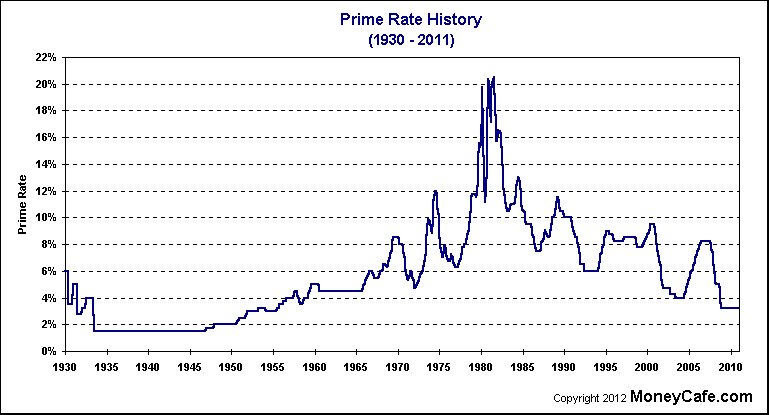
Interest rates are at historic lows. There is no better time to make infrastructure investments to propel us into another half-century of prosperity.

Saturday, October 29, 2011
Saturday, September 17, 2011
Weekend Reading
Contracting Out Costs Government Lots Extra
Higher Fees Paid to U.S. Physicians
Historically Low Taxes
The Investor's Dilemma
The Keynes-Hayek Rematch
The Legend of Margaret Thatcher
The Magical World of Voodoo Economists
Painful Medicine
Republican Assault on Post Office and Postal Unions
Studies Cite CEO Pay Cause of Wealth Inequality
U.S. Healthcare Costs High Because Doctor Fees are High
Was Marx Right?
What Caused the Recession of 1937-38?
Why Do Mayors Love Sports Stadiums?
Saturday, August 20, 2011
Wednesday, April 13, 2011
Unemployment versus Debt
Rage Against The Machine - Wake Up (Live) by popefucker
Tuesday, February 22, 2011
It's The Economy, Stupid
Saturday, September 18, 2010
Wednesday, February 25, 2009
Pushing On A String
Megan 'seems' like a very bright person, and she even raises some good points (for the first few minutes). But too often she cuts Dean Baker off or uses deflectors like, "well, the real question is" or, "anyways, what really matters is." And sometimes she just doesn't seem to have a grasp of the facts or just won't admit that she doesn't, whereby she then rambles and morphs the discussion into a new argument.
She goes on and on about “make-work” jobs. Saying the WPA wouldn’t have been created if there was full employment. Duh! That is the purpose of demand-side stimulus. The government steps in to do that which the private sector will not or can not.
Megan implies that workers in the WPA program just recorded oral histories and painted murals. And, also (latter) in a rather immature quip she compares it to hiring people to mow their lawns. Ridiculous! She conveniently sweeps past Dr. Baker’s evidence of roads and bridges. As if to imply, the work being done added no long-term value, built nothing of value, created no jobs, nor helped the economy recover. The GDP and employment indicators of the time tell a different story.
She then goes on to say how proxies, ways of measuring, are imperfect…as if, there’s just no good way to measure anything, so therefore, we really don’t know anything, what works, or what doesn’t. But, stupendously, somehow she knows.And, also, she makes the distinction between good and bad “make-work” jobs – if she doesn’t like the project or thinks it's wasteful, then it’s bad “make-work.”
Next, she explains how a son-in-law being hired because of nepotism is a “make-work” job. Huh, that’s an interesting one. The old saying, “it’s who you know, not what you know” didn’t come about for just any reason. So all the people who knew someone whom helped you obtain a job, because of that connection your job isn’t real. Wow, the unemployment rate is going to rise spectacularly under Megan’s new way of measuring.
To her this is all most likely bad debt. She feels we can't borrow and spend and have any good come from it. But that train of thought is debunked here, here and here.
I also was really 'charmed' by her use of phrases like “everyone knows,” implying everyone but Dr. Baker knows and he’s an idiot to even be debating her on this particular point. Or when he would squash her weak argument, she would then say, “we’re arguing about two different things,” or “that’s neither here nor there.” The only thing she seems to have done successfully here is muddle the discussion into the realm of incoherence (which is Republicans' want).
Or when she tries to sound academic and says things like the marginal product of labor ("if we value what they are creating more than we are paying them" - her definition). But this concept really supports the notion that productivity rather than debt is a better indicator of our growth and quality of life. That is, looking back years from now, even if we are paying off debt, yet we have increased our productivity (more so than we otherwise would have), the stimulus plan will have been successful.
Her whole argument also has an underlying assumption - there is no waste in the private sector. Which, if the last eight (or, for that matter, twenty-eight) years have shown us anything, this is definitely not the case. She appears to be nothing other than an enraptured ideologue.
One can only conclude Megan McArdle is a train-wreck.
During a few spots I was hoping Dean would just say, "OK. Next topic." Since it was obvious Megan only wanted to hear herself pontificate and bloviate.But nonetheless, it's a good informative hour...at least when Dean is allowed to speak.