
Showing posts with label labor. Show all posts
Showing posts with label labor. Show all posts
Saturday, August 16, 2025


Monday, August 12, 2024
Thursday, October 27, 2022
How To Solve (Mostly) All Our Problems
TAX THE RICH!!!

And, by "rich", I mean millionaires. Which, for the U.S., is about 9% of the entire population. This isn't a call for increased taxation on low-income, working families, or the middle-class. It's a call to tax those that have clawed, cheated, and stolen the wealth and productivity gains of the past few decades. No, not all millionaires have clawed, cheated, and stolen. But those who have clawed, cheated and stolen, and who have bought politicians to get legislation and tax laws in their favor, need to be taxed more.
Income has been steadily redistributed upward since the 1980s. Millionaires are reaping more and more of the gains of workers. This is not sustainable. It's time to reverse this. Tax the rich!
Monday, May 30, 2022
Holiday Reading



Saturday, January 15, 2022



Saturday, May 15, 2021
Weekend Reading
Jen Psaki Bombs Peter Doocy For Absurd Unemployment ClaimHousing and the Rising GDPWhy are American workers becoming harder to find?U.S. labor shortage? Unlikely. Here’s whyU.S. Labor Shortage? No, We Have a Crisis of Low Wages.Esquire ranks Milwaukee among five domestic cities that are 'unexpectedly awesome'
Friday, March 19, 2021
More Weekend Reading
'Quiet Part Out Loud': RNC Lawyer Admits GOP Cheats To WinTrump’s Dismal Record on the EconomyNot Another Rich Guy for SenatorElena Kagan Dismantled a Republican Lawyer and Might Have Saved Voting Rights Act in the ProcessLabor Law Is Broken, Economist SaysRaising the federal minimum wage to $15 by 2025 would lift the pay of 32 million workers
Saturday, July 13, 2019
Weekend Reading: Economics Edition
Society-Wide Benefits of Raising The Minimum Wage
The Puzzle In The Labor Data
The Trump Tax Reform, As Seen In The U.S. Balance Of Payments Data
Why The 'Free-Market' Economy Is A Myth And How To Rebuild Public Power
The Failures of Neoliberalism Are Bigger Than Politics
What Kansas's Rebounding Economy Tells Us About The Farce of Republican Tax Cuts
How The Federal Government Rigs The Game Against Small Businesses
Make Corporations Pay For The Green New Deal
Rich Get Richer, Everyone Else Not So Much In Record U.S. Expansion
Unions Did Great Things For The Working Class
The Puzzle In The Labor Data
The Trump Tax Reform, As Seen In The U.S. Balance Of Payments Data
Why The 'Free-Market' Economy Is A Myth And How To Rebuild Public Power
The Failures of Neoliberalism Are Bigger Than Politics
What Kansas's Rebounding Economy Tells Us About The Farce of Republican Tax Cuts
How The Federal Government Rigs The Game Against Small Businesses
Make Corporations Pay For The Green New Deal
Rich Get Richer, Everyone Else Not So Much In Record U.S. Expansion
Unions Did Great Things For The Working Class
Saturday, February 9, 2019
Weekend Reading
Alexandria Ocasio-Cortez's Tax Hike Idea Is Not About Soaking The Rich
Unions Did Great Things For The Working Class
Economists Get Serious About Harm From Monopolies
If Only Obama Had Done The Things Obama Actually Did
Antitrust And The Financial Sector
Cory Booker's Baby Bonds Nearly Close The Racial Wealth Gap For Young Adults
All Of The Extremist Killings In The US In 2018 Had Links To Right-Wing Extremism
How Elizabeth Warren's Wealth Tax Would Remake America
Alexandria Ocasio-Cortez, Crusher Of Sacred Cows
Progressive Labor Standards
What Do We Actually Know About The Economy?
Yes, Polarization Is Asymmetric - And Conservatives Are Worse
Should Billionaires Even Exist?
How Frigid Polar Vortex Blasts Are Connected To Global Warming
The Wealth Gap And Miller Park's Deal
Republicans Cynically Demonized Government For Decades. The Shutdown Belongs To Them.
Unions Did Great Things For The Working Class
Economists Get Serious About Harm From Monopolies
If Only Obama Had Done The Things Obama Actually Did
Antitrust And The Financial Sector
Cory Booker's Baby Bonds Nearly Close The Racial Wealth Gap For Young Adults
All Of The Extremist Killings In The US In 2018 Had Links To Right-Wing Extremism
How Elizabeth Warren's Wealth Tax Would Remake America
Alexandria Ocasio-Cortez, Crusher Of Sacred Cows
Progressive Labor Standards
What Do We Actually Know About The Economy?
Yes, Polarization Is Asymmetric - And Conservatives Are Worse
Should Billionaires Even Exist?
How Frigid Polar Vortex Blasts Are Connected To Global Warming
The Wealth Gap And Miller Park's Deal
Republicans Cynically Demonized Government For Decades. The Shutdown Belongs To Them.
Monday, December 24, 2018
Holiday Reading
The Shrinking Middle Class
Good Dogs
The Rise And Fall Of Scott Walker
The Corruption Of The Republican Party
You're Worth $1 Trillion. Why Do You Need Our $3 Billion?
GE Powered The American Century - Then It Burned Out
How The IRS Was Gutted
Sins Of The Fathers
Progressive Labor Standards
Kimberly-Clark To Receive $28 Million In Taxpayer Funds From Scott Walker
Foxconn & The Village: The $10 Billion Factory Deal That Turned One Small Wisconsin Town Upside Down
New Election Data Highlights The Ongoing Impact Of 2011 GOP Redistricting In Wisconsin
Good Dogs
The Rise And Fall Of Scott Walker
The Corruption Of The Republican Party
You're Worth $1 Trillion. Why Do You Need Our $3 Billion?
GE Powered The American Century - Then It Burned Out
How The IRS Was Gutted
Sins Of The Fathers
Progressive Labor Standards
Kimberly-Clark To Receive $28 Million In Taxpayer Funds From Scott Walker
Foxconn & The Village: The $10 Billion Factory Deal That Turned One Small Wisconsin Town Upside Down
New Election Data Highlights The Ongoing Impact Of 2011 GOP Redistricting In Wisconsin
Saturday, November 10, 2018
Wisconsin Reading
What A New Governor Means For Wisconsin's Controversial Foxconn Factory
As Soon As Scott Walker Lost, His Pet Legislators Started Stripping The Governor's Powers
GOP Assembly Speaker Robin Vos Threatens To Take Power Away From Tony Evers Before January
Will Republicans Steal Power From New Democratic Governors?
The States That Elected Trump Have Turned Against Him
How Labor Helped Bring Down Scott Walker And Bruce Rauner
Racism And The Wisconsin Idea
Court Strips Workers Of $10 Million Award
Did Scott Walker & Donald Trump Deal Away The Wisconsin Governor's Race To Foxconn?
As Soon As Scott Walker Lost, His Pet Legislators Started Stripping The Governor's Powers
GOP Assembly Speaker Robin Vos Threatens To Take Power Away From Tony Evers Before January
Will Republicans Steal Power From New Democratic Governors?
The States That Elected Trump Have Turned Against Him
How Labor Helped Bring Down Scott Walker And Bruce Rauner
Racism And The Wisconsin Idea
Court Strips Workers Of $10 Million Award
Did Scott Walker & Donald Trump Deal Away The Wisconsin Governor's Race To Foxconn?
Saturday, September 15, 2018
Weekend Reading
Trump Proposes $100 Billion Gift To Richest 1%
Giving Government Workers The Shaft
We Are All Accumulating Mountains Of Things
Unions In The 21st Century: A Potent Weapon Against Inequality
Taxpayers Are Footing The Bill For Sky-High CEO Salaries
Withheld Emails Show Brett Kavanaugh May Have Perjured Himself
Where Labor Unions Aren't Going Away
Where Will The Next Crisis Come From?
The Housing Bubble And Financial Crisis Was Easy To See Coming
Bernanke, Geithner and Paulson Still Don't Have A Clue About The Housing Bubble
The Dangerous Myth We Still Believe About The Lehman Brothers Bust
Misunderstanding Credit And Housing Crises: Blaming The CRA, GSEs
He Was The Resistance Inside The Obama Administration
Many Lawmakers And Aides Who Crafted Financial Regulations After The 2008 Crisis Now Work For Wall Street
An Alternative View Of Boom And Bust Cycles
What Does The Current Slope Of The Yield Curve Tell Us?
Giving Government Workers The Shaft
We Are All Accumulating Mountains Of Things
Unions In The 21st Century: A Potent Weapon Against Inequality
Taxpayers Are Footing The Bill For Sky-High CEO Salaries
Withheld Emails Show Brett Kavanaugh May Have Perjured Himself
Where Labor Unions Aren't Going Away
Where Will The Next Crisis Come From?
The Housing Bubble And Financial Crisis Was Easy To See Coming
Bernanke, Geithner and Paulson Still Don't Have A Clue About The Housing Bubble
The Dangerous Myth We Still Believe About The Lehman Brothers Bust
Misunderstanding Credit And Housing Crises: Blaming The CRA, GSEs
He Was The Resistance Inside The Obama Administration
Many Lawmakers And Aides Who Crafted Financial Regulations After The 2008 Crisis Now Work For Wall Street
An Alternative View Of Boom And Bust Cycles
What Does The Current Slope Of The Yield Curve Tell Us?
Saturday, August 4, 2018
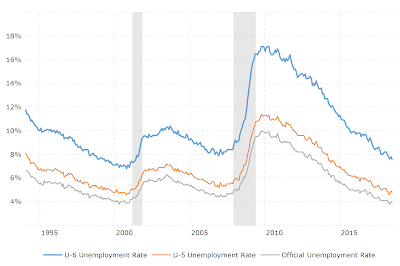
Unemployment
The U-6 rate is the unemployment rate that includes discouraged workers who have quit looking for a job and part-time workers who are seeking full-time employment.

[source]
For Further Reading:
Total unemployed, plus all marginally attached workers plus total employed part time for economic reasons
Wednesday, June 14, 2017
Midweek Reading
How Much Does Gov. Scott Walker Affect The Wisconsin Economy? Less Than You Might Think
Why Is CEO Pay Still Soaring?
The $400 Million, Pension Problem
These 8 U.S. Streetcar Projects Could Break Ground By 2020
Labor's Declining Share: A Primer
Discrimination Is Not De Facto
Tackling The 'Nastiest, Hardest Problem In Finance'
How Conservatives Betrayed Virtue For Donald Trump
Want To Fix The Budget? Collect Taxes
Trump And Congress Are About To Ruin America's $220 Billion Economic Secret Weapon
Why Is CEO Pay Still Soaring?
The $400 Million, Pension Problem
These 8 U.S. Streetcar Projects Could Break Ground By 2020
Labor's Declining Share: A Primer
Discrimination Is Not De Facto
Tackling The 'Nastiest, Hardest Problem In Finance'
How Conservatives Betrayed Virtue For Donald Trump
Want To Fix The Budget? Collect Taxes
Trump And Congress Are About To Ruin America's $220 Billion Economic Secret Weapon
Sunday, May 7, 2017
Labor: Human Activity That Provides The Goods Or Services In An Economy
"If any man tells you he loves America, yet hates Labor, he is a liar." ~ Abraham Lincoln
What's wrong with giving out pay raises? Plenty, according to some Wall Street analysts
If we want to address the increasing income inequality in our society, we need to break from this capital-worship paradigm.
"Labor is prior to and independent of capital. Capital is only the fruit of labor, and could never have existed if labor had not first existed. Labor is the superior of capital, and deserves much the higher consideration." ~ Abraham Lincoln
Yet, this seems to be exactly the message of Wall Street, conservatives and capital investment, in general.
According to investors, workers don't really deserve the fruit of their labor.
“This is frustrating. Labor is being paid first … again. Shareholders get leftovers,” wrote Citi analyst Kevin Crissey in a note to clients.
Jamie Baker of Morgan Stanley downgraded American shares to “neutral” from “overweight,” saying the pay decision “establishes a worrying precedent, in our view, both for American and the industry.”John Cotton condensed the Wall Street view:
"There’s always this tension between what companies would want for the long term and what Wall Street wants for the short term," said John Cotton, professor of management and director of the Executive MBA Program in the College of Business Administration at Marquette University. "As far as Wall Street is concerned, if you could pay minimum wage to everybody on every job, that would be great because that would leave more money for stockholder.
...
"Wall Street, they don’t care so much long term," Cotton said. "They would rather have the company buy back stock than, say, invest in making their business more effective over the long term, because that’s not going to pay off in the next 90 days.
"It is short-sighted, but then Wall Street almost by definition is short-sighted," he added. "If you could do something to jack up your stock price 5%, the fact that it’s going to hurt your company over the next 10 years is irrelevant."American Airlines CEO defended worker raises:
"As a service organization, investments in our team are investments in our product," Parker said during a conference call with analysts. "We think it's precisely this kind of investment in our people that is going to make the difference in our service. And while this won't happen overnight, we also think it's the kind of investment that will continue to drive revenue (growth) for American. And as that happens, all of you will be the beneficiaries of those returns."For Wall Street, raises should be reserved for the CEOs that decide to fire workers and/or suppress wages.
If we want to address the increasing income inequality in our society, we need to break from this capital-worship paradigm.
"Labor is prior to and independent of capital. Capital is only the fruit of labor, and could never have existed if labor had not first existed. Labor is the superior of capital, and deserves much the higher consideration." ~ Abraham Lincoln
Sunday, September 4, 2016
Decline of Unions Has Hurt All Workers
Decline of unions has hurt all workers
The steep decline in union membership in recent decades has had an outsize effect on the American workforce, tamping down wage increases for nonunion workers, a new study says.
Average weekly earnings for nonunion private-sector male workers would have been 5%, or $52, higher in 2013 if the share of union workers had remained at 1979 levels, according to the study out Tuesday from the liberal-leaning Economic Policy Institute ahead of Labor Day. That’s tantamount to a loss of $2,704 annually for the average nonunion worker.
The paper was authored by Washington University sociologists Jake Rosenfeld and Patrick Denice, and Jennifer Laird, a research scientist at Columbia University’s Center on Poverty and Social Policy.
The earnings loss is smaller for women because they were not as unionized as men in 1979. Weekly wages would be about 2% to 3% higher for women if union membership had stayed at 1979 levels, the report says.
About 10% of male private-sector workers were union members in 2013, down from 34% in 1979. In that period, the share of women who belong to unions fell to 6% from 16%.
The report argues the dwindling influence of unions is a significant but often ignored reason for wage stagnation, along with globalization, technological change and the slowdown in educational achievement gains.
The prevalence of unions affects the pay of nonunion workers in various ways, the study says. Nonunion employers often raise their workers’ pay to foster loyalty and head off an organizing drive. Kodak deployed that strategy in highly organized New York State, the study says.
The fatter paychecks of union workers also creates a more competitive labor market that forces nonunion companies to lift wages to prevent employees from jumping ship. And unions often establish labor-friendly policies that generally promote fairness in pay, benefits and worker treatment, according to the report.
The gains of yesteryear were not limited to nonunion workers at risk of joining unions, the study says. When those workers received raises, their higher-level supervisors who couldn't join unions also saw sharper pay increases to maintain salary hierarchies, the paper says.
But the losses engendered by shrinking union participation are most pronounced for nonunion private-sector male workers who lack a Bachelor's degree. Wages for that group would be 8% higher in 2013 if union membership had stayed at 1979 levels, translating into an annual wage loss of $3,016.
Friday, April 17, 2015
Sunday, August 31, 2014
Labor's Fair Share
On Labor Day, What About Labor’s Fair Share?
- According to the Economic Policy Institute, productivity went up about 25 percent from 2000 to 2012. How much did compensation increase? Only about 7 percent.
- From 1979 to 2010 the top 1 percent of households saw their after-tax income grow by about 202 percent.
Tuesday, July 9, 2013
Subscribe to:
Posts (Atom)