Showing posts with label inflation. Show all posts

Wednesday, November 6, 2024

Endarkenment

So the supposedly Jesus-loving, flag-waving crowd feels a convicted felon, convicted rapist, bankrupt, tax cheat, philandering, con man is the best leader for our country and the example they'd like to set for the children. What a disgrace!

Republicans, don't preach another second about law-and-order, God, morality, right-and-wrong, or any of your other meaningless talking points. The Republicans are the party of stupid. They are the party of ignorance. They are the party of immaturity. They are the party of hypocrisy. They are the party of petulance. They are the party of greed. They are the party of misogyny. They are the party of racism. They are the party of homophobia. They are the party of transphobia. They are the party of cognitive dissonance. Republicans are non-thinking, spineless, windbags. 

But now let's talk about the apathetic American voter. In 2020, 66% of eligible voters went to the polls. Pathetic in it's own right. But, in 2024, what was deemed the most consequential election ever, even fewer voters turned out. Twenty million less people (as of this writing) voted for president in 2024 than in 2020. Embarrassing! 

Let's not forget about the media. Normalizing this insanity every step of the way. I'm not just talking about Fox News, Newsmax, and OAN. We all know they are full-of-shit shills. But all media outlets reporting on the Trump candidacy as if it were just any other. If anyone should have been continually sounding the alarm and raising questions about a cheating, traitorous, felon, it was our media. Instead, Trump got a pass. His incoherence and ramblings were largely ignored. The media overlooked the actual economic record of Biden/Harris and failed to correct the narrative that the economy was doing poorly. Everyone was focused on questioning Kamala and having her discuss specific policies. Meanwhile, Trump was allowed to ramble and dance at his rallies.   

I can't end this without mentioning the fact that Joe Biden and Kamala Harris entered office and ushered us out of the pandemic without pulling us down into a recession. In case you forget, Donald Trump had lost jobs, lowered the American standard of living, ignored the pandemic and told people to drink bleach. [Plus this, this, and this.] And, not only did the U.S. not enter a recession under Biden/Harris, our economy is leading the world - the stock market it up, GDP is up, wages are up, jobs are up, and inflation is down. As The Economist noted, The U.S. Economy is the Envy of The World. This is what the geniuses on the right have voted against and the apathetic slouches on the left decided not to vote for. Sad.

For Further Reading:
U.S. economic growth remains impressive. It’s the envy of the world, except at home
The American economy has left other rich countries in the dust
The U.S. Economy Reaches Superstar Status
The robust U.S. economy is leaving ‘other rich countries in the dust’
The envy of the world

Thursday, October 27, 2022

How To Solve (Mostly) All Our Problems

 TAX THE RICH!!!


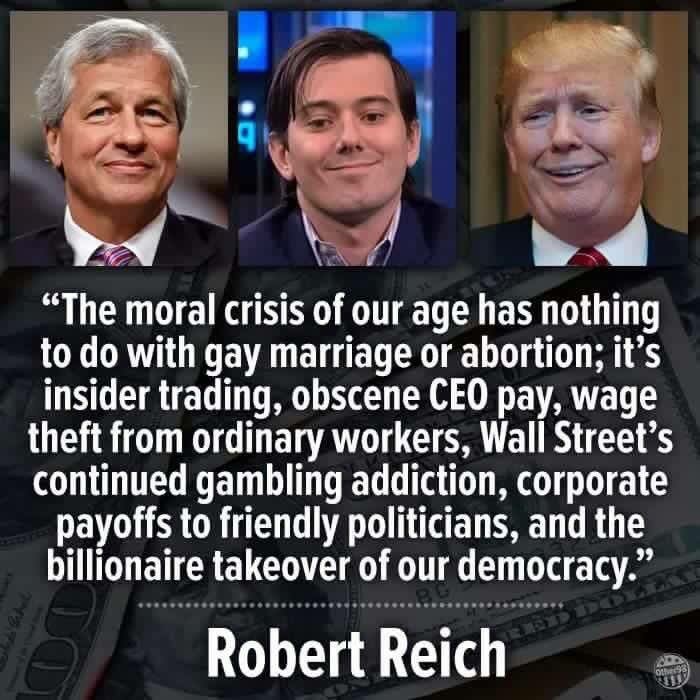
And, by "rich", I mean millionaires. Which, for the U.S., is about 9% of the entire population. This isn't a call for increased taxation on low-income, working families, or the middle-class. It's a call to tax those that have clawed, cheated, and stolen the wealth and productivity gains of the past few decades. No, not all millionaires have clawed, cheated, and stolen. But those who have clawed, cheated and stolen, and who have bought politicians to get legislation and tax laws in their favor, need to be taxed more.

Income has been steadily redistributed upward since the 1980s. Millionaires are reaping more and more of the gains of workers. This is not sustainable. It's time to reverse this. Tax the rich! 

Monday, February 5, 2018

Trump Makes History

Dow Plunges Nearly 1,600 Points In Biggest Intraday Point Drop In History
U.S. stocks plunged in highly volatile trading on Monday, with the Dow industrials falling nearly 1,600 points during the session, its biggest intraday decline in history, as investors grappled with rising bond yields and potentially firming inflation.

Sunday, March 13, 2016

Stop Cryin' In Yer Beer

I've heard varieties of the "Obama hasn't done anything" idea spouted about in the media, from friends, by co-workers, etc.

Now, I wanted a more liberal agenda pursued, but nonetheless, I'm not blind to the fact that Barack Obama has accomplished very, very big things.

Government is shrinking, deficits are declining, employment is improving, health care inflation is subsiding, infrastructure projects have been completed nationwide ...

For Further Enlightenment:

PRESIDENT OBAMA HAS DONE A LOT! A LIST OF 340 ACCOMPLISHMENTS SO FAR, WITH CITATIONS

Obama's top 10 accomplishments


Thursday, December 5, 2013

The Minimum Wage

President Barack Obama, Pope Francis and the fight against income inequality
A small way to attack the chronic problem of wealth concentration is to modestly boost the federal minimum wage.
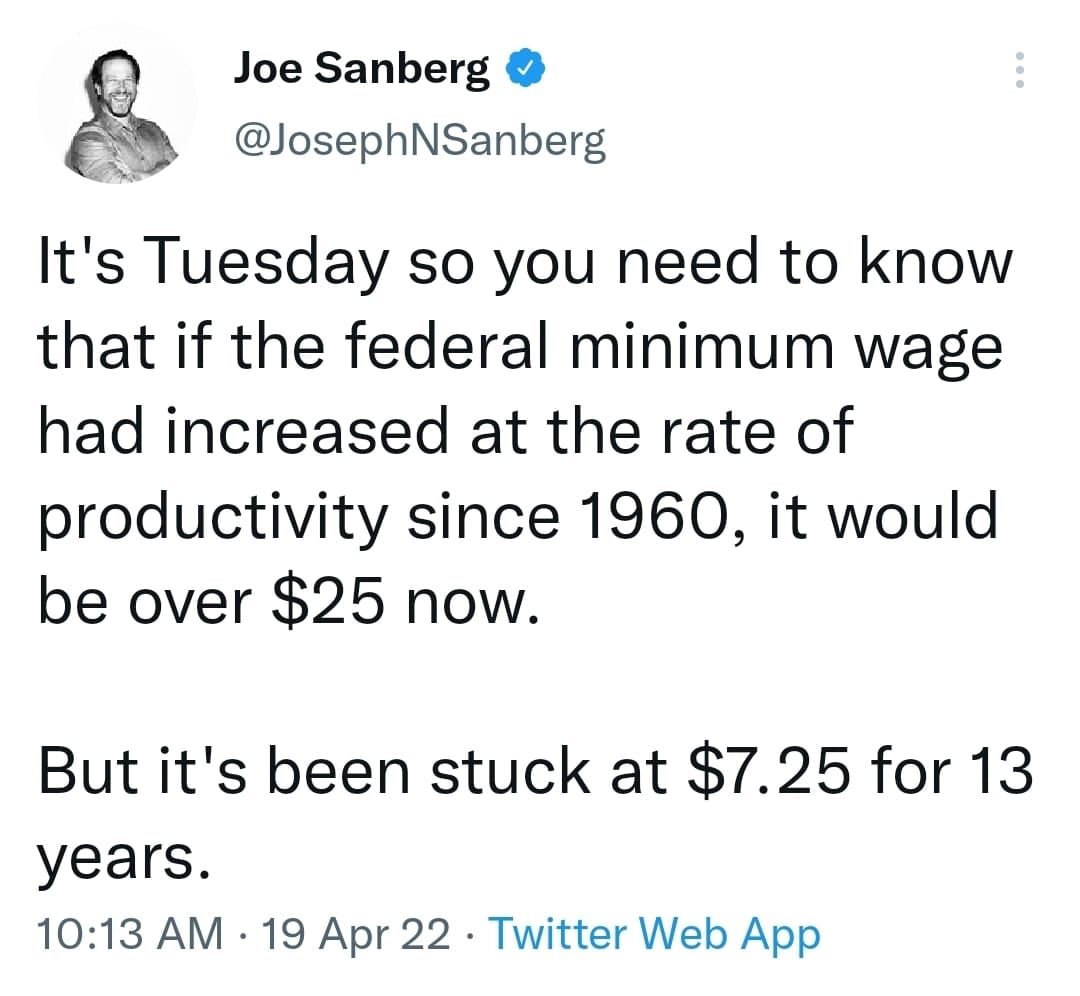
As Maura Stephens, of Alternet, reported, "If the minimum hourly wage had advanced with the cost of living and productivity from its high-water mark of 1968, it would have been $21.72 in 2012, according to a March 2012 study by John Schmitt for the Center for Economic Policy and Research." Over the past few decades, our economy has experienced an increasing rate of GDP per capita - a growing economy. Yet, this bounty hasn't found its way into the wages of most workers. Workers haven't shared in this growing prosperity. Here's a series of graphs that speaks volumes about the disparity between wages and general economic growth over the past few decades.


For Further Reading:
Why Does the Minimum Wage Have No Discernible Effect on Employment?

Thursday, September 13, 2012

Are We "Printing Money"?

Conservatives have a talking-point about the Federal Reserve printing money. The U.S. is (supposedly) continually printing money, running up debt and fanning the flames of inflation. This is debasing the dollar and leading us, in general, toward calamity.

But the real problem is unemployment and its effects on economic growth and, thus, debt reduction. We have a demand-side problem, not a supply-side problem. The longer we go leaving millions without work and wasting their potential, the more we hurt not only them but the entire economy.

"One of the themes I’ve hit on many times is the fact that the crisis and slump have been a testing ground for economic doctrines. People came into this mess with very different views about how the economy works, and the crisis in effect provided natural experiments that tested those views. Most notably, what we got was a test of demand-side versus supply-side stories about the nature of depressions. Demand-siders like me saw this as very much a slump caused by inadequate spending: thanks largely to the overhang of debt from the bubble years, aggregate demand fell, pushing us into a classic liquidity trap. But many people — some of them credentialed economists — insisted that it was actually some kind of supply shock instead. Either they had an Austrian story in which the economy’s productive capacity was undermined by bad investments in the boom, or they claimed that Obama’s high taxes and regulation had undermined the incentive to work (of course, Obama didn’t actually impose high taxes or onerous regulations, but leave that aside for now). How could you tell which story was right? One answer was to look at the behavior of interest rates; the other was to look at inflation. For if you believed a demand-side story, you would also believe that even a large monetary expansion would have little inflationary effect; if you believed a supply-side story, you would expect lots of inflation from too much money chasing a reduced supply of goods. And indeed, people on the right have been forecasting runaway inflation for years now. Yet the predicted inflation keeps not coming," notes Paul Krugman.

Krugman also states, "What’s wrong with the idea that running the printing presses is a giveaway to plutocrats? Let me count the ways. First, as Joe Wiesenthal and Mike Konczal both point out, the actual politics is utterly the reverse of what’s being claimed. Quantitative easing isn’t being imposed on an unwitting populace by financiers and rentiers; it’s being undertaken, to the extent that it is, over howls of protest from the financial industry. I mean, where are the editorials in the WSJ demanding that the Fed raise its inflation target? Beyond that, let’s talk about the economics. The naive (or deliberately misleading) version of Fed policy is the claim that Ben Bernanke is “giving money” to the banks. What it actually does, of course, is buy stuff, usually short-term government debt but nowadays sometimes other stuff. It’s not a gift. To claim that it’s effectively a gift you have to claim that the prices the Fed is paying are artificially high, or equivalently that interest rates are being pushed artificially low. And you do in fact see assertions to that effect all the time. But if you think about it for even a minute, that claim is truly bizarre. I mean, what is the un-artificial, or if you prefer, “natural” rate of interest? As it turns out, there is actually a standard definition of the natural rate of interest, coming from Wicksell, and it’s basically defined on a PPE basis (that’s for proof of the pudding is in the eating). Roughly, the natural rate of interest is the rate that would lead to stable inflation at more or less full employment. And we have low inflation with high unemployment, strongly suggesting that the natural rate of interest is below current levels, and that the key problem is the zero lower bound which keeps us from getting there. Under these circumstances, expansionary Fed policy isn’t some kind of giveway to the banks, it’s just an effort to give the economy what it needs. Furthermore, Fed efforts to do this probably tend on average to hurt, not help, bankers. Banks are largely in the business of borrowing short and lending long; anything that compresses the spread between short rates and long rates is likely to be bad for their profits. And the things the Fed is trying to do are in fact largely about compressing that spread, either by persuading investors that it will keep short rates at zero for a longer time or by going out and buying long-term assets. These are actions you would expect to make bankers angry, not happy — and that’s what has actually happened.

As Dean Baker explained, "In normal times, the economy is, at least partially, supply-constrained. Collectively, we want more goods and services than the economy is capable of producing.... In our demand-constrained economy, how- ever, there is no problem of inflation. The economy can produce more of almost anything right now. The reason that we are not doing it is simply the lack of demand."

Krugman elaborates, "Surely we don’t mean to identify money with pieces of green paper bearing portraits of dead presidents. Even Milton Friedman rejected that, more than half a century ago. For one thing, a lot of those pieces of green paper are pretty much inert — sitting outside the United States, in the hoards of drug dealers and such. For another, checking accounts are clearly a close substitute for cash in hand. Friedman and Schwartz dealt with this by proposing broader aggregates –M1, which adds checking accounts, and M2, which adds a broader range of deposits. And circa 1960 you could argue that those aggregates were good enough. But now we have a large shadow banking system, in which things like repo serve much the same function as deposits; M3 used to capture some of that, but the Fed discontinued it, in part I think because it wasn’t clear which repo belonged there, and data on repo not involving primary dealers is scattered. Whatever. The truth is that these days — with credit cards, electronic money, repo, and more all serving the purpose of medium of exchange — it’s not clear that any single number deserves to be called “the” money supply. Intellectually, this isn’t a problem; nor is there necessarily a problem maintaining monetary policy even if there isn’t any single thing you’re willing to call money. Mike Woodford has been writing about this stuff for years. But if you’re determined to view economic affairs through a sort of paleo-monetarist lens, focused on the evils of “printing money”, you’re going to have a hard time in the modern world, where the definition of money is increasingly vague."

We still have a world more than willing to buy U.S. debt (the dollar is still the world currency and the preferred store of value) and inflation is nowhere in sight.

Here, again, we have the Republicans bloviating to justify their own interests, their discredited worldview, and to enable policies benefiting their cronies. But none of their ideas have anything to do with reality. Yet another talking-point of the right-wing which you would be wise to ignore.

Tuesday, April 19, 2011

Here's To Your Health

Allowing the Bush tax cuts to expire solves our most immediate budget problems. Health care costs pose the long-term dilemma if allowed to inflate along the current path. But, with unemployment hovering near 9 percent, this is not the time to worry about debt or inflation. Nor is it the time to attempt to debilitate our current health care reform which is aiming to control costs and cover more people. Peoples lives depend on us not worrying about asset prices right now. Getting people healthy and back to work will take care of price appreciation.

90 percent of American households have less than $10,000 in stocks. Thus, of those with a 401K or a similar retirement package (whose solvency is contingent on the up-and-downs of the market) most have less than $10,000 in that account. This isn't an adequate amount to retire on. The majority of the population is better off with affordable health care and the allowance of the expiration of the Bush tax cuts. They need a job and health care! They can't even contemplate retirement at this point.

The master revisionists have hoodwinked the American people yet again. Republicans have transformed Wall Street's follies into a government-caused catastrophe. Budget problems, in their narrative, are the fault of public workers. The reality is that continual tax cuts and ever-increasing health care costs are the culprits in a steadily decreasing American quality of life for the majority of citizens.

Health care cost inflation has steadily outpaced salary increases. Factoring in general inflation, alongside these increasing health care costs, workers have been losing ground for decades. We've heard a lot lately about entitlements and workers needing to pay more for their health care and retirement. The truth is that workers have been paying more for health care. And, for too many its been too much. Burdensome health care costs are the largest cause of bankruptcy.

Compound this with the fact that the U.S. spends nearly $2,500 more per person than the next country (Norway) on health care and its clear that our managed health care system is very inefficient and needs reform. Almost half of health care spending treats only 5 percent of the population. Just under a quarter of all spending treats only 1 percent of the population.

For all of the health care dollars we spend, the U.S. is among the worst in infant mortality and deaths from medical errors, and among the lower half in life expectancy. The percentage of health care that is publicly financed in the U.S. is also among the lowest among OECD countries. Nearly 45 percent of health care is financed publicly in the U.S.. The average for the other OECD countries is 73 percent. The only other country to publicly spend less than 50 percent is Mexico.

The average OECD country spends 9 percent of its GDP on health care. The U.S. spends the most - 16 percent of our GDP goes toward health care. Poor to mediocre results, limited coverage, and explosive costs - the hallmarks of U.S. health care - are what we get for almost one-fifth of our GDP. Americans should consider this an international embarrassment. That we allow so many to go without health care, whilst simultaneously allowing others to egregiously profit off health care misfortune or necessity, Americans should be ashamed and want our health care system improved.

President Obama's health care reform was a good step in the right direction. But until we remove the middleman - insurance companies - from the equation, or at the very least, more heavily regulate what they do (service provision requirements and cost controls), we will see waste and inefficiency. Nevertheless, there are many admirable reforms in the health care plan which deserve proper implementation to gauge efficiencies. The adopted health care reform is projected to save money over the next decade, cover more citizens, and would actually cost millions to repeal.

Now is not the time for austerity. We are merely making the poor, working and middle classes suffer needlessly on the cross of the free marketeers with continual budget cuts for education, transit, local aid, environmental protection, regulation, and other efficient public services that benefit all taxpayers. Voters electing Republicans with the hopes of tax cuts leading to a wonderland of worker-prosperity are biting off their own noses to spite their faces. The Reagan-era of deregulation and tax cuts has decreased our quality of life - stagnating wages, destabilizing retirement, and increasing inequality.

It's time for the government to provide the health care, jobs, and retirement security that the private sector just can't seem to accomplish. Ratings agencies, insurance companies, and other tax cut zealots be damned!

For Further Reading: