

[source]

[source]


[source]

[source]
Chief Dave Erwin — who has overseen a crackdown on Walker protesters at the statehouse — received an overall salary hike of 11.7%, to $111,067 a year, the same rate as his predecessor. That amounts to an $11,680 annual raise...
Walker officials took similar steps to skirt civil service salary limits for Deputy Police Chief Dan Blackdeer. His pay jumped by 14.6%, to $96,048, on June 16.Why Pot Makes You Feel Good

"The position I pushed is not unlike the principle that Franklin Delano Roosevelt — not exactly a conservative — pushed as well when it came to public sector collective bargaining," Walker remarked at the annual Governmental Research Association policy conference.FDR's opposition to collective bargaining, per se, was more against public workers striking or using quasi- militant tactics as a means to an end. He supported the public workers' voice in attempts at fair treatment. Roosevelt said, "It is one of the characteristics of a free and democratic nation that it have free and independent labor unions."
Although the future of labor unions looked grim in 1933, their fortunes would soon change. The tremendous gains labor unions experienced in the 1930s resulted, in part, from the pro-union stance of the Roosevelt administration and from legislation enacted by Congress during the early New Deal. The National Industrial Recovery Act (1933) provided for collective bargaining. The 1935 National Labor Relations Act (also known as the Wagner Act) required businesses to bargain in good faith with any union supported by the majority of their employees.Public works and unions became kind of a big thing specifically during FDR's time in office. For Walker to claim a parallel between himself and Roosevelt for doing the exact opposite during his reign as Wisconsin governor is batshit crazy.

[Above: FDR visiting the Allis-Chalmers factory near Milwaukee, Wisconsin during an inspection trip. Milwaukee, Wisconsin, September 19, 1942.]Walker goes on to claim one of his major policy innovations was pension reform. Yet, Walker himself, in the Journal article, even states, "Our pension system is the only one in the country that's fully funded." As a Pew report, A Widening Gap In Cities, documents:
At the end of fiscal year 2009, the largest city in Wisconsin had the best-funded system among 61 American cities, with 113 percent of the money.The report also found the State of Wisconsin, at the end of fiscal year 2009, had 100 percent of needed funding.
Walker deserves credit for helping launch the Wisconsin Economic Development Corp., which is a good model for deploying scarce resources even if poor management at the agency resulted in a series of embarrassing mistakes.Good Jobs First actually published The Risks of Privatizing State Economic Development Agencies in January 2011.
Transferring state business recruitment functions from government agencies to private entities is not the panacea that its proponents suggest. In fact, the track record of those few states that have taken the step is filled with examples of misuse of taxpayer funds, political interference, questionable subsidy awards, and conflicts of interest. Rather than making economic development activities more effective, privatization often is little more than a power grab by governors and powerful business interests...
Most of the seven states that currently make use of economic development PPPs have experienced a variety of performance problems. These include the following:Why does the Journal continue to push an idea that has failed everywhere it has been tried? Why do they still defend such a bogus program, even after it has been shown to be an embezzling debacle here in Wisconsin?
Misuse of taxpayer funds (Rhode Island, Florida and Wyoming)
Excessive executive bonuses (Virginia, Florida, Michigan and Wyoming)
Questionable subsidy awards by the subset of PPPs that have a role in that process (Michigan and Rhode Island)
Conflicts of interest in subsidy awards (Florida, Utah and Texas, which makes limited use of PPPs)
Questionable claims by the PPP about its effectiveness (Wyoming, Florida, Utah and Indiana)
Resistance to accountability (Florida and Michigan)
The Worst Governors In America
Gov. Scott Walker (R-WI) was elected in 2010 and won a recall election in 2012. He is running for re-election in 2014. His inclusion stems from: (1) using his office to promote donors’ interests; (2) illegally using state troopers to track down his political opponents; (3) an investigation into illegal activity by his aides; (4) diverting money from a nationwide mortgage settlement; (5) an investigation into the state economic development corporation he chairs; (6) dismissing a political appointee for signing the recall petition against him; and (7) advocating for new voter identification restrictions.
The budget approved by the Republican-controlled Legislature includes all of Walker’s priorities, including a $650 million income tax cut, expansion of private school vouchers and changes to the state’s Medicaid and food stamp programs...
The “biggest, boldest reform” in the budget was new work requirements for people on food stamps. Able-bodied adults must spend at least 20 hours a week working or getting trained for a job, or they will be limited to three months of benefits over three years. Walker described this as a kindness.
“We say it’s time to get the training, and the access to training so that when a job becomes available, you are ready to get in the game,” he said.Tax Plans for Wisconsin Go From Bad to Worse
Here is how the tax cut would be distributed among income groups:
- The top 5% of earners alone, a group with an average income of $392,000, would receive more than 1/3 of the benefit of the income tax cuts.
- The top 20% of earners, a group with an average income of $183,000, would receive more than 2/3 of the benefit.
- The bottom 60% of earners – those making $60,000 a year or less – would only receive 11% of the benefit of the income tax cuts.
- The 20% of the Wisconsinites with the lowest incomes would receive just two cents out of every $100 in individual income tax cuts under this proposal.

The budget Governor Walker just signed also created a structural deficit of $505 million in the next biennium.The Truth About State Taxes
The record suggests that taxes in Wisconsin were lower under Doyle than under any governor in the last five decades, as compared to other states...
One of the peak levels of taxation came under Republican Gov. Tommy Thompson, who increased taxes to the point that they took 13.1% of personal income in Wisconsin in 1996, when the state ranked 3rd in taxes nationally. The state still ranked 4th when Thompson left office...
Another way of measuring this is to look at total state-local spending. The WisTax figures show the 2011 state/local expenditures per person were $8,351 nationally and almost exactly the same, $8,383 in Wisconsin.For Further Reading:


County Executive Chris Abele has decided to award the $164 million dollar county transit contract to a new company, MV Transportation, and drop Milwaukee Transport Services (MTS), the non-profit operation that has run the county bus system for decades...
The not-for profit operator would be replaced by MV Transportation, a privately held corporation based in Texas, whose website says it “provides passenger transportation management, operations, and related services to jurisdictional and private entities around the world.” ...
However, once a new entity takes over, the contracts for all union workers would have to be renegotiated, and the new company may push for more efficiencies. Anticipating that, the bus drivers’ union, ATU 998, has been circulating a PowerPoint presentation opposing the move to a for-profit management firm.
When asked if he expected wage or benefit givebacks, Abele said “I honestly don’t know. I can tell you that was not the goal. The goal was better services and to keep fares down.”In this instance, Abele is being naive, stupid or devious. Or maybe it's just his typical cliched response/excuse, providing little insight into his actual thought-process, giving little explanation as to how he decided a major program change for the county. "How was I to know they'd save money by cutting corners and wages?"
In the wake of Detroit’s bankruptcy, you may be wondering: How could anyone be surprised that a city so tied to manufacturing faces crippling problems in an era that has seen such an intense public policy assault on domestic American manufacturing? You may also be wondering: How could Michigan officials possibly talk about cutting the average $19,000-a-year pension benefit for municipal workers while reaffirming their pledge of $283 million in taxpayer money to a professional hockey stadium? ...
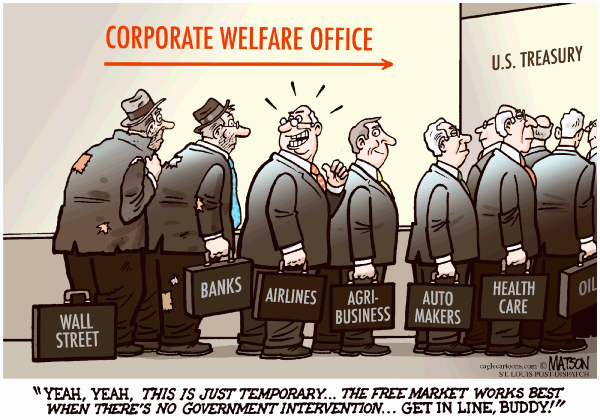
It’s a straightforward conservative formula: the right blames state and municipal budget problems exclusively on public employees’ retirement benefits, often underfunding those public pensions for years. The money raided from those pension funds is then used to enact expensive tax cuts and corporate welfare programs. After years of robbing those pension funds to pay for such giveaways, a crisis inevitably hits, and workers’ pension benefits are blamed — and then slashed. Meanwhile, the massive tax cuts and corporate subsidies are preserved, because we are led to believe they had nothing to do with the crisis. Ultimately, the extra monies taken from retirees are then often plowed into even more tax cuts and more corporate subsidies.Just How Generous Are Detroit's Worker Pensions for Retirees?
"My basic takeaway was that [Detroit's] pension system itself was not overly generous," said Jean-Pierre Aubry, assistant director of State and Local Research at Boston College's Center for Retirement Research...
Retired general city workers, such as librarians or sanitation workers, received average payments of $18,275 a year in 2011, according to the Detroit General Retirement System...
While retired Detroit firefighters and police officers receive more generous pension checks than auto workers -- checks averaged almost $30,000 a year in 2011 -- they often don't receive the added bonus of Social Security payments.We Need A Federal Bailout for Detroit's Pensions
Does $1,500 a month after hauling garbage cans your whole adult life really sound like a fortune? ...
Retired Detroit employees didn't cause the financial crisis of 2008, which hit the pension plan's investment fund hard. Yet they're being handled as if they were morally equivalent to the Wall Street creditors who did. As the New York Times reports, the unelected city manager's plan would "treat bondholders the same as retirees" and ask them both to sacrifice...
The average Detroit city pension is slightly less than $19,000 per year. For police and firefighters, pensions are their only source of retirement income. (They don't have Social Security.)Five myths about Detroit
The real culprit in the city’s decline has been federal policies that put corporate health ahead of community health, such as free-trade agreements that sacrifice U.S. jobs for foreign trade...
Detroit’s major financial problem is that its shrinking tax base has meant years of declining revenue. Remember, the city has lost more than 1 million residents since its population peaked in the 1950s. Those who blame pensions confuse cause and effect — like blaming a personal bankruptcy on a pesky car loan after one’s salary was cut in half. The difference, of course, is that getting rid of a car you can no longer afford isn’t the same as reneging on a promise to 21,000 retirees.
Wisconsin sees the largest month-to-month gain in a decade but most are low-wage jobs.
The good news: Wisconsin had a June jobs surge, a boost from May of 13,800 private sector jobs. State officials rightfully called it the largest month-to-month gain in nearly a decade.
The bad news: Most of the growth—7,200 jobs—was in the “leisure and hospitality” sector, where average weekly pay was only $284 last year. That’s barely one-third the overall average wage in Wisconsin of $803.
One of Wisconsin's largest real estate developers wrote to Gov. Scott Walker to express his interest in buying several prominent state office buildings at the same time the Legislature was considering doing away with competitive bidding for such sales, according to newly released records.
Terrence Wall offered his cellphone number in the letter, urging that the "appropriate person" call him to discuss possible deals for properties including the State Crime Laboratory, records obtained by The Associated Press show. Wall also offered his support for the change in the bidding process, an idea that originated with Walker.
Wall sent the letter on June 10. The Republican-controlled Legislature agreed 11 days later to allow no-bid sales of state properties over the objection of Democrats, who argued that it opened the door for political cronies to be cut special deals...
Walker called for legalizing no-bid sales of state properties in the budget he proposed in February. The Republican-controlled Legislature agreed in June, after adding a requirement that any sale negotiated by the governor be approved by the budget committee. The state Building Commission, which Walker chairs and is controlled by Republicans, would also have to approve.Stay classy, Scotty.
After nearly $1 million in expenses, the state is ending its contract with a Republican-aligned law firm that helped it fight litigation over the 2011 law that sharply limits collective bargaining for most public workers.
From now on, the legal work will be handled entirely by the state Department of Justice.Why wasn't the work handled by the state Department of Justice from the beginning?
As for Wisconsin, the state routinely pulls in less than 1% of all venture capital raised, and the numbers are so small that it's difficult to pull any insights from quarterly trends. In the first quarter, state companies raised $18.42 million of venture capital, the best showing to start the year since 2010.Has the Journal ever shown any type of link between employment, poverty, or any other economic indicators and a particular place's venture capital? You know, something like: as such-and-such place increased their amount of venture capital over the last decade, they have also shown an increase in employment and a decline in poverty...and this is also true for the other places attracting the most venture capital. I don't recall much analysis of any kind. They just simply keep repeating this storyline of how much we need more venture capital, yet I haven't really heard any convincing arguments as to why.
Gov. Scott Walker says activities of protesters at the site of proposed iron ore mine near Lake Superior "has no place in Wisconsin."Gov. Scott Walker blasts anti-mining activists
"The type of harassment and abuse we saw on the recent video of radical activists at Gogebic Taconite's proposed mine site has no place in Wisconsin. These extremists - who are disrupting work and causing harm to law-abiding employees - should be prosecuted to the fullest extent of the law," Walker said.Was Scott Walker calling for the full prosecution of the Tea Partiers and other disruptors (during the last election cycle) who impeded, interrupted and scuffled at their opponents Town Hall meetings and other gatherings?
What can we do as a nation to take advantage of these interest rates before they return to normal? Choose your favorite part of America that can be upgraded:
- Our electrical grid consists mostly of wires strung between wooden poles, which may have been innovative in 1850 but is somewhat past its sell-by date today. After Hurricane Sandy, much of New Jersey, Long Island and Connecticut lost electrical service for two weeks. The entire grid needs to be hardened, upgraded against cyberattack — and buried underground.
- We can make our road system “intelligent” by using sensors and software to move traffic more quickly and efficiently than the current “dumb” system does. The productivity boost and fuel savings make this a big return on investment.
- Bridges that are well past their life expectancy should not simply wait to fail. We should be actively replacing these. The alternative is waiting for random events — like the truck crash that caused the Washington state Skagit River bridge collapse — to cause a disaster.
- The United States’ cellular network is a decade behind Europe’s and Asia’s coverage and reliability. Mandate better minimum service requirements and make available cheap financing to wireless providers to do so. We can do the same with broadband as well.
- The interstate highway system has been one of the lasting legacies of the Eisenhower administration. It is time for a full upgrade of this economic multiplier.

State and local governments had 703,000 fewer employees in June 2013 than in August 2008, according to the jobs numbers released on Friday. That number has barely budged since January 2012 (see chart), meaning that in the last year and a half, states and localities essentially have made no progress in refilling the giant workforce hole that the recession caused. Although the days of drastic employment cuts seem over, state and local governments aren’t replacing the teachers, firefighters, police officers, sanitation workers, and many other critical employees that they lost in recent years.


This is part of a long-term effort to eliminate data collection or pervert it so that policy is biased toward Republican priorities. For example, Republicans have:
- Forced the Internal Revenue Service to drop a program called the Taxpayer Compliance Measurement Program in order to make the extent of tax evasion harder to calculate. This has made it easier to cut the IRS budget.
- Abolished the Office of Technology Assessment and the Advisory Commission on Intergovernmental Relations because they often produced widely respected data that conflicted with Republican dogma on issues such as global warming.
- Prohibited the federal government from collecting data on the cost of gun-related injuries and death in order to prevent it from being used by gun control supporters.
- Are currently attempting to defund a Census Bureau program called the American Community Survey. Among other things, it would eliminate the government’s ability to properly calculate the unemployment rate. Republicans claim it is too intrusive.
The New York Times obituary for Douglas C. Englebart, identified as the “Computer Visionary Who Invented the Mouse,” is fascinating reading, in part because Englebart, an Oregon farm boy, was in many ways the father of modern networked computing. Beginning in the early 1960s, he put together a team of engineers and computer scientists, funded by the federal government, that developed a prototype for most of the computer tools we all take for granted today...
Mariana Mazzucato, a professor of economics at the University of Sussex, has been making the point very effectively in lectures and a new book, The Entrepreneurial State, that the real innovation engine in the global economy is not business, nor the market, but the government. A recent story about Mazzucato in Forbes cites her view that long-term, patient capital–provided by government–is the absolute prerequisite for breakthrough innovation.
“Her case study for myth-debunking is the iPhone, that icon of American corporate innovation. Each of its core technologies–capacitive sensors, solid-state memory, the click wheel, GPS, internet, cellular communications, Siri, microchips, touchscreen—came from research efforts and funding support of the U.S. government and military."
A federal judge on Monday granted a temporary restraining order blocking enforcement of a new Wisconsin law that bans doctors who lack admitting privileges at nearby hospitals from performing abortions. The order by Judge William Conley of Federal District Court will remain in place pending a fuller hearing on July 17. Planned Parenthood of Wisconsin and Affiliated Medical Services filed a lawsuit Friday. The suit alleged that the requirement would unconstitutionally restrict the availability of abortions in the state, violate the Constitution’s due process guarantee and unconstitutionally treat doctors who perform abortions differently from other doctors. The bill was introduced in the Legislature on June 4, passed nine days later and signed into law Friday by Gov. Scott Walker.


It's going to be a gateway to campus from the south on Maryland Avenue," Lovell said of the glassy five-story building. "We really don't have any iconic buildings on campus to showcase. This will be iconic.Here's a refresher on some of the already iconic buildings on the University of Wisconsin-Milwaukee campus.
Downer College, Hartford and Downer Avenues...Merrill Hall's battlemented tower and the ornate decoration above the entrance to Johnston Hall. Designed by Alexander Eschweiler and executed in red sandstone, terra cotta and brick.Waymarking details:
MILWAUKEE-DOWNER COLLEGE, 2512 E. Hartford Ave., is a private school for women. Its eleven red-brick buildings in Tudor Gothic design stand on a wooded campus of 50 acres. In 1895 the school was founded through coalition of Milwaukee College, chartered under the auspices of the Congregational Church in 1851, and Downer College, chartered in 1855 at Fox Lake, Wisconsin. Milwaukee College, which had been started in 1848 as the Milwaukee Female Seminary, was reorganized in 1851 through the efforts of Catherine Beecher, sister of Harriet Beecher Stowe, author of Uncle Tom's Cabin, and of Henry Ward Beecher, abolitionist author and preacher. Although primarily a liberal arts college, Milwaukee-Downer has pioneered in art, home economics, and occupational therapy. ---Wisconsin, A Guide to the Badger State, 1941
Today the college is part of the University of Wisconsin - Milwaukee. The Milwaukee-Downer moved to Appleton and joined with Lawrence College when UW purchased this property.

The Milwaukee-Downer "Quad" NRHP on the campus of UW-Milwaukee, at the corner of Hartford and Downer. This view is looking north at Merrill Hall (architect Howland Russel), with Johnston Hall (architect Alexander C. Eschweiler) to the right. Holton Hall is out of view to the left. [source]Chapman Hall 2310 East Hartford Ave


