Showing posts with label Bradley Center. Show all posts
Showing posts with label Bradley Center. Show all posts
Monday, July 13, 2015


Sunday, July 5, 2015
Proposed Milwaukee Arena Musings
These are just a few more of my thoughts regarding the Milwaukee basketball arena boondoggle playing out.
A recent Milwaukee Biz Times article, Milwaukee County comptroller's report raises questions about arena funding, raises a number of issues, but fails to analyze the implications.
Part of the arena plan is for the county to contribute $4 million per year for 20 years. As Dan Bice explains in a separate article, "The county would 'certify' its uncollected debt, allowing the state to hit up Milwaukee County residents for at least $80 million over the next 20 years. The state would cut its aid to the county if it failed to gather up at least $4 million in any year under the proposal."
As the Milwaukee County comptroller, Scott Manske, reported, "While the county is able to make a $4 million annual payment out of existing cash flows from receivables, it is unlikely the county will be able to generate an additional $80 million over 20 years for payments on the arena debt based on the changes to the collection of its receivables."
The Biz Times article does give space to Patricia Jursik's view that this funding mechanism for the county is a "trick" and "a con game." Jursik stated, "The county executive's deal is unconscionable since this bad debt collection will fall mostly on the poor, the elderly, those suffering medical setback or loss of a job. Does the Buck's organization really want to be associated with such a deal?"
Sadly, this is followed by quotes from the usual cast of characters bloviating the usual arena platitudes. The arena will improve quality of life and it will create temporary and permanent jobs.
If work associated with development creates jobs and grows the property tax base, what is the excuse for not spending more on other development projects - roads, bridges, trains, greening public buildings, etc.? If public spending has such good a return on investment, why do the proponents only support such spending when the primary recipients are privately-owned developments?
The article continues, "Arena supporters also say the county should sell 9.8 acres of land in the Park East corridor to the Bucks ownership group for $1 to assist the plans for $400 million in ancillary development around the arena." The article then gives Tammy Maddente, VP at First Weber Group, space to opine how $1 for the land would be a great deal.
Should the state, county and city now have to pay for the sites of private developments. If this arena proposal is such a great deal for everyone involved, shouldn't the Bucks have to at least pay the market rate for the land. Should the public just give away its assets to private developers?
It's amazing how many professional stadiums have been built in Wisconsin, yet it seems we've learned nothing and logic is absent from the discussion.
As I've said many times, if these arena developments were such no-brainers, economic catalysts, why aren't market forces lined up to grab a piece of this low-risk, high-reward income stream? If, comparatively speaking, this arena-investment has such a great return, greater than alternative investments, why is the public footing most of the costs and taking on most of the risk? Why, suddenly, when it comes to building sporting arenas, is the market so bad at allocating resources?
Of course the answer is because these are bad investments. They money spent is basically corporate welfare and the supposed benefits are always exponentially exaggerated. And, don't forget, the costs are always much more than initial estimates.
To borrow a descriptor from Antonin Scalia, this arena-funding scheme for the county, along with the assumed and inflated ancillary outcomes, is complete jiggery-pokery.
A recent Milwaukee Biz Times article, Milwaukee County comptroller's report raises questions about arena funding, raises a number of issues, but fails to analyze the implications.
Part of the arena plan is for the county to contribute $4 million per year for 20 years. As Dan Bice explains in a separate article, "The county would 'certify' its uncollected debt, allowing the state to hit up Milwaukee County residents for at least $80 million over the next 20 years. The state would cut its aid to the county if it failed to gather up at least $4 million in any year under the proposal."
As the Milwaukee County comptroller, Scott Manske, reported, "While the county is able to make a $4 million annual payment out of existing cash flows from receivables, it is unlikely the county will be able to generate an additional $80 million over 20 years for payments on the arena debt based on the changes to the collection of its receivables."
The Biz Times article does give space to Patricia Jursik's view that this funding mechanism for the county is a "trick" and "a con game." Jursik stated, "The county executive's deal is unconscionable since this bad debt collection will fall mostly on the poor, the elderly, those suffering medical setback or loss of a job. Does the Buck's organization really want to be associated with such a deal?"
Sadly, this is followed by quotes from the usual cast of characters bloviating the usual arena platitudes. The arena will improve quality of life and it will create temporary and permanent jobs.
If work associated with development creates jobs and grows the property tax base, what is the excuse for not spending more on other development projects - roads, bridges, trains, greening public buildings, etc.? If public spending has such good a return on investment, why do the proponents only support such spending when the primary recipients are privately-owned developments?
The article continues, "Arena supporters also say the county should sell 9.8 acres of land in the Park East corridor to the Bucks ownership group for $1 to assist the plans for $400 million in ancillary development around the arena." The article then gives Tammy Maddente, VP at First Weber Group, space to opine how $1 for the land would be a great deal.
Should the state, county and city now have to pay for the sites of private developments. If this arena proposal is such a great deal for everyone involved, shouldn't the Bucks have to at least pay the market rate for the land. Should the public just give away its assets to private developers?
It's amazing how many professional stadiums have been built in Wisconsin, yet it seems we've learned nothing and logic is absent from the discussion.
As I've said many times, if these arena developments were such no-brainers, economic catalysts, why aren't market forces lined up to grab a piece of this low-risk, high-reward income stream? If, comparatively speaking, this arena-investment has such a great return, greater than alternative investments, why is the public footing most of the costs and taking on most of the risk? Why, suddenly, when it comes to building sporting arenas, is the market so bad at allocating resources?
Of course the answer is because these are bad investments. They money spent is basically corporate welfare and the supposed benefits are always exponentially exaggerated. And, don't forget, the costs are always much more than initial estimates.
To borrow a descriptor from Antonin Scalia, this arena-funding scheme for the county, along with the assumed and inflated ancillary outcomes, is complete jiggery-pokery.
Sunday, May 10, 2015
Sneakers And Hardwood Over Fresh Air
In Scott Walker's Wisconsin, public dollars should be spent on a basketball arena, but state parks aren't as deserving.
State parks, which enhance communities throughout the state and can be enjoyed by all, have had it too easy. Park-users need to pay higher fees.
As the Wisconsin State Journal notes:
Why can't we just increase the price of basketball tickets to pay for the new arena? Following the increased park-user-fee logic, let the basketball game attendees pay for the arena.
Walker has proposed bonding over $200 million for a new basketball arena, but $17 million for our state park budget is too much?
State tourism spending is increasing. People are increasingly visiting to see Wisconsin's beautiful coasts, forests and lakes. The park system is an integral part of Wisconsin's allure. Cutting funding makes absolutely no sense.
State parks, which enhance communities throughout the state and can be enjoyed by all, have had it too easy. Park-users need to pay higher fees.
As the Wisconsin State Journal notes:
As part of his 2015-17 state budget, Walker is proposing to remove all general-purpose revenue to operate Wisconsin state parks, trails and recreation areas — a cut of $4.6 million, or nearly 28 percent, of their current $16.7 million operational budget, according to the Legislative Fiscal Bureau.Here's some history on Wisconsin state parks:
The state park system in Wisconsin includes both state parks and state recreation areas. Wisconsin currently has 66 state park units, covering more than 60,570 acres (245.1 km2) in state parks and state recreation areas. Each unit was created by an act of the Wisconsin Legislature and is maintained by the Wisconsin Department of Natural Resources, Division of Parks and Recreation. The Division of Forestry manages a further 471,329 acres (1,907.40 km2) in Wisconsin's state forests...Yet another Wisconsin tradition Scott Walker is dismantling.
Wisconsin became the first state to have a state park in 1878 when it formed "The State Park". The park consisted of 760 square miles (2,000 km2) in northern Wisconsin (most of Vilas County). The state owned 50,631 acres (205 km2), which was less than 10% of the total area.
Why can't we just increase the price of basketball tickets to pay for the new arena? Following the increased park-user-fee logic, let the basketball game attendees pay for the arena.
Walker has proposed bonding over $200 million for a new basketball arena, but $17 million for our state park budget is too much?
State tourism spending is increasing. People are increasingly visiting to see Wisconsin's beautiful coasts, forests and lakes. The park system is an integral part of Wisconsin's allure. Cutting funding makes absolutely no sense.
Sunday, April 26, 2015
Bonds & Bondage: Indentured To The Sports Entertainment Cabal
The parade of boosters continues. The chairmen of Johnson Controls and Briggs and Stratton, and the former chief executive of Bucyrus International feel Investing Public Money In A New Arena Is A Smart Bet. Seeing as all three are millionaires, I'm curious how much of their own money they'll be betting? [Just an aside: the belief that there is a smart "bet" is actually what is known as the gambler's fallacy - "When an individual erroneously believes that the onset of a certain random event is less likely to happen following an event or a series of events. This line of thinking is incorrect because past events do not change the probability that certain events will occur in the future." Regarding stadiums and arena building, history shows us these are not economic catalysts, and to believe the latest construction is going to be "the one" is delusional.]
Robin Vos has called on the city and the county to "Step Up Their Game." The $50 million they've proposed, thus far, just isn't enough, according to Vos. The city and the county need to offer more corporate welfare to the Bucks billionaire owners.
Even the Commercial Association of Realtors is actively lobbying legislators in favor of more public funding for a new arena. But they're just hoping for a commission on the imagined new units in the area that they'll be able to sell. Too bad, according to the state's proposal, much of the development could be exempt from taxation. Add that to the fact that these are mostly low-wage jobs, most observers should see this is not a "good bet."
State Representative John Nygren also feels Milwaukee Needs To Commit More Money To New Arena. His main reasoning is that other cities have been blackmailed out of a higher percentage of the total project costs, hence, Milwaukee should put up the same amount of welfare as other cities. He cites flawed and inflated research from other boosters. But the ruse comes crashing down when Nygren writes, "The arena alone provides thousands of jobs and the gross dollar impact of the BMO Harris Bradley Center, both direct and indirect, on the Milwaukee metro area totals $204.5 million annually. However, should we do nothing, taxpayers are still left on the hook for $120 million in maintenance costs and debt related to the Bradley Center." How can anyone claim the Bradley Center is the huge economic driver and money-maker if after all its "greatness" since being built in 1988 it still owes $120 million (debt plus repairs)? Maybe it's time to get out of the stadium subsidization business. If it's so profitable, why are we in debt $120 million because of it?
It's a wonder the Moderne was constructed and all the redevelopment of Pabst City has occurred despite the fact that we haven't had a new arena. How necessary is all this money for an arena? The area is growing despite the "old" Bradley Center and the perpetual cellar-dweller Bucks.
I should note, I'm not saying public financing should never be used on projects. But it is one thing to build housing, provide good jobs, and redevelop blighted areas, it's quite another to subsidize billionaire sport team owners.
According to the Legislative Fiscal Bureau, the actual cost to the taxpayers, including debt service, could be as much as $488 million. Other monies include: $150 million will be from the new owners; Herb Kohl would kick in $100 million; and $220 million in bonding would come from the State.
Tax-exempt bonds are a loophole that has allowed sports stadiums to get a giant federal tax break for nearly 30 years. Bond buyers don't have to pay taxes on their earnings. President Obama's latest budget would bar the use of tax-exempt bonds to finance professional sports facilities. Just like the good little party and plutocratic shill he is, Paul Ryan Opposes Obama's Plan To Bar Tax-Exempt Arena Bonds. Sometimes you really have to wonder if our elected representatives have Wisconsin's best interest at heart or just their paymasters'.
Bruce Murphy, in numerous articles analyzing the subject, wrote about a Secret Tax Subsidy Society. Basically discussing how most of the details of the costs are hidden from taxpayers until it's too late. Murphy has even opined Bucks Owners Must Build Without A Subsidy. Here Murphy highlights the fact that other cities (only a few) have actually built stadiums with complete private financing, while also pointing out that the Bucks owners are billionaires and can afford to build the stadium. He also notes, "A study by University of Michigan professor Judith Grant Long found that, in recent years, the average public-private partnership has saddled cities with 78 percent of the cost and the teams with 22 percent. In 2010, she found, 121 professional sports facilities in the five major sports leagues required $43 billion in investments in new construction or major renovations."
In looking deeper into the State's plan for funding a new arena, Murphy discovered some disturbing facts:
Though the deal as revised by legislators calls for the state to provide $150 million in funding and the city and county to cough up as much as $100 million, in addition to providing a huge tax exemption to the Bucks, the “sports and entertainment district” spelled out by Gov. Scott Walker’s administration gives all control of the district to the state. It calls for 11 board members, with nine appointed by the governor, one by Milwaukee’s mayor and one by the Milwaukee County Executive. The language calls the sports district a “local government unit,” but the overwhelming majority of state appointed board members leaves no real power to local governments in Milwaukee. When asked, Walker’s spokesperson Laurel Patrick offered no answer as to why the board membership was structured this way.On top of all this, an American City Business Journals report found, "Milwaukee and Green Bay are among 20 markets where total personal incomes (TPI) were deemed to be insufficient for their existing teams, let alone any new franchises. TPI is the sum of all money earned by all residents in a given year." The report, "Analyzed the income bases of 83 major markets across the United States and Canada. It investigated whether those areas have the financial ability to adequately support their existing teams in baseball, football, basketball, hockey and soccer -- and determined whether they have the wherewithal to support new teams."
The proposal also fully protects the state’s investment, noting that “if the team breaks or otherwise fails to fulfill its obligations under the lease, the professional basketball team would have to pay the state an amount sufficient to retire the state appropriation obligation issued for the sports and entertainment facility.” But there is no such protection for any investment provided by the city or county. Patrick offered no explanation for why the proposal offers protection only to the state...
Then there is the matter of the proposal’s lavish tax exemptions for the Bucks. The language of the proposal is quite sweeping, calling it not an NBA arena, but a “Sports and Entertainment District,” and specifying that a property tax exemption will be extended to “parking lots, garages, restaurants, parks, concession facilities, entertainment facilities, transportation facilities and other functionally related or auxiliary facilities or structures.” It would appear that nearly anything the Bucks owners develop in the area is going to be exempt from property taxes.
It was hardly coincidental that when the Bucks owners made their recent announcement of a $500 million, downtown development plan they called it a new “sports and entertainment district” and a “dynamic entertainment district (that) will serve as a destination that draws the people of the region together.” It suggests that the owners and Walker made sure each was using the same language. Indeed, the Bucks’ proposal for an entertainment district calls for building a separate “state of the art” practice facility, a 60,000 square foot public plaza and a new parking facility. By a neat coincidence, the state proposal for the district specifically awards an exemption for a practice facility and “parks” like the public plaza the Buck plan to build. Additionally, any “restaurants” or other “auxiliary facilities or structures” would be tax exempt...
In short, Walker will assure the estimated $10 million in state income taxes on ballplayers isn’t lost, but has created legal language that allows the Bucks a massive property tax exemption. Not only will the $500 million arena be tax exempt, but so will the beer garden, practice facility, public plaza, probably any Bucks apparel and merchandise shops and who knows what else? Assuming everything within the entertainment district will cost at least $700 million (a very conservative estimate) and figuring that value times the current property tax rate of $29.97 per $1,000 of value, that would equal a property tax payment of nearly $21 million per year, meaning local taxpayers would lose far more in tax revenue than state taxpayers would gain. Over the likely 30-year life of the arena that’s a total property tax exemption of $629 million. (That might be a high estimate as property tax assessments for new buildings are often set below construction costs. On the other hand, I’m applying the current tax level for all 30 years of use, while the buildings’ value and taxes are likely to rise over time.)...
The proposal’s language also specifies that the “income of a sport and entertainment district would be exempt from the state corporate income and franchise tax.” This language is very broad and would seem to include anything the Bucks develop under the banner of an entertainment district. Given the state corporate income tax of 7.9 percent, this exemption could be huge and wipe out most of the $10 million in annual income taxes Walker says he wants to protect.
It’s almost comic to hear state legislators repeat the mantra that the city and county must contribute to the Bucks because they will benefit from this huge development coming downtown. In fact, they are getting nothing but a massive non-profit eating up acres of developable land that will now be stricken from the tax base, and at a time when Downtown has become a magnet to new businesses. For the city, county, Milwaukee Public Schools, Milwaukee Area Technical College and Milwaukee sewerage district, this will represent a huge loss of property taxes that could have been paid by business, residential and retail development. This tax exemption is so far-reaching it leaves no way for the city to create a Tax Incremental District to finance a contribution to the proposed arena because no taxes will be collected in the district.
The promises are false, the costs are high, and the jobs are bad. Sounds more like a stupid bet to me.
For Further Reading:
A Public Plan
Drowning in Delusions
Loot, Loot, Loot For The Home Team
Nudging Away Nonsense
Professional Sports Subsidies
Should Cities Pay For Sports Facilities
Stadium Subsidies
Subsidy Resources
Welcome to Walmart
Basket Case
Buck The System
Buck You
Economic Engine Or Albatross?
Is There Anything A Stadium Can't Solve?
Overblown Bradley Center Impacts
Stadium Swindle
More Bradley Center Bull
Bradley Center Booster Keep Pounding That Drum
Will Herb Kohl Blackmail Milwaukee?
Friday, January 2, 2015
Let Milwaukee Bucks Owners Pay Their Own Way
Under the current plan, private investors would own the team franchise (an appreciating asset with high upside potential) while taxpayers would support an arena (a depreciating asset with a considerable downside). A better deal for taxpayers would be to treat them like investors with an ownership share in proportion to their contribution, entitling them to gains and not just losses. In particular, they would share in the gains in franchise value if the team left town after they built an arena. ...
It is time to pivot away from attempts to gain tax support for the depreciating asset of this business. The economic recovery has been very kind to the high-income owners; they should fund the entire business, both the franchise and the arena. [source]
Sunday, September 14, 2014
Give Taxpayers Better Deal On Milwaukee Bucks Arena
Give taxpayers a better deal on Milwaukee Bucks arena
To break the logjam, here's a hybrid solution that does not require tax gimmicks or out-sized estimates of the public benefits of having a sports franchise: Let taxpayers be investors with a chance to gain, rather than be donors with a guaranteed financial loss. Offer them the opportunity to earn the same rate of return on their tax dollars as the private investors earn on their investment as the value of the franchise rises over time. Their share of the gains could easily be remitted back to the taxing authority and used for needed public purposes and/or tax cuts.
The current NBA business model separates the franchise investment from the arena investment. The franchise is an appreciating asset, as demonstrated by the recent huge increases in franchise sale prices. In contrast, the arena is a depreciating fixed asset, as demonstrated by the claimed worthlessness of the BMO Harris Bradley Center after only 26 years. Under the taxpayer-as-investor proposal, the taxpayers would share in any future capital gains in proportion to their investment in the total value of the enterprise.
Saturday, May 17, 2014
Milwaukee's Boondoggle Twofer
It isn't enough for the self-interested developers and their boosters to try and blackmail the public for a basketball stadium, now they also want a publicly-funded convention center expansion.
I won't rehash how stadiums are money losers and not economic catalysts. (See 'For Further Reading' at the end for more on that.)
Here we'll get into how convention centers are money losers and not economic catalysts.
A consultant, for the Wisconsin Center District (booster for the Bradley Center and operator of the Wisconsin Center), recently opined Best to expand convention center in tandem with a new arena. Yes, Milwaukee, for the low price of hundreds of millions you can have two boondoggles instead of just one.The consultants are HVS, out of Chicago. Another "impact assessment" song-and-dance, erroneously purporting to quantify these boondoggles.
The Milwaukee Journal Sentinel and the Milwaukee Business Journal have been more than compliant lapdogs shoveling this debunked drivel to readers day in and day out. Hardly a day goes by without one of these media outlets boasting about the jobs, economic impact, and general boom that will be caused by both/either of these projects.
Rich Kirchen, at the Milwaukee Business Journal, trotted out the usual cast of boosters in 'NO': Buck sale sets off new debate. In the article, Barry Mandel, real estate developer and major corporate welfare recipient, talks of how Milwaukee will fall into mediocrity without these projects. You shouldn't find it odd that he wants the public to fund this, he has received millions for his projects in the past, and the new projects are adjacent to other properties he owns. This is typical of the boosters - its about self-interest and what they can get out of the public coffers. The job talk and inflated impacts are just the lipstick on the pig.
The article said, "This is a community that struggled mightily to agree on a plan to fund Miller Park for the Milwaukee Brewers in the 1990s." Actually, citizens voted against Miller Park, repeatedly. State Senator George Petak, of Racine, changed a vote in the middle of the night, overturning the will of the people and pushing forward the construction of Miller Park.
It continues, "Given the community's ambivalence at best about public funds for a new arena...," casting a negative light as if Milwaukee is against everything just for the sake of being against it. But, we've actually voted repeatedly for a tax to fund the Park system. Yet, elected officials have never acted upon these wishes of their constituents.
Public goods (like parks) are non-starters, yet private playgrounds should have millions in public dollars lavished upon them.
Many of the biggest corporate welfare recipients are also some of the biggest finger-pointers. They feel taxpayers should fund even more of their speculation and projects. They have the audacity to criticize the City for not doing enough. Yet, as Mayor Barrett suggested, "The naysayers are the same developers seeking taxpayer money for their own projects." What a sad situation we're in - corporate welfare moochers trying to shame the City into wasting taxpayer money on their speculative ventures. Socialism is bad, unless its socialism for the rich.
The Business Journal goes on to compare Milwaukee with Indianapolis and Cincinnati. They've built new stadiums and conventions centers, they're supposedly booming (though this isn't quantified), ergo this is the formula for success. The article talks of major hotel growth in these cities due to these projects. Yet, Milwaukee has seen hotel growth already without a new basketball arena or convention center expansion. Brady Street, the Third Ward, Walker's Point, and Bay View - to name just a few Milwaukee neighborhoods - have been growing steadily without the expansion of a convention center or the addition of a new basketball arena.
A primary thing to keep in mind with these initiatives - they do not produce good jobs. Our recovery has already been plagued by low-wage jobs. More ticket-takers, ushers, vendors, janitors, etc. are not going to be a catalyst for the City.
Convention center expansion is often talked of as some sort of arms race - "Milwaukee is falling behind. Everyone else is expanding. We must expand, too." But, as experience has shown, the number of conventions and convention-goers has been falling the past few decades. With faltering demand already in place, increased supply drives the value down for everyone. A classic case of a race to the bottom. Maybe it's a good thing Milwaukee hasn't wasted hundreds of millions on pointless convention center expansion. If not for the Wisconsin Center, just think of the other uses for the prime real estate which the Wisconsin Center occupies.
From Governing magazine's The Great Convention Center Bailout:
HVS speculates an expanded convention center would generate $182 million per year economic impact and 1,800 permanent jobs in the Milwaukee area. With a cost of $200 million for the expansion, the cost per job would be $111,111. A ridiculously high per-job cost for primarily low-wage jobs. [An earlier Business Journal article reported on an HVS impact study showing all of the Wisconsin Center District properties have an $355 million impact supporting 4,000 jobs. $126 million is new spending, creating 1,400 jobs. By which they are implying without their facilities $126 million in spending and 1,400 jobs would not exist. Based on the $175 million cost for the convention center and the $40 million remodeling of the theater, this equates to a $153,571 per job cost.]
Though the Wisconsin Center District and HVS are so sure of the importance and impact of the facilities in question, their impact studies are flawed and biased. Upon closer look at what they feel the average spending per visitor is, the ratio of out-of-town attendees, their usage of spending multipliers, and how they arrived at all of those numbers, good impact-assessment analysts have laughed at their dubious numbers. The boosters claim pie-in-the-sky while concealing the true details.
Why doesn't the Wisconsin Center open its books? Publish the number of conventions held and the number of convention-goers, show us the competition and their numbers, let us see the profit (or loss), and let us compare these numbers over a period of time to see if things are stable, improving or declining.
As a 2006 article by UWM professor Marc V. Levine notes:
Amanda Erickson of The Atlantic, in Is It Time to Stop Building Convention Centers?, wrote:
Just this past December, Mark Belko, of the Pittsburgh Gazette, described how Pittsburgh's David L. Lawrence Convention Center isn't living up to its high expectations.
Typically these types of projects merely realign spending. This is known as the substitution effect - where spending for one activity merely replaces spending on other previous activities. Ronald Wirtz elaborates, "While new entertainment options do likely bring in some new spending, advocates often mistake economic activity (all spending related to a sporting event or convention) with economic impact (new spending that otherwise would not have taken place)."
As Vladimir Kogan at Smart City Memphis describes, "From an economic standpoint, it seems incredibly silly and unproductive to invest half a billion dollars to simply shift economic activity from one region of the country to another. (Almost as silly and unproductive as spending hundreds of millions to move football teams from one stadium to another.) It’s much more beneficial to use scarce public dollars to invest in projects that actually grow the size of the economy, increasing productivity and overall societal well-being."
We've heard all this talk of [our government] being broke. We can't fix potholes, we can't expand rail transit, the parks can't be improved, schools need to close, workers don't deserve even a minimum wage, and pretty much any other public good or public project (except highways for the oil polluting, sprawling, road-builders) is out of the question. Yet, we have millions for Mercury Marine, Harley-Davidson, Miller Park, the Wisconsin Center, and millions more for well-to-do corporate interests and their speculative schemes.
Isn't it odd that these anti-government, free market advocates are always coming to the public with their hands out? I thought the government was supposed to just get out of the way and let these entrepreneurs create?
Oh, except for anytime these corporate players actually want to do something. Then they hire consultants, journalists and other talking-heads to sell, beg, and misinform the public about why taxpayers need to fund these private activities.
It wasn't the truth the first time they told us about the magical stadium and convention center economic impacts. It's not the truth now.
I won't rehash how stadiums are money losers and not economic catalysts. (See 'For Further Reading' at the end for more on that.)
Here we'll get into how convention centers are money losers and not economic catalysts.
A consultant, for the Wisconsin Center District (booster for the Bradley Center and operator of the Wisconsin Center), recently opined Best to expand convention center in tandem with a new arena. Yes, Milwaukee, for the low price of hundreds of millions you can have two boondoggles instead of just one.The consultants are HVS, out of Chicago. Another "impact assessment" song-and-dance, erroneously purporting to quantify these boondoggles.
The Milwaukee Journal Sentinel and the Milwaukee Business Journal have been more than compliant lapdogs shoveling this debunked drivel to readers day in and day out. Hardly a day goes by without one of these media outlets boasting about the jobs, economic impact, and general boom that will be caused by both/either of these projects.
Rich Kirchen, at the Milwaukee Business Journal, trotted out the usual cast of boosters in 'NO': Buck sale sets off new debate. In the article, Barry Mandel, real estate developer and major corporate welfare recipient, talks of how Milwaukee will fall into mediocrity without these projects. You shouldn't find it odd that he wants the public to fund this, he has received millions for his projects in the past, and the new projects are adjacent to other properties he owns. This is typical of the boosters - its about self-interest and what they can get out of the public coffers. The job talk and inflated impacts are just the lipstick on the pig.
The article said, "This is a community that struggled mightily to agree on a plan to fund Miller Park for the Milwaukee Brewers in the 1990s." Actually, citizens voted against Miller Park, repeatedly. State Senator George Petak, of Racine, changed a vote in the middle of the night, overturning the will of the people and pushing forward the construction of Miller Park.
It continues, "Given the community's ambivalence at best about public funds for a new arena...," casting a negative light as if Milwaukee is against everything just for the sake of being against it. But, we've actually voted repeatedly for a tax to fund the Park system. Yet, elected officials have never acted upon these wishes of their constituents.
Public goods (like parks) are non-starters, yet private playgrounds should have millions in public dollars lavished upon them.
Many of the biggest corporate welfare recipients are also some of the biggest finger-pointers. They feel taxpayers should fund even more of their speculation and projects. They have the audacity to criticize the City for not doing enough. Yet, as Mayor Barrett suggested, "The naysayers are the same developers seeking taxpayer money for their own projects." What a sad situation we're in - corporate welfare moochers trying to shame the City into wasting taxpayer money on their speculative ventures. Socialism is bad, unless its socialism for the rich.
The Business Journal goes on to compare Milwaukee with Indianapolis and Cincinnati. They've built new stadiums and conventions centers, they're supposedly booming (though this isn't quantified), ergo this is the formula for success. The article talks of major hotel growth in these cities due to these projects. Yet, Milwaukee has seen hotel growth already without a new basketball arena or convention center expansion. Brady Street, the Third Ward, Walker's Point, and Bay View - to name just a few Milwaukee neighborhoods - have been growing steadily without the expansion of a convention center or the addition of a new basketball arena.
A primary thing to keep in mind with these initiatives - they do not produce good jobs. Our recovery has already been plagued by low-wage jobs. More ticket-takers, ushers, vendors, janitors, etc. are not going to be a catalyst for the City.
Convention center expansion is often talked of as some sort of arms race - "Milwaukee is falling behind. Everyone else is expanding. We must expand, too." But, as experience has shown, the number of conventions and convention-goers has been falling the past few decades. With faltering demand already in place, increased supply drives the value down for everyone. A classic case of a race to the bottom. Maybe it's a good thing Milwaukee hasn't wasted hundreds of millions on pointless convention center expansion. If not for the Wisconsin Center, just think of the other uses for the prime real estate which the Wisconsin Center occupies.
From Governing magazine's The Great Convention Center Bailout:
“A lot of the over-building is a result of local business leaders who see the centers as a bulwark against declining property values in cities,” he [Heywood Sanders, professor of public administration at the University of Texas at San Antonio] says. Throw in consultants who often play up the impact of a convention center, says Sanders, and the result is an overbuilt market.Maybe this money would be better spent bringing the regions public transit infrastructure up to 21st-century standards. As the article Dim light at the end of the tunnel states:
Unlike in virtually all other large U.S. cities, leaders here have balked for two decades at building any form of regional rail transit... In an era of expensive gas and pressures to reduce carbon footprints, it takes some magical thinking to believe that Milwaukee can remain economically competitive as one of the nation’s only large cities without such infrastructure...Moreover, even in fiscally strapped Milwaukee, we’ve found a way to spend billions in the past decade on a baseball stadium and a convention center, mega-projects that nearly all economists agree contribute precious little to regional economic growth... Businesses increasingly will locate in transit-friendly regions that offer the efficient and economical flow of people, goods and services. A Milwaukee without rail transit runs the risk of becoming economically obsolete, a city whose leaders failed to invest in its economic future.The convention center opened in 1998 at a cost of $175 million. The Milwaukee Theater (another Wisconsin Center District property) had a $40 million remodel. Not to mention Miller Park, which Bruce Murphy calls our Billion-dollar Baby. Within the past 15 years we've spent somewhere in the neighborhood of a billion dollars on projects, according to the boosters logic, shouldn't we already be experiencing our job-growth renaissance?
HVS speculates an expanded convention center would generate $182 million per year economic impact and 1,800 permanent jobs in the Milwaukee area. With a cost of $200 million for the expansion, the cost per job would be $111,111. A ridiculously high per-job cost for primarily low-wage jobs. [An earlier Business Journal article reported on an HVS impact study showing all of the Wisconsin Center District properties have an $355 million impact supporting 4,000 jobs. $126 million is new spending, creating 1,400 jobs. By which they are implying without their facilities $126 million in spending and 1,400 jobs would not exist. Based on the $175 million cost for the convention center and the $40 million remodeling of the theater, this equates to a $153,571 per job cost.]
Though the Wisconsin Center District and HVS are so sure of the importance and impact of the facilities in question, their impact studies are flawed and biased. Upon closer look at what they feel the average spending per visitor is, the ratio of out-of-town attendees, their usage of spending multipliers, and how they arrived at all of those numbers, good impact-assessment analysts have laughed at their dubious numbers. The boosters claim pie-in-the-sky while concealing the true details.
Why doesn't the Wisconsin Center open its books? Publish the number of conventions held and the number of convention-goers, show us the competition and their numbers, let us see the profit (or loss), and let us compare these numbers over a period of time to see if things are stable, improving or declining.
As a 2006 article by UWM professor Marc V. Levine notes:
As the leaders of the Metropolitan Milwaukee Association of Commerce and the Greater Milwaukee Committee, the public policy arms of corporate Milwaukee, put it: "The business community's role is to provide economic growth and jobs." By that criterion, Milwaukee's business leaders have colossally failed this community since the city has had nearly the worst job growth record among big U.S. cities for two decades. Moreover, corporate Milwaukee has exerted a pernicious influence on local economic development policy. Notwithstanding business leadership's rhetoric about "market-driven" economic development, corporate Milwaukee has continually demanded public subsidies and incentives, all justified in the interests of job growth. Yet, since 1990, the end result of providing millions of dollars in business incentives and development subsidies has been a 10% net job loss in Milwaukee. In that vein, consider Milwaukee's signature initiatives over the past decade: Miller Park, the Midwest Airlines convention center, the Grand Avenue mall make-over and the "Initiative for a Competitive Milwaukee."All were heavily promoted by the MMAC and GMC, which lobbied for massive public spending on these projects chiefly on the grounds that they would be prodigious job generators. Well, the results are in - and Milwaukee's employment decline over the past decade speaks volumes on the job-generating efficacy of the business community's pet projects.As Steven Malanga reports, in The Convention Center Shell Game, "A vast expansion of Chicago’s McCormick Place, costing $1 billion in the mid-1990s, didn’t prevent a drop in that city’s share of major conventions... Another word of warning: city-commissioned studies almost always wind up recommending convention centers—meaning that the industry of consultants who churn out such studies has a pretty lousy track record, considering the long list of underperforming centers around the country."
Amanda Erickson of The Atlantic, in Is It Time to Stop Building Convention Centers?, wrote:
McCormick Place's 2.2 million square feet host the greatest fraction of top tradeshows in the country. At its peak, in 1996, it hosted 30 large-scale events (attended by some 1.1 million people). That's more events than are hosted in Las Vegas, New York, or Atlanta.
And as a center, it has a lot of selling points. For one, Chicago is well-located. It's a major city in the center of the country. It's easily accessible by air (another national center of conventions, Atlanta, shares this virtue) and there are a lot of hotels and restaurants nearby.
Still, despite all these advantages, Chicago's been struggling to keep up. Between 2001 and 2011, the number delegates attending trade shows and meetings at McCormick place fell about 37 percent, from 1,333,906 to 828,013. Other national venues have seen a similar decline. As the Brookings Institution's Sanders writes, "major commercial centers, Chicago, New York, Atlanta, and New Orleans have all seen significant recent loss in convention activity, even as they expand their convention centers." In Las Vegas and Orlando — the two up-and-comers in the convention space — recent expansions have done little to grow the number of visitors per year.
This, in turn, leaves fewer and fewer options for second-tier cities. If Chicago is feeling the burn, what chance does Cincinnati have, or Buffalo?Chicago is the biggest convention center city in America. If a billion-dollar investment can't prevent their slide, does anyone plausibly think a different outcome will occur in Milwaukee?
Just this past December, Mark Belko, of the Pittsburgh Gazette, described how Pittsburgh's David L. Lawrence Convention Center isn't living up to its high expectations.
Typically these types of projects merely realign spending. This is known as the substitution effect - where spending for one activity merely replaces spending on other previous activities. Ronald Wirtz elaborates, "While new entertainment options do likely bring in some new spending, advocates often mistake economic activity (all spending related to a sporting event or convention) with economic impact (new spending that otherwise would not have taken place)."
As Vladimir Kogan at Smart City Memphis describes, "From an economic standpoint, it seems incredibly silly and unproductive to invest half a billion dollars to simply shift economic activity from one region of the country to another. (Almost as silly and unproductive as spending hundreds of millions to move football teams from one stadium to another.) It’s much more beneficial to use scarce public dollars to invest in projects that actually grow the size of the economy, increasing productivity and overall societal well-being."
We've heard all this talk of [our government] being broke. We can't fix potholes, we can't expand rail transit, the parks can't be improved, schools need to close, workers don't deserve even a minimum wage, and pretty much any other public good or public project (except highways for the oil polluting, sprawling, road-builders) is out of the question. Yet, we have millions for Mercury Marine, Harley-Davidson, Miller Park, the Wisconsin Center, and millions more for well-to-do corporate interests and their speculative schemes.
Isn't it odd that these anti-government, free market advocates are always coming to the public with their hands out? I thought the government was supposed to just get out of the way and let these entrepreneurs create?
Oh, except for anytime these corporate players actually want to do something. Then they hire consultants, journalists and other talking-heads to sell, beg, and misinform the public about why taxpayers need to fund these private activities.
It wasn't the truth the first time they told us about the magical stadium and convention center economic impacts. It's not the truth now.
For Further Reading:
Buck The System
Buck You
Big League Confusion
Stadium Swindle
More Bradley Center Bull
The Time Is Now?
Is There Anything A Stadium Can't Solve?
The Legalized Bribery That Is Sports Subsidization
It's A Scandal! It's A Outrage!
Bradley Center Boosters Keep Pounding That Drum
Overblown Bradley Center Impacts
Buck You
Big League Confusion
Stadium Swindle
More Bradley Center Bull
The Time Is Now?
Is There Anything A Stadium Can't Solve?
The Legalized Bribery That Is Sports Subsidization
It's A Scandal! It's A Outrage!
Bradley Center Boosters Keep Pounding That Drum
Overblown Bradley Center Impacts
Saturday, April 26, 2014
The Math and Taxes of Stadium Boondoggles
Jim Owczarski over at OnMilwaukee feels Milwaukee should "Stop whining and pay the arena freight."
He's talked to a few people about the Miller Park tax, it wasn't a big deal to them, so a new basketball arena shouldn't be a big deal for anyone else either.
Owczarski then uses an example of buying a car to clarify his point, "People get all worked up over the idea of a tax, than the actual number itself. Let's be real. If you're buying a $30,000 car, an extra $200 or whatever it comes out to isn't a big deal in the scheme of it."
So we can see why Jim doesn't have a big problem with taxes or paying them - he doesn't understand them and he's not very good at math. If you're buying a new car in Milwaukee County, your paying a 5.6% sales and use tax on it, which is a $1,680 tax on a $30,000 car.
Most people probably do have a difference of opinion if you're talking $200 or $1,680. To which, Jim says, "Do a better job negotiating that [the tax] out of your final [car] price if you're that upset by it." Just as we can negotiate with team owners - making them pay the majority of costs for their team.
I find it unbelievable that in a state with such a strong labor history, prudent social investments, and an aversion to boondoggles, so many are suddenly reverse Robin Hoods, wanting the many to subsidize the few. [Yet, when calls are made for the rich to feed the hungry, employ the jobless, house the homeless, or pay more taxes, those people are labeled parasites, moochers, and communists.] Bribery is now an accepted form of negotiation. Taxpayers must fund private team owners' cost of doing business.
Sports are a great diversion and entertainment option, but they are not economic catalysts. They typically represent less than 1 percent of a local economy. Often, much, much less.
Jim then moves forward with the Major League City argument, "If the new ownership group winds up having to sell the team back to the NBA in 2017, the people of Wisconsin will relegate their marquee city a second-class citizen on the national landscape." Even with the Brewers still here, by not having the Bucks - who haven't competed for over a decade and have had among the worst attendance among NBA teams - suddenly Milwaukee will fall off the map.
Austin, El Paso, Louisville, Las Vegas, Albuquerque, Rochester, Birmingham, Hartford, Richmond, Providence, Virginia Beach, Riverside and Tucson are just a few larger U.S. cities that have no major league sports team. 25 of the states have no professional sport team. All second-class cities and states, no doubt.
Owczarski closes with a flourish of gobbledygook, "If the Brewers are left alone, Milwaukee becomes … what? San Antonio? Oklahoma City? Jacksonville? Ugh. I'm sure some would like it to become Portland, but the city won't allow for strip clubs Downtown and, frankly, we don't have an ocean about two hours away. Name every important city in this country. Professional sports are an integral part of its culture, and its economy. It is here in Milwaukee, too. I'm a taxpayer and I won't mind keeping it that way."
San Antonio, Oklahoma City and Jacksonville are all faster-growing and larger cities, Yeah, we'd hate to be like that, not to mention their warmer weather. Portland's success is due to downtown strip clubs? We may not have an ocean, but we have the two largest Great Lakes nearby (one within minutes for most citizens). See two paragraphs above for important cities without professional teams. Also, most wouldn't consider a less-than-1% economic-impact an "integral" part of the economy.
It seems taxpayers are again hurtling toward more corporate welfare in the form of another stadium subsidy. The boosters' regurgitated arguments have been dubious, at best, and have often been proven false. There may be a place for the public in helping to finance local sport facilities or site preparation. But it's a minimal one. Taxpayers should not be footing 70%, or more, of facility cost, which has been the typical amount over the past few decades.
For Further Reading:
Buck The System
Buck You
Big League Confusion
Stadium Swindle
More Bradley Center Bull
The Time Is Now?
Is There Anything A Stadium Can't Solve?
The Legalized Bribery That Is Sports Subsidization
It's A Scandal! It's A Outrage!
Bradley Center Boosters Keep Pounding That Drum
Overblown Bradley Center Impacts
Buck You
Big League Confusion
Stadium Swindle
More Bradley Center Bull
The Time Is Now?
Is There Anything A Stadium Can't Solve?
The Legalized Bribery That Is Sports Subsidization
It's A Scandal! It's A Outrage!
Bradley Center Boosters Keep Pounding That Drum
Overblown Bradley Center Impacts
Sunday, November 10, 2013
Sunday Reading
Gambling With Civilization
20 Big Questions In Science
Median Wage Falls To Lowest Level Since 1998
Mathematics In "The Simpsons"
U.S. Government Is Not $16 Trillion In The Hole
Talgo Files Claim Against State
Why A Regional Tax Is Needed
The Myth Of The Exploding Federal Government
Collapse Of U.S. Infrastructure Spending
No Evidence Obamacare Forcing Large Numbers Into Part-Time Work
The American Health Care System Sucks
A War On The Poor
New Moves To Bail Out The Bucks
20 Big Questions In Science
Median Wage Falls To Lowest Level Since 1998
Mathematics In "The Simpsons"
U.S. Government Is Not $16 Trillion In The Hole
Talgo Files Claim Against State
Why A Regional Tax Is Needed
The Myth Of The Exploding Federal Government
Collapse Of U.S. Infrastructure Spending
No Evidence Obamacare Forcing Large Numbers Into Part-Time Work
The American Health Care System Sucks
A War On The Poor
New Moves To Bail Out The Bucks
Saturday, October 5, 2013
The Toys Go Winding Down
James Causey, of the Milwaukee Journal Sentinel, is the latest to jump on the 'Milwaukee must build the Bucks a new basketball stadium or else' bandwagon. He opines, The clock is winding down for the Bucks.
Local taxpayers should not expect Kohl to foot the entire bill for a new or renovated facility. No owner will take on such a task. But, remember, taxpayers didn't pay for the Bradley Center. The facility was a $90 million gift from the late philanthropist Jane Bradley Pettit. And although everyone groaned about the stadium tax — that we all still pay — most of us are glad we have Miller Park.
"Everybody was bitching about the tax, but the stadium is pretty, so everything is OK." That's not a justification for spending millions of taxpayers' dollars.
Plus, most of the taxpayers probably never even go to a Brewers game. The majority of residents paying the stadium tax most likely never attend a game.
The Bucks averaged 15,035 people per home game last year. The five counties paying the stadium tax have a combined population (as of 2012) of 1,761,778. That's less than 1% of the five-county population per game attending a game. If we assume no person in the five-county area saw more than 1 game over the course of last season, based on last years attendance, that would still be less than 35% of the five-county population that went to a Bucks' game. [(15,035 * 41 home games)/1,761,778]
The Milwaukee Brewers' attendance in 2013 was the lowest its been since 2006. Miller Park is a lovely stadium...it should be, it was built in 2001. The primary reason for increased attendance was not the new stadium, it was fielding a competitive team. Hence, the Brewers are back to their losing ways and less people are showing up.
In 2013, the Bucks had the 4th worst attendance and the 13th worst record. If the public must fund stadiums, can we at least have a clawback provision which assures that teams spend a certain amount on payroll? If they don't, they need to repay the subsidy. If we have to fork over cash to fund a private operation, we need some assurances that we'll be getting a competitive team (or at least a team trying to be competitive) for our investment.
Causey concedes stadiums are a low priority, "Milwaukee has a number of problems more pressing than a new sports arena. Our schools could use more funding, poverty is a very real problem and some of our roads and streets have so many potholes that you have to play dodge ball with your car. These issues will still exist with or without a new Bucks facility."
Or we could take the money to address those real problems instead of spending it on a sport stadium.
Yet, we really need this stadium?
For Further Reading:
Buck The System
Buck You
Big League Confusion
Stadium Swindle
More Bradley Center Bull
The Time Is Now?
Is There Anything A Stadium Can't Solve?
The Legalized Bribery That Is Sports Subsidization
It's A Scandal! It's A Outrage!
Bradley Center Boosters Keep Pounding That Drum
Overblown Bradley Center Impacts
Plus, most of the taxpayers probably never even go to a Brewers game. The majority of residents paying the stadium tax most likely never attend a game.
The Bucks averaged 15,035 people per home game last year. The five counties paying the stadium tax have a combined population (as of 2012) of 1,761,778. That's less than 1% of the five-county population per game attending a game. If we assume no person in the five-county area saw more than 1 game over the course of last season, based on last years attendance, that would still be less than 35% of the five-county population that went to a Bucks' game. [(15,035 * 41 home games)/1,761,778]
The Milwaukee Brewers' attendance in 2013 was the lowest its been since 2006. Miller Park is a lovely stadium...it should be, it was built in 2001. The primary reason for increased attendance was not the new stadium, it was fielding a competitive team. Hence, the Brewers are back to their losing ways and less people are showing up.
In 2013, the Bucks had the 4th worst attendance and the 13th worst record. If the public must fund stadiums, can we at least have a clawback provision which assures that teams spend a certain amount on payroll? If they don't, they need to repay the subsidy. If we have to fork over cash to fund a private operation, we need some assurances that we'll be getting a competitive team (or at least a team trying to be competitive) for our investment.
Causey concedes stadiums are a low priority, "Milwaukee has a number of problems more pressing than a new sports arena. Our schools could use more funding, poverty is a very real problem and some of our roads and streets have so many potholes that you have to play dodge ball with your car. These issues will still exist with or without a new Bucks facility."
Or we could take the money to address those real problems instead of spending it on a sport stadium.
Yet, we really need this stadium?
For Further Reading:
Buck The System
Buck You
Big League Confusion
Stadium Swindle
More Bradley Center Bull
The Time Is Now?
Is There Anything A Stadium Can't Solve?
The Legalized Bribery That Is Sports Subsidization
It's A Scandal! It's A Outrage!
Bradley Center Boosters Keep Pounding That Drum
Overblown Bradley Center Impacts
Sunday, June 30, 2013
Big League Broke
Over the past few years, here in Milwaukee, we've heard evermore rumblings regarding a new, or remodeled, basketball arena. The usual cast of characters has steadily increased their rhetoric. For them, the bottom line is that these arenas, stadia, etc. are economic engines. If your city wants to be "big league," every 20 to 25 years or so, the public must subsidize the remodeling of an existing arena or the building of a completely new arena.
Yet, Don Walker recently reported, Head of Wisconsin Center District Says It Has No Money For Arena. From the Wisconsin Center's website, "The Wisconsin Center District (WCD) is a government body created in 1994 to fund, build and operate the Delta Center in downtown Milwaukee, and continue operating the existing venues now called the U.S. Cellular Arena and Milwaukee Theatre."
I thought the boosters were claiming these convention centers and arenas were economic catalysts? How can these facilities be considered catalysts or game-changers if there isn't any money to show for them?
We're an important part of the economic fabric, business is booming ... nonetheless, we're broke.
Typical businesses have an accounting item called replacement reserves. It's just what it sounds like - a reserve of money to replace and fix things. It's an annual expense item, a reserve of money, just in case there are issues that need to be addressed to allow a continued income stream to the facility, building, etc.
Stadiums, and their ilk, seem to operate under the facade of being economic igniters, yet they have no money for repairs, nor do they have any (or hardly any) money for renovations. Wisconsin continually has pumped money into the Bradley Center, Miller Park and the rest of our white elephants. If you can't fund your own operations, you're not a game-changer, you're a charity case.
The cost to the public for these arenas does not support the return we receive on our investment. The public needs to get out of the business of being responsible for building the playing fields for professional sport teams.
Yet, Don Walker recently reported, Head of Wisconsin Center District Says It Has No Money For Arena. From the Wisconsin Center's website, "The Wisconsin Center District (WCD) is a government body created in 1994 to fund, build and operate the Delta Center in downtown Milwaukee, and continue operating the existing venues now called the U.S. Cellular Arena and Milwaukee Theatre."
I thought the boosters were claiming these convention centers and arenas were economic catalysts? How can these facilities be considered catalysts or game-changers if there isn't any money to show for them?
We're an important part of the economic fabric, business is booming ... nonetheless, we're broke.
Typical businesses have an accounting item called replacement reserves. It's just what it sounds like - a reserve of money to replace and fix things. It's an annual expense item, a reserve of money, just in case there are issues that need to be addressed to allow a continued income stream to the facility, building, etc.
Stadiums, and their ilk, seem to operate under the facade of being economic igniters, yet they have no money for repairs, nor do they have any (or hardly any) money for renovations. Wisconsin continually has pumped money into the Bradley Center, Miller Park and the rest of our white elephants. If you can't fund your own operations, you're not a game-changer, you're a charity case.
The cost to the public for these arenas does not support the return we receive on our investment. The public needs to get out of the business of being responsible for building the playing fields for professional sport teams.
Friday, June 7, 2013
Wisconsin Reading
Tax Plans For Wisconsin Go From Bad To Worse
Herb Kohl Says New Arena Will Benefit More Than Team
Ron Kind Hits Scott Walker On Job Creation
Rail Plan Advances For Milwaukee-Twin Cities Route
Scott Walker Cutting Medicaid To Fund Tax Cuts For The Rich
Special-Interest Items In Budget Plan
Wisconsin Lags Behind Neighbors In Clean Energy
Wealthy Earners Would Save Most In $444 Million Tax Cut
Tax Cut Success Hinges On A Revived State Economy
Herb Kohl Says New Arena Will Benefit More Than Team
Ron Kind Hits Scott Walker On Job Creation
Rail Plan Advances For Milwaukee-Twin Cities Route
Scott Walker Cutting Medicaid To Fund Tax Cuts For The Rich
Special-Interest Items In Budget Plan
Wisconsin Lags Behind Neighbors In Clean Energy
Wealthy Earners Would Save Most In $444 Million Tax Cut
Tax Cut Success Hinges On A Revived State Economy
Saturday, April 27, 2013
Weekend Reading
Why Not Worry About The Deficit Right Now?
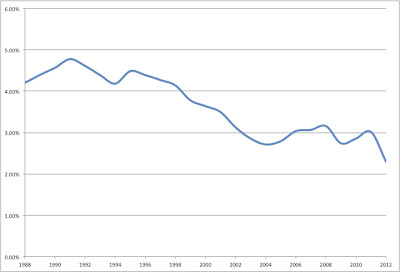
The Great Tax Cut Experiment
Government Interest Expense on Debt Outstanding Relative to GDP

Saturday, April 13, 2013
Big League Confusion
Maybe it's just me, but I'm not a big fan of cliche as public policy. The current fervor over a new basketball arena in Milwaukee is full of them. Dan Cody recently opined, "Milwaukee [is] not only deciding on new stadium for the Bucks, but whether we're a major American city anymore."
Yes, without a professional sport team, we're not "big league." Sigh.
Cody proclaims, "Everyone agrees that the Bucks will need a new stadium in order to stay in Milwaukee." Everyone? I'll agree that nearly every professional-sport team-owner blackmails their host city into funding the majority of the cost for a new stadium.
It's all about Milwaukee's image. Where would Milwaukee be without the Bucks? (Stop laughing.)
In explaining what a "huge deal" it is to have a pro team, Cody rattles off Green Bay, Jacksonville, Nashville and Oklahoma City as examples of the transformative power of hosting a pro team. Yes, we all know what world-renowned tourist destinations these locales are. Look out Paris and New York, here's Nashville!
This is the intangibles argument. There's just something that can't be explained, but it's magical and it's a big deal. It just can't be quantified. We're supposed to make a multi-million dollar investment based on the idea of being cool, big league, etc.
Maybe we should be talking about the monopoly control professional sports have over the numbers and locations of teams, and thus their ability to blackmail cities.
Milwaukee already has a basketball and a baseball team. Yet, Cody offers, "Milwaukee is already seen by much of the Country as a city on the decline and giving up our NBA team will only increase that perception." So why isn't Milwaukee already "big league"? If sports teams are such catalysts, why is Milwaukee "on the decline"? We recently built (2001) Miller Park, shouldn't this have eased the decline? Why didn't Miller Park make us "big league"?
And, if logic hasn't been stretched far enough in this ridiculous debate cities have over providing more corporate welfare to team owners, Cody goes on to say, "This City and the area need to give people a reason to want to move here." The Bucks are already here. Where are all the young professionals attracted by the Bucks? Was there a boom in young professionals and activity in the City when the Bradley Center was built in 1988? (There wasn't.) Most move for family, weather, or a job, not because of a basketball team.
And, as I've repeatedly said, if stadiums are such no-brainers, such economic catalysts, why does the public have to assume most of the risk (cost)? Sports represent one-tenth of one percent of the local economy; and some think that is an overstatement.
We can't raise taxes for good jobs, for schools, for parks, for public transportation, for health care, for retirement, etc. But, to be cool, to be "big league," that's a reason for a new tax?
I like sports. It's another entertainment option for a city. But that's hardly a reason to give away millions of dollars.
Yes, without a professional sport team, we're not "big league." Sigh.
Cody proclaims, "Everyone agrees that the Bucks will need a new stadium in order to stay in Milwaukee." Everyone? I'll agree that nearly every professional-sport team-owner blackmails their host city into funding the majority of the cost for a new stadium.
It's all about Milwaukee's image. Where would Milwaukee be without the Bucks? (Stop laughing.)
In explaining what a "huge deal" it is to have a pro team, Cody rattles off Green Bay, Jacksonville, Nashville and Oklahoma City as examples of the transformative power of hosting a pro team. Yes, we all know what world-renowned tourist destinations these locales are. Look out Paris and New York, here's Nashville!
This is the intangibles argument. There's just something that can't be explained, but it's magical and it's a big deal. It just can't be quantified. We're supposed to make a multi-million dollar investment based on the idea of being cool, big league, etc.
Maybe we should be talking about the monopoly control professional sports have over the numbers and locations of teams, and thus their ability to blackmail cities.
Milwaukee already has a basketball and a baseball team. Yet, Cody offers, "Milwaukee is already seen by much of the Country as a city on the decline and giving up our NBA team will only increase that perception." So why isn't Milwaukee already "big league"? If sports teams are such catalysts, why is Milwaukee "on the decline"? We recently built (2001) Miller Park, shouldn't this have eased the decline? Why didn't Miller Park make us "big league"?
And, if logic hasn't been stretched far enough in this ridiculous debate cities have over providing more corporate welfare to team owners, Cody goes on to say, "This City and the area need to give people a reason to want to move here." The Bucks are already here. Where are all the young professionals attracted by the Bucks? Was there a boom in young professionals and activity in the City when the Bradley Center was built in 1988? (There wasn't.) Most move for family, weather, or a job, not because of a basketball team.
And, as I've repeatedly said, if stadiums are such no-brainers, such economic catalysts, why does the public have to assume most of the risk (cost)? Sports represent one-tenth of one percent of the local economy; and some think that is an overstatement.
We can't raise taxes for good jobs, for schools, for parks, for public transportation, for health care, for retirement, etc. But, to be cool, to be "big league," that's a reason for a new tax?
I like sports. It's another entertainment option for a city. But that's hardly a reason to give away millions of dollars.
Friday, December 28, 2012
The Legalized Bribery That Is Sport Subsidization
A great article on the "system-gaming moocher class, an entitled, irresponsible, parasitic piglet subset, lazily suckling from the public teat, pulled up by shiny new bootstraps purchased with government giveaways, forever hiding in plain sight," otherwise known as sport subsidies.
As Patrick Hruby writes, "According to Harvard professor Judith Grant Long and economist Andrew Zimbalist, the average public contribution to the total capital and operating cost per sports stadium from 2000 to 2006 was between $249 and $280 million. A fantastic interactive map at Deadspin estimates that the total cost to the public of the 78 pro stadiums built or renovated between 1991 and 2004 was nearly $16 billion."
Go read the entire article - Cut Welfare To Sports - to find out more about the land giveaways, infrastructure freebies, tax breaks, and other government handouts the public provides to sport millionaires.
As Patrick Hruby writes, "According to Harvard professor Judith Grant Long and economist Andrew Zimbalist, the average public contribution to the total capital and operating cost per sports stadium from 2000 to 2006 was between $249 and $280 million. A fantastic interactive map at Deadspin estimates that the total cost to the public of the 78 pro stadiums built or renovated between 1991 and 2004 was nearly $16 billion."
How does all this (continue to) happen? Especially considering our supposedly pinched budgets and ever-burgeoning fiscal constraints, why do we continue to subsidize sport millionaires? Hruby explains, "Team owners ask for public handouts and threaten to move elsewhere unless they get them, pitting cities against in each other in corporate welfare bidding wars -- wars rooted in the various publicly granted antitrust exemptions that effectively allow sports leagues to control and maintain a limited supply of teams to be leveraged against widespread demand."
Sound familiar? These are the same tactics (build us a stadium or we're leaving town) which were applied to Miller Park for the Brewers and which are being used to strong-arm the public into supporting a new Bradley Center for the Bucks.
Sound familiar? These are the same tactics (build us a stadium or we're leaving town) which were applied to Miller Park for the Brewers and which are being used to strong-arm the public into supporting a new Bradley Center for the Bucks.
Go read the entire article - Cut Welfare To Sports - to find out more about the land giveaways, infrastructure freebies, tax breaks, and other government handouts the public provides to sport millionaires.
Thursday, December 6, 2012
It's A Scandal! It's A Outrage!
Following up on some earlier thoughts about Milwaukee's (well, really the MMAC's) fascination with Oklahoma City (OKC) and their new basketball stadium, partially funded by a 1 percent sales tax.
An additional 1% on the sales tax to pay for infrastructure and other civic investments is a worthy idea, used by OKC to finance some of their new projects. (Taxpayers have already voted in favor of such a tax to support our parks.) But, is a basketball arena the first priority of such spending? Considering transportation, water, sewer, education, health care, and a host of other more immediate needs, is a sport venue the crucial link to fostering explosive growth?
What we have here is a self-interested cabal throwing everything they can think of at taxpayers hoping something finally persuades them into thinking that subsidizing a sport arena is a great investment (again).
Sports are fun, stadiums are economic catalysts, Herb Kohl is a good guy, we need the Bucks to be a "big league" city, etc. Now they're surveying the country, identifying the most recently completed basketball stadiums, and if that city or region is experiencing growth, abracadabra - the stadium is a defining element of that growth, and yet another reason why Milwaukee should get on this bandwagon.
OKC is growing ... and they just built a basketball stadium ... ergo, Milwaukee needs to get with the program if they want to experience growth. Nevermind our lack of an advanced rail system (when compared with other cities), shrinking bus routes, continual cuts to our parks, crumbling bridges and roads, declining schools, to name a few. For the majority of residents (businesses and individuals), these needs far outweigh a sport stadium.
For Further Reading:
Are Basketball Arenas Catalysts Of Economic Development?
As Stadiums Vanish, Their Debt Lives On
Basket Case
Buck The System
Buck You
City Lays Off Workers While Giving Millions To Pro Hockey Team
Economic Engine Or Albatross?
Economic Of Sports Facilities & Their Communities
5 Cities Financing Pro Stadium Boondoggles
Growth Effects Of Sports Franchises, Stadia, And Arenas
Is There Anything A Stadium Can't Solve?
NBA Arenas Lousy For Local Economies
Overblown Bradley Center Impacts
Professional Sports As Catalysts For Metropolitan Economic Development
Selig Defends Taxpayer Subsidies For Stadiums
Should Cities Pay For Sports Facilities
Stadiums Don't Bolster Local Economies
Stadium Swindle
Will Herb Kohl Blackmail Milwaukee?
An additional 1% on the sales tax to pay for infrastructure and other civic investments is a worthy idea, used by OKC to finance some of their new projects. (Taxpayers have already voted in favor of such a tax to support our parks.) But, is a basketball arena the first priority of such spending? Considering transportation, water, sewer, education, health care, and a host of other more immediate needs, is a sport venue the crucial link to fostering explosive growth?
What we have here is a self-interested cabal throwing everything they can think of at taxpayers hoping something finally persuades them into thinking that subsidizing a sport arena is a great investment (again).
Sports are fun, stadiums are economic catalysts, Herb Kohl is a good guy, we need the Bucks to be a "big league" city, etc. Now they're surveying the country, identifying the most recently completed basketball stadiums, and if that city or region is experiencing growth, abracadabra - the stadium is a defining element of that growth, and yet another reason why Milwaukee should get on this bandwagon.
OKC is growing ... and they just built a basketball stadium ... ergo, Milwaukee needs to get with the program if they want to experience growth. Nevermind our lack of an advanced rail system (when compared with other cities), shrinking bus routes, continual cuts to our parks, crumbling bridges and roads, declining schools, to name a few. For the majority of residents (businesses and individuals), these needs far outweigh a sport stadium.
For Further Reading:
Are Basketball Arenas Catalysts Of Economic Development?
As Stadiums Vanish, Their Debt Lives On
Basket Case
Buck The System
Buck You
City Lays Off Workers While Giving Millions To Pro Hockey Team
Economic Engine Or Albatross?
Economic Of Sports Facilities & Their Communities
5 Cities Financing Pro Stadium Boondoggles
Growth Effects Of Sports Franchises, Stadia, And Arenas
Is There Anything A Stadium Can't Solve?
NBA Arenas Lousy For Local Economies
Overblown Bradley Center Impacts
Professional Sports As Catalysts For Metropolitan Economic Development
Selig Defends Taxpayer Subsidies For Stadiums
Should Cities Pay For Sports Facilities
Stadiums Don't Bolster Local Economies
Stadium Swindle
Will Herb Kohl Blackmail Milwaukee?
Saturday, November 17, 2012
More Bradley Center Bull
The Journal Sentinel has run yet another editorial pushing for a new basketball stadium. Yes, in the wake of a recession second only to the Great Depression, the thing we need most, right now, is a new sport stadium.
Even the Journal Sentinel's own Don Walker previously wondered how Bradley Center officials and boosters can have it both ways - the arena is uncompetitive and doesn't generate sufficient revenues, yet it is also is a huge economic driver for the region.
The editorial uses Miller Park as an example (to highlight the often repeated stadium subsidy threat), "Without a new Miller Park, the Brewers would not be in Milwaukee today. Now, with new ownership and a new stadium, the team brings in more than 3 million fans a year." The impressive sounding 3 million attendees (closer to 2.8 million, ranking 11th in MLB for 2012, down from 7th place in 2011) doesn't seem as impressive when you express it as 81 games with roughly 35,000 attendees per game (in a stadium that holds just under 42,000; a 17% vacancy rate).
And, so what? If the Brewers weren't in Milwaukee, we wouldn't have a baseball team. That's it. No baseball team - boo hoo! There isn't a single economic indicator the boosters can point to which shows Miller Park has had a positive economic effect on anything but the owners' and players' wallets.
Yet, without any evidence, without anything to back up the claim, the editorial gushes, "A new arena could spark economic development downtown, especially in the Park East corridor."
The editorial even eludes to the substitution effect (consumers spending at one place rather than another), "The Bucks need to have a plan in place to construct a new state-of-the-art facility by 2015 - a new arena that would be a year-round draw for downtown Milwaukee." The new stadium will end up being a draw from non-subsidized establishments, venues, and other entertainment options. Sure, more people may attend games for the first few years of the new stadium, but this will be due to the decreased patronage at other local establishments. It would be nice if the Journal would explain why we should be picking stadiums as winners over other restaurants, bars, and entertainment options.
The editorial went on to state, "[Herb] Kohl will not bear the entire cost of a new facility, and he shouldn't." A most perplexing line. The whole consideration of a new stadium is for the primary purpose of housing the Bucks basketball team - Herb Kohl's team! I would love for the Journal Sentinel to elaborate as to why the public needs to fund private enterprise. Just because the public is allowed to purchase tickets to an event at an establishment, that doesn't really make it a "public" facility (actually a state-owned building operated by a quasi-private board). [The discussion of whether or not to have a public arena - for concerts and collegiate sporting events is an entirely different discussion.]
Obviously unable to see the contradiction in their own thought, the Journal continues on, "Newer NBA facilities are self-sustaining and can make money even when the teams are not playing." If these are such sure-fire, game-changing, no-brainers, why does the public have to be involved at all? Yet another point where the logic of stadium subsidization falls apart.
They close with, "And so the clock is winding down on the Bucks. It's time for the city and business leaders to pull up and try a game-winning shot." Yes, when the evidence and data contradict your premise, simply use a hackneyed sports cliche to sell that sow's ear as if it were a silk purse.
Even the Journal Sentinel's own Don Walker previously wondered how Bradley Center officials and boosters can have it both ways - the arena is uncompetitive and doesn't generate sufficient revenues, yet it is also is a huge economic driver for the region.
The editorial uses Miller Park as an example (to highlight the often repeated stadium subsidy threat), "Without a new Miller Park, the Brewers would not be in Milwaukee today. Now, with new ownership and a new stadium, the team brings in more than 3 million fans a year." The impressive sounding 3 million attendees (closer to 2.8 million, ranking 11th in MLB for 2012, down from 7th place in 2011) doesn't seem as impressive when you express it as 81 games with roughly 35,000 attendees per game (in a stadium that holds just under 42,000; a 17% vacancy rate).
And, so what? If the Brewers weren't in Milwaukee, we wouldn't have a baseball team. That's it. No baseball team - boo hoo! There isn't a single economic indicator the boosters can point to which shows Miller Park has had a positive economic effect on anything but the owners' and players' wallets.
Yet, without any evidence, without anything to back up the claim, the editorial gushes, "A new arena could spark economic development downtown, especially in the Park East corridor."
The editorial even eludes to the substitution effect (consumers spending at one place rather than another), "The Bucks need to have a plan in place to construct a new state-of-the-art facility by 2015 - a new arena that would be a year-round draw for downtown Milwaukee." The new stadium will end up being a draw from non-subsidized establishments, venues, and other entertainment options. Sure, more people may attend games for the first few years of the new stadium, but this will be due to the decreased patronage at other local establishments. It would be nice if the Journal would explain why we should be picking stadiums as winners over other restaurants, bars, and entertainment options.
The editorial went on to state, "[Herb] Kohl will not bear the entire cost of a new facility, and he shouldn't." A most perplexing line. The whole consideration of a new stadium is for the primary purpose of housing the Bucks basketball team - Herb Kohl's team! I would love for the Journal Sentinel to elaborate as to why the public needs to fund private enterprise. Just because the public is allowed to purchase tickets to an event at an establishment, that doesn't really make it a "public" facility (actually a state-owned building operated by a quasi-private board). [The discussion of whether or not to have a public arena - for concerts and collegiate sporting events is an entirely different discussion.]
Obviously unable to see the contradiction in their own thought, the Journal continues on, "Newer NBA facilities are self-sustaining and can make money even when the teams are not playing." If these are such sure-fire, game-changing, no-brainers, why does the public have to be involved at all? Yet another point where the logic of stadium subsidization falls apart.
They close with, "And so the clock is winding down on the Bucks. It's time for the city and business leaders to pull up and try a game-winning shot." Yes, when the evidence and data contradict your premise, simply use a hackneyed sports cliche to sell that sow's ear as if it were a silk purse.
Saturday, November 3, 2012
Bradley Center Boosters Keep Pounding That Drum
Sheehy Plans Task Force To Study New Arena
Don Walker begins the article stating, "By mid-2014, the community needs to have a good idea of what role the private and public sectors will play in the construction of a new, multipurpose arena in Milwaukee."
We hear tales about the omnipotent private sector and free market...so efficient, so perfect.
Simultaneously, we're also told how the government is wasteful, full of slackers, and just can't do anything right.
Yet (for some reason) the inefficient, know-nothing government needs to play a major role in the planning and funding of private sector activities.
Enter sport stadiums. These privately controlled initiatives are (supposedly) such game changers, job creators, catalysts, no-brainers. [They're not.] But, again, for some unexplainable reason, the inept public sector needs to invest heavily and absorb most of the risk.
Living wages, universal health care, pensions, unemployment insurance, Medicare, Social Security - that's just a bunch of welfare for moochers. But corporate welfare - such as the public sector picking up most of the tab to build teams new stadiums - is just good policy?
The question should be - why is the public sector involved, at all, in the financing of these private sector playgrounds? If Herb Kohl and the Bucks want a new stadium, go ahead and build one. But the public shouldn't have to shoulder most of the cost.
Where does such a corporate welfare policy end? This misguided corporate welfare is why we now must pay blackmail money to Harley-Davidson and Mercury Marine when they threaten to take jobs away.
If the public is now responsible for the cost of building private businesses, shouldn't the public have a greater say in the operation - the pay scales, the retirement plans, the health care options, the environmental footprint, etc.? If the public sector is a necessary partner in construction, financing, and maintaining the viability of a business, shouldn't they have a representative voice in the organization making sure the public is getting back a fair return on their investment?
For Further Reading:
Basket Case
Buck The System
Buck You
Economic Engine Or Albatross?
Is There Anything A Stadium Can't Solve?
Overblown Bradley Center Impacts
Stadium Swindle
Will Herb Kohl Blackmail Milwaukee?
Don Walker begins the article stating, "By mid-2014, the community needs to have a good idea of what role the private and public sectors will play in the construction of a new, multipurpose arena in Milwaukee."
We hear tales about the omnipotent private sector and free market...so efficient, so perfect.
Simultaneously, we're also told how the government is wasteful, full of slackers, and just can't do anything right.
Yet (for some reason) the inefficient, know-nothing government needs to play a major role in the planning and funding of private sector activities.
Enter sport stadiums. These privately controlled initiatives are (supposedly) such game changers, job creators, catalysts, no-brainers. [They're not.] But, again, for some unexplainable reason, the inept public sector needs to invest heavily and absorb most of the risk.
Living wages, universal health care, pensions, unemployment insurance, Medicare, Social Security - that's just a bunch of welfare for moochers. But corporate welfare - such as the public sector picking up most of the tab to build teams new stadiums - is just good policy?
The question should be - why is the public sector involved, at all, in the financing of these private sector playgrounds? If Herb Kohl and the Bucks want a new stadium, go ahead and build one. But the public shouldn't have to shoulder most of the cost.
Where does such a corporate welfare policy end? This misguided corporate welfare is why we now must pay blackmail money to Harley-Davidson and Mercury Marine when they threaten to take jobs away.
If the public is now responsible for the cost of building private businesses, shouldn't the public have a greater say in the operation - the pay scales, the retirement plans, the health care options, the environmental footprint, etc.? If the public sector is a necessary partner in construction, financing, and maintaining the viability of a business, shouldn't they have a representative voice in the organization making sure the public is getting back a fair return on their investment?
For Further Reading:
Basket Case
Buck The System
Buck You
Economic Engine Or Albatross?
Is There Anything A Stadium Can't Solve?
Overblown Bradley Center Impacts
Stadium Swindle
Will Herb Kohl Blackmail Milwaukee?
Sunday, September 16, 2012
We're Broke?
State gives $5 million to BMO Harris Bradley Center for repairs.
Yes, we are so broke.
Unless the already well-to-do and well-connected want millions for their private playgrounds.
Yes, we are so broke.
Unless the already well-to-do and well-connected want millions for their private playgrounds.
Saturday, June 23, 2012
Is There Anything A Stadium Can't Solve?
We're broke. (Well, at least that's what Scott Walker keeps telling us.)
What better time to build a few hundred million dollar stadium?
Yes, we're no longer just considering upgrading the Bradley Center.
The power brokers and urban growth coalition of Milwaukee are scheming to build a completely new stadium on vacant Park East land.
No one would love to see development along this corridor more than me, but as I (and much more rigorous analysts before me) have written many times, stadiums are not economic catalysts.
We have no money for public workers, parks, trains, schools, green energy, or numerous other projects that would benefit the majority of citizens. But we have more than enough cash for tax cuts, bailouts, stadiums, and any other scams well-connected private-sector actors can imagine.
You may be out of work, but at least the Bucks will have a shiny new stadium to play in. Hooray!
For Further Reading:
Basket Case
Buck The System
Buck You
Economic Engine Or Albatross?
Overblown Bradley Center Impacts
Stadium Rip-off(s)
Stadium Swindle
The Time Is Now?
What better time to build a few hundred million dollar stadium?
Yes, we're no longer just considering upgrading the Bradley Center.
The power brokers and urban growth coalition of Milwaukee are scheming to build a completely new stadium on vacant Park East land.
No one would love to see development along this corridor more than me, but as I (and much more rigorous analysts before me) have written many times, stadiums are not economic catalysts.
We have no money for public workers, parks, trains, schools, green energy, or numerous other projects that would benefit the majority of citizens. But we have more than enough cash for tax cuts, bailouts, stadiums, and any other scams well-connected private-sector actors can imagine.
You may be out of work, but at least the Bucks will have a shiny new stadium to play in. Hooray!
For Further Reading:
Basket Case
Buck The System
Buck You
Economic Engine Or Albatross?
Overblown Bradley Center Impacts
Stadium Rip-off(s)
Stadium Swindle
The Time Is Now?
Subscribe to:
Posts (Atom)