Austerity!
Shrink government!
Make those teachers sacrifice!
Those labor unions have too much power!
Medicare, Social Security, pensions, unemployment insurance, public services, parks ... they're things of the past.
Our ultra efficient, ultra market, ultra conservative post-Reagan paradigm is allocating capital in a much different fashion.
Much more efficiently!
[Wink. Wink.]
No longer do we use government as a tool for mass investment and mass benefit. Instead, we funnel seemingly endless streams of money into private, for lack of a better word, schemes. Government has stepped aside based on the (empirically disproven) belief that less regulation and less taxation are some panacea.
This is a Republican political concoction which caused Thomas Frank, in 2004, to ask,
What's The Matter With Kansas? Why do people vote against their own economic interest? The question, perplexingly, still applies today.
Look around you. You can already count ten things that government does for you. Roads, street lights, sewers, stops signs, police, parks, water, the broadcasting airwaves, libraries, waste management, schools, recycling...
Whatever! They're overpaid hacks! I refuse to allow those positive societal outcomes to change my political opinions!
Yes, the level of discourse has sunk to new depths. And, as Thomas Mann and Norman Ornstein affirm,
The Republicans Are The Problem.
La, la, la, I can't hear you!

As the
Economic Policy Institute shows, "The passage in 1935 of the National Labor Relations Act, which protected and encouraged unions, sparked a wave of unionization that led to three decades of shared prosperity and what some call the Great Compression. The “countervailing power” of labor unions (not just at the bargaining table but in local, state, and national politics) gave them the ability to raise wages and working standards for members and non-members alike. Both median compensation and labor productivity roughly doubled into the early 1970s. Labor unions both sustained prosperity, and ensured that it was shared; union bargaining power has been shown to moderate the compensation of executives at unionized firms. However, over the next 30 years—an era highlighted by the filibuster of labor law reform in 1978, the Reagan administration’s crushing of the PATCO strike, and the passage of anti-worker trade deals with Mexico and China—labor’s bargaining power collapsed. The consequences are driven home by the figure below, which juxtaposes the historical trajectory of union density and the income share claimed by the richest 10 percent of Americans. Union membership has fallen and income inequality has worsened—reaching levels not seen since the 1920s."
Cate Long, of Reuters,
found, "Benjamin Landy writes eloquently in his Blog of the Century about the outstanding work being done by the Project on Government Oversight (POGO). POGO calculated the cost differential between work done by government workers versus private contractors, and the data is strinking. It may be time to rethink the conventional wisdom that says outsourcing equals cost savings. Here is the money quote and graph." That's right...the public sector actually does a lot of things more cheaply than the private sector. And, the jobs are family-supporting. WOW! What a concept!

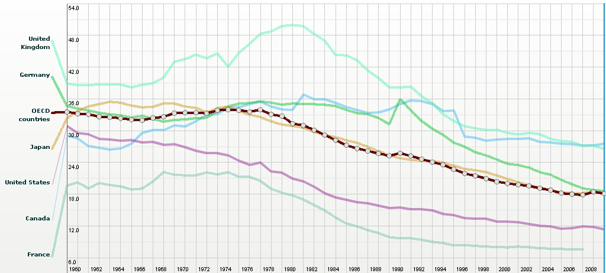
Ezra Klein writes, "I don’t think anyone disputes that it’s harder to unionize in the modern economy. This chart shows unionization rates in the United States, the United Kingdom, Germany, France, Japan and Canada since 1960. It also shows average unionization across the 34 countries in the Organization for Economic Cooperation and Development — that’s the highlighted red line with the gray dots* — most of which are much friendlier to labor unions than we are. The decline is sharpest in the United States, but evident in all the included countries, and in the aggregate of all OECD countries."
But, for Republicans, it's just a coincidence that when workers have a weaker voice they tend to see a weaker paycheck.
Move along, nothing to see here.
As E.J. Dionne
laments, "And the events of recent weeks suggest that if progressives do not speak out plainly on behalf of government, they will be disadvantaged throughout the election-year debate. Gov. Scott Walker’s victory in the Wisconsin recall election owed to many factors, including his overwhelming financial edge. But he was also helped by the continuing power of the conservative anti-government idea in our discourse."
Dionne adds, "One of the reasons I wrote my book “Our Divided Political Heart” was to show that, from Alexander Hamilton and Henry Clay forward, farsighted American leaders understood that action by the federal government was essential to ensuring the country’s prosperity, developing our economy, promoting the arts and sciences and building large projects: the roads and canals, and later, under Abraham Lincoln, the institutions of higher learning, that bound a growing nation together...permitting federal action to serve the common good. A belief in government’s constructive capacities is not some recent ultra-liberal invention."
But why stop going to the well if it hasn't run dry? Thus, Republicans continue their
Phony War On Public Employees. Yet, as John Perr finds, "Over 44% of federal employees have a college degree, compared to about 19% of private sector workers. More importantly, an assessment of salaries (excluding benefits) by the Office of Personnel Management found that on average comparable federal civilian workers are paid 22 percent less than private workers. The disparities, even including incentive pay, are even greater in some metropolitan areas.
"

Ben Polak and Peter Schott
explain, "There is something historically different about this recession and its aftermath: in the past, local government employment has been almost recession-proof. This time it’s not. Going back as long as the data have been collected (1955), with the one exception of the 1981 recession, local government employment continued to grow almost every month regardless of what the economy threw at it. But since the latest recession began, local government employment has fallen by 3 percent, and is still falling. In the equivalent period following the 1990 and 2001 recessions, local government employment grew 7.7 and 5.2 percent. Even following the 1981 recession, by this stage local government employment was up by 1.4 percent...Without this hidden austerity program, the economy would look very different. If state and local governments had followed the pattern of the previous two recessions, they would have added 1.4 million to 1.9 million jobs and overall unemployment would be 7.0 to 7.3 percent instead of 8.2 percent.
"

David Cooper, Mary Gable and Algernon Austin
detail how the austerity taking place amongst state and local government is disproportionately hurting minorities and women.
With some historical perspective, Bruce Western and Jake Rosenfeld
state, "As unions started to make concessions to big business in the lean days of the early 1980s, however, the Treaty of Detroit formula was abandoned. In an influential 2009 paper, "Institutions and Wages in Post-World War II America," the MIT economists Frank Levy and Peter Temin described the emergence in the 1980s of what they called "the Washington Consensus," an era of deregulation in which earnings inequality increased. As the decline of unions accelerated in those years, wage bargaining became more defensive. New union workers were given less favorable contracts, and lump-sum payments commonly replaced regular wage increases. As the fraction of all income captured by the top one percent of earners more than doubled, middle-class pay stagnated for the first time in decades; from 1973 to 2009, the median hourly wage increased by less than ten percent, even though nonfarm productivity ballooned by about 70 percent."
Zaid Jilani
recounts, "Strong unions have traditionally been the free-market solution to income inequality, allowing people to get higher salaries without government intervention. Unionization has allowed middle class and working-class Americans to have the ability to bargain for stronger wages and benefits and a larger share of national income. Highly-unionized countries tend to have far less income inequality.
"

One of the few economists, before the last bubble burst, to warn that the economy was a house of cards, Nouriel Roubini
commented on the detrimental outcomes from undervaluing labor, "Karl Marx had it right. At some point, capitalism can destroy itself. You cannot keep on shifting income from labor to capital without having an excess capacity and a lack of aggregate demand. That's what has happened. We thought that markets worked. They're not working. The individual can be rational. The firm, to survive and thrive, can push labor costs more and more down, but labor costs are someone else's income and consumption. That's why it's a self-destructive process."
Lee Sustar points to
research from David Rosenburg which found, "The 'labor share of national income has fallen to its lower level in modern history,' 57.5 percent in the first quarter of 2011, compared to 59.8 percent when the recovery began. While that might seem like a small change, given the $14.66 trillion size of the U.S. economy, it's huge.
"
In the real world, Labor's numbers are diminishing, government size and spending are shrinking, and, simultaneously, income inequality is increasing. If one were to actually delve into the data, he/she would find that reality doesn't support the idea of a growing, recklessly-spending government, full of do-nothing, overpaid public workers.
Paul Krugman observes, "We haven’t seen spending cuts like this since the demobilization that followed the Korean War."
Let's simply look at the promises of Republican doctrine contrasted with their actual results.
"Like Ronald Reagan, President Bush began his term in office with big tax cuts for the rich and promises that the benefits would trickle down to the middle class. Like Reagan, he also began his term with an economic slump, then claimed that the recovery from that slump proved the success of his policies. And like Reaganomics — but more quickly — Bushonomics has ended in grief. The public mood today is as grim as it was in 1992. Wages are lagging behind inflation. Employment growth in the Bush years has been pathetic compared with job creation in the Clinton era. Even if we don’t have a formal recession — and the odds now are that we will — the optimism of the 1990s has evaporated. This is, in short, a time when progressives ought to be driving home the idea that the right’s ideas don’t work, and never have,"
declares Krugman.
So, to recap, we're blaming the wrong people (government, public workers) for the wrong things (recession, bailouts, debt), while letting the true culprits (financial engineers and their political operatives - primarily Republicans) responsible for our recurring bubbles and economic calamities off the hook. Our conservative leaders also want us to double-down on the same policies that got us into this mess - tax cuts and deregulation. And, while we're at it, let's elect more jokers, like Scott Walker and Mitt Romney, to keep pushing the same hollow policies.
What's the matter with America?