Showing posts with label pensions. Show all posts

Saturday, March 17, 2018

Backdrop Boy Involved In Another Possible Backdrop

Milwaukee Police Union Accused Of Peddling Plan Like Infamous County Backdrop Scheme

Okay. Can we agree that it's time to rein in the Milwaukee Police Department?

Neither the County or the City needs another retirement scandal.

And, the "Backdrop Boy," Tony Zielinski, who voted for the County pension backdrop, has been involved in this latest scheme:
At the union's request, Ald. Tony Zielinski asked city attorneys in November if Milwaukee could increase the city's property tax levy to help defray the city's pension obligations. 
City Attorney Grant Langley said the only way to exceed the levy limits was through a vote of city residents in a referendum. But doing this, Langley wrote, could jeopardize how much money the state gives to Milwaukee each year.

Two days after the city issued its opinion, the Milwaukee police union endorsed Zielinski in his mayoral bid against Barrett in 2020.

But Zielinski said there was no connection between the endorsement and the letter, labeling the notion "preposterous." He said his support for Milwaukee cops is well known. 
Zielinski said the city attorney's letter was "off my radar" since November.
"Did I do anything with this?" he asked. "I didn't do anything with this." 
Reminded that he twice voted for the backdrop program as a county supervisor — a sore spot with the alderman — Zielinski said the staffer who created the Milwaukee County plan was convicted of misconduct in office. Also, he said, supervisors were misled by the county's pension actuary, which later paid the county $30 million to a settle a lawsuit.

Zielinski criticized the mayor and his people for trying to tar him by making an issue of the deferred retirement plan. He said Barrett should focus on his poor record on crime, not Zielinski's letter to the city attorney. 
"I do my due diligence," Zielinski said.
Two things we now know for sure: 1) the City of Milwaukee needs to restructure and rein in the salaries, pensions and costs of the Milwaukee Police Department and 2) Tony Zielinski is, by all appearances, sleazy and corrupt, and the last person Milwaukee should elect mayor and allow to guide the City budget.

Friday, November 24, 2017

Put Your Money Where Your Yard Sign Is

If you are one of those gung-ho, 'back the badge' crusaders; one who believes there is never enough police and the costs for those police are always justified, then you need to pay more in taxes. The police take up the majority of nearly every municipal budget, and their burden on budgets continually grows.

So how about if you have a 'back the badge' sign in your yard, or when you obtain your 'back the badge' sign, you're automatically signed up for an additional 10% tax on your yearly earnings to help pay for the exorbitant costs of the police? Otherwise, how about supporting a mayor when he tries to reign in the ever-increasing demands and costs from police departments?
They promise to serve and protect, and in return, Milwaukee police officers are rewarded with full pensions after 25 years on the job. For some, that means retirement as early as age 42. Milwaukee's mayor said the costs are cutting into public safety. 
"Unfortunately, it's going not to police officers on the street. It's going to pay for their pension," Milwaukee Mayor Tom Barrett said in October. 
So how expensive are these police pensions? WISN 12 News did the math. 
According to city records, a 42-year-old retiree gets an average $57,134 in pension yearly. By the time he's 65, he'll have collected $1.3 million. If he lives to 80, he'll collect an additional $857,000. That's more than a $2.1 million pension payout. 
But there's more than one. 
The average retirement age at Milwaukee Police Department is 53, but there are 834 officers between 42 and 52 currently collecting pensions. The cost to taxpayers for a single year is nearly $48 million. [source]

Saturday, February 1, 2014

Comparing State Pension Costs To Corporate Subsidies And Tax Breaks

Putting State Pension Costs In Context 
PUTTING PENSION COSTS IN CONTEXT: NEW REPORT SHOWS CORPORATE TAX SUBSIDIES AND LOOPHOLES OFTEN EXCEED STATE RETIREMENT COSTS 
Attacks on Pensions, Safety Net Programs, Distract from Corporate Giveaways that Exacerbate Economic Inequality 
Washington D.C., January 30, 2014 — State lawmakers who are considering drastic cuts to the retirement benefits of state workers are simultaneously giving away billions of dollars in corporate tax subsidies and loopholes, often in amounts far exceeding the cost of pensions, according to a new report. 
Putting State Pension Costs in Context by Good Jobs First examines 10 states where elected officials are threatening to undermine retirement security by cutting the pension benefits of their teachers, firefighters, police officers, and hundreds of thousands of other public employees. The states included in the report are: Arizona; California; Colorado; Florida; Illinois; Louisiana; Michigan; Missouri; Oklahoma; and Pennsylvania. 
The findings show that in each state, the revenue lost to corporations through loopholes and tax breaks outpaces the current cost of pension benefits to state employees. 
“In states across the country, politicians are attempting to solve the budget woes caused by Wall Street and the Great Recession by cutting the pension benefits of public employees,” said Philip Mattera, Research Director of Good Jobs First. “It is often stated that budgets are a matter of priorities. And our research shows that corporate interests are generally prioritized over teachers, firefighters, police officers, and thousands of other employees who dedicate their lives to public service.” 
The average retirement for a member of the Louisiana State Retirement fund is $19,000 a year. Yet, Louisiana gives away about $1.8 billion a year to corporations through corporate subsidies and tax loopholes—totaling about five times the annual pension cost for state workers. 
Pennsylvania loses nearly $4 billion annually as a result of corporate subsidies and loopholes—more than two and half times the cost of public pensions. Pennsylvania’s state pensions average a modest $24,000 a year. In Michigan, corporations also enjoy about $1.8 billion in subsidies and tax breaks – more than three times the cost of meeting the state’s commitment to retirees. The list goes on. 
These ten states were chosen for analysis because their legislatures are underfunding pensions or elected officials are threatening to cut pension benefits. Actuarial analysis provided the normal cost of funding pensions on a yearly basis, which excludes the costs of making up for past underfunding. Data was derived by examining the latest state tax expenditure reports, state budget documents, and reports by state tax and budget watchdog groups. 
“As a matter of honest accounting and fair budgeting, state leaders should examine all forms of spending before they single out pensions or any other expense,” said Mattera. “Corporate tax breaks and loopholes are often poorly understood and little-noticed because they do not get debated as appropriations, nor do they often get sunsetted or audited. But over time they add up to hundreds of millions, or even billions, of dollars per year.”

Saturday, August 24, 2013

The Most Precious Of All

Tom Barrett is walking a precarious line by talking about expanding Act 10. Barrett believes that by reining in the police and firefighters unions he could eventually aid both departments and make the city safer at the same time. A noble, yet circuitous and confrontational proposition.

The police and firefighters are holding to the rationalization that they are The Public Safety and thus completely different from and above other public employees.

James Palmer, the executive director of the Wisconsin Professional Police Association, bellows, "The mayor should understand that his public appeal for an expansion of Act 10 to police officers and firefighters ignores the reality that public safety employees are already paying toward their health insurance and their pensions in largely the same manner as general municipal employees. Since the 2011-2013 state budget was enacted, public safety employees can no longer negotiate over their health insurance benefits and costs. In addition, the vast majority of public safety contracts require police and fire employees to pay their share for pensions."

Other public employees also pay toward their health insurance and retirement, and they also can't negotiate their health insurance benefits or costs. And, these other public employees haven't seen the 3 and 4 percent raises the police and firefighters have seen over the last six or seven years.

Palmer goes on to decry, "Any assertion that expanding Act 10 will free up funding that could be used to hire more employees is without any reasonable basis."

If Act 10 can't free up funding, why was it a good idea when it was used to bludgeon the other public employees? Wasn't the initial point of Act 10 about saving money and saving budgets? Is Mr. Palmer admitting the Act 10 emperor has no clothes? Or is he just willing to throw other union members under the bus as long as police and fire members are exempted?

The police and fire protection departments are responsible for roughly 50 - 75 percent of most city budgets. These two departments are where most taxpayer dollars go. If there is anywhere to find efficiencies, these would seem to be the departments. In Milwaukee, police and fire account for nearly 59 percent of the budget. And, as we can also see, their budgets have increased almost 16 percent over the last decade.

Share of budget for general city services:

                                            2003            2013
Fire Dept.                            16.1%          17.9%
Police Dept.                         34.6%         40.6%
Protective Services total      50.7%         58.8%

Palmer persists, "It's important to recognize that public safety employees are unique, both in the challenges that they face and in the critical role that they play in our communities." Sure, but teachers, mental health care workers, social workers, engineers constructing our bridges, scientists providing our clean water supply, and a host of other public workers play a pretty critical role, too.

As James Rowen details, "The City of Milwaukee currently employs 6,865 employees. 4,168 are general city employees (including fire and police civilian staff). 2,697 are sworn fire and police employees...their average annual salaries. $41,361 for general city employees. $65,649 for sworn police employees. $67,554 for sworn fire employees." The average police officer or fight fighter makes over one and a half times as much as a general city employee.

Palmer's revisionist history continues, "He [Barrett] now appears to have abandoned the very principles that once drew WPPA's support, thus causing us to question whether that support was misplaced."

"...That once drew the WPPA's support"? Yeah, as I remember, the WPPA supported Scott Walker. Which is why they were preferentially carved out of Act 10. It seems the police and firefighter unions support whomever gives them preferential treatment. 59 percent of the entire Milwaukee budget already goes to these two departments, how much more do they want?

Maybe Barrett is on to something here. Maybe the police and firefighters should learn to live with the same rules as their other union brothers and sisters.

Saturday, August 3, 2013

Scott Walker Is FDR: F'ing Dumbass Redneck

It was all I could do to keep from falling out of my chair when I read Scott Walker's latest bullshit self-congratulatory rhetoric, Wisconsin A Model For Country, Scott Walker Says. [This despite the fact that the budget Governor Walker just signed also created a structural deficit of $505 million in the next biennium.]
"The position I pushed is not unlike the principle that Franklin Delano Roosevelt — not exactly a conservative — pushed as well when it came to public sector collective bargaining," Walker remarked at the annual Governmental Research Association policy conference.
FDR's opposition to collective bargaining, per se, was more against public workers striking or using quasi- militant tactics as a means to an end. He supported the public workers' voice in attempts at fair treatment. Roosevelt said, "It is one of the characteristics of a free and democratic nation that it have free and independent labor unions."

As the Library of Congress details:
Although the future of labor unions looked grim in 1933, their fortunes would soon change. The tremendous gains labor unions experienced in the 1930s resulted, in part, from the pro-union stance of the Roosevelt administration and from legislation enacted by Congress during the early New Deal. The National Industrial Recovery Act (1933) provided for collective bargaining. The 1935 National Labor Relations Act (also known as the Wagner Act) required businesses to bargain in good faith with any union supported by the majority of their employees.
Public works and unions became kind of a big thing specifically during FDR's time in office. For Walker to claim a parallel between himself and Roosevelt for doing the exact opposite during his reign as Wisconsin governor is batshit crazy.

[Above: FDR visiting the Allis-Chalmers factory near Milwaukee, Wisconsin during an inspection trip. Milwaukee, Wisconsin, September 19, 1942.]
Walker goes on to claim one of his major policy innovations was pension reform. Yet, Walker himself, in the Journal article, even states, "Our pension system is the only one in the country that's fully funded." As a Pew report, A Widening Gap In Cities, documents:
At the end of fiscal year 2009, the largest city in Wisconsin had the best-funded system among 61 American cities, with 113 percent of the money.
The report also found the State of Wisconsin, at the end of fiscal year 2009, had 100 percent of needed funding.

More great Scott Walker logic - reform the program (our pension system) that is performing better than any similar program in the country. So, if you're doing something better than anyone else, that's the thing you want to change, and for this, you should be heralded as a model for the country?

Saturday, July 27, 2013

Correcting The Right-Wing Myths About Detroit

Don’t buy the right-wing myth about Detroit
In the wake of Detroit’s bankruptcy, you may be wondering: How could anyone be surprised that a city so tied to manufacturing faces crippling problems in an era that has seen such an intense public policy assault on domestic American manufacturing? You may also be wondering: How could Michigan officials possibly talk about cutting the average $19,000-a-year pension benefit for municipal workers while reaffirming their pledge of $283 million in taxpayer money to a professional hockey stadium? ...
It’s a straightforward conservative formula: the right blames state and municipal budget problems exclusively on public employees’ retirement benefits, often underfunding those public pensions for years. The money raided from those pension funds is then used to enact expensive tax cuts and corporate welfare programs. After years of robbing those pension funds to pay for such giveaways, a crisis inevitably hits, and workers’ pension benefits are blamed — and then slashed. Meanwhile, the massive tax cuts and corporate subsidies are preserved, because we are led to believe they had nothing to do with the crisis. Ultimately, the extra monies taken from retirees are then often plowed into even more tax cuts and more corporate subsidies.
Just How Generous Are Detroit's Worker Pensions for Retirees?
"My basic takeaway was that [Detroit's] pension system itself was not overly generous," said Jean-Pierre Aubry, assistant director of State and Local Research at Boston College's Center for Retirement Research... 
Retired general city workers, such as librarians or sanitation workers, received average payments of $18,275 a year in 2011, according to the Detroit General Retirement System... 
While retired Detroit firefighters and police officers receive more generous pension checks than auto workers -- checks averaged almost $30,000 a year in 2011 -- they often don't receive the added bonus of Social Security payments.
We Need A Federal Bailout for Detroit's Pensions
Does $1,500 a month after hauling garbage cans your whole adult life really sound like a fortune? ...
Retired Detroit employees didn't cause the financial crisis of 2008, which hit the pension plan's investment fund hard. Yet they're being handled as if they were morally equivalent to the Wall Street creditors who did. As the New York Times reports, the unelected city manager's plan would "treat bondholders the same as retirees" and ask them both to sacrifice... 
The average Detroit city pension is slightly less than $19,000 per year. For police and firefighters, pensions are their only source of retirement income. (They don't have Social Security.)
Five myths about Detroit
The real culprit in the city’s decline has been federal policies that put corporate health ahead of community health, such as free-trade agreements that sacrifice U.S. jobs for foreign trade...
Detroit’s major financial problem is that its shrinking tax base has meant years of declining revenue. Remember, the city has lost more than 1 million residents since its population peaked in the 1950s. Those who blame pensions confuse cause and effect — like blaming a personal bankruptcy on a pesky car loan after one’s salary was cut in half. The difference, of course, is that getting rid of a car you can no longer afford isn’t the same as reneging on a promise to 21,000 retirees.

Saturday, January 26, 2013

Union Membership & Middle Class Decline

Under the privatized HMO system, health care costs were rising. The privatized retirement system, the 401K, has made retirement more volatile. Wages, for the majority of workers, have been stagnating for decades.

Union membership has steadily been on the decline alongside all of these factors.

Coincidence?


Thursday, December 6, 2012

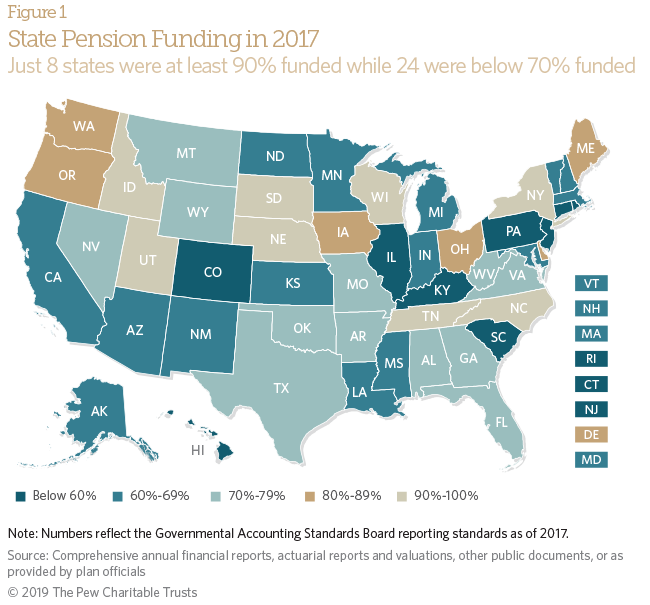
Best State Pension System: Wisconsin

21 States' Pension Systems Not Fiscally Sound

Pundits, talking-heads, politicos, and other supposed experts warning about an impending Wisconsin pension crisis are merely using false information and scare tactics in an attempt to eviscerate the pension system. Plain and simple. This is another one of those "entitlements" (anything having to do with a fair society, the social contract, or shared prosperity - all of which, Republicans hate) the anti-government zealots complain about with the hope that some of the smears stick.

This situation is very similar to the debt ceiling theater (here, here, and here). Money has already been earmarked for a certain purpose - budgetary items/programs or employee compensation. Creating some phantom ceiling doesn't mean the liability goes away. Because varies entities may have taken pension money and spent it on other purposes, this does not absolve their responsibility to pay previously contracted pension obligations.

As David Cay Johnston explains, "The fact is that all of the money going into these plans belongs to the workers because it is part of the compensation of the state workers. The fact is that the state workers negotiate their total compensation, which they then divvy up between cash wages, paid vacations, health insurance and, yes, pensions. Since the Wisconsin government workers collectively bargained for their compensation, all of the compensation they have bargained for is part of their pay and thus only the workers contribute to the pension plan. This is an indisputable fact."

Some of these pundits and politicos don't want you to have a stable retirement. Well, that's implicating them too much. They really just want that money - in the form of tax cuts, subsidies, and giveaways - for themselves. As far as your retirement is concerned, they really don't care.

Pensions (public & private) are in trouble because slippery mayors, duplicitous governors, gluttonous politicians, and greedy business owners have diverted funds (compensation) away from pension accounts and into other uses - plugging budget holes, subsidizing business parks and sporting arenas, constructing more and more roadways, and even for new vacation homes.

You're going to see more articles and more pundits bloviating about this "we must transform the pension system to save it" talking-point in the near future, feel free to laugh at them, but make sure you're not swept up into their misguided rhetoric.

For Further Reading:
Deferred Wages
More Bad Pension Reporting
Pension Petulance
Politicking With Pensions
Recoiling Retirement
Retirement Revisionists
Scott Walker Is Coming For Your Pension

Sunday, July 29, 2012

Work Until You're Dead

Christian Schneider, of the Journal Sentinel and WPRI, advises, Take It Slow On Pension Changes. This isn't the first time the Journal has allowed right-wing hacks to vilify and lead the way toward making our retirements more volatile.

But this begs the question, why make changes at all?

Wisconsin has the best - most solvent - pension system in the country.

Rather than taking it slow, better yet, leave it alone.

For Further Reading:
Deferred Wages
More Bad Pension Reporting
Pension & Retirement Reading
Pension Petulance
Politicking With Pensions
Recoiling Retirement
Retirement Revisionists

Sunday, July 8, 2012

More Bad Pension Reporting

The Journal Sentinel's PolitiFact Wisconsin deemed Marty Beil's (executive director AFSCME) description of the state pension plan being self-funded as "mostly false".

Then, after numerous contortions and rhetorical gymnastics, the articles itself states, "Pensions are an integral part of an employee’s compensation package. In effect, it is money set aside now to be available when the worker retires. "It’s not like they’re giving it to us," said Susan McMurray (AFSCME lobbyist Council 11), who spoke for Beil. This point of view was advocated during the original collective bargaining debate by financial journalist David Cay Johnston. "The money the state ‘contributes’ is actually part of the compensation that has been negotiated with state workers in advance so it is their money that they choose to take as pension payments in the future rather than cash wages or other benefits today," Johnston wrote in a 2011 article for Tax.com."

At the end of the day, contributions by the state - the employer of state public workers - are part of the workers' overall compensation. These are terms negotiated in the workers' contracts. Rather than demanding a higher wage, the workers forego hourly pay in exchange for a pension contribution. It's actually the workers' deferred wages being used to fund the pension plan. Pretty straight forward concept.

The employer - the state - places a certain percentage of earnings into a retirement account. They can either do this or pay the worker the equivalent more per hour. Is this too complicated for PolitiFact to understand?

I guess this is just another attempt at sensationalistic journalism with the well-worn theme of union bashing.

How PolitiFact can conclude that the pension plan being self-funded is mostly false is totally bullshit.