The dutiful parrots of the media continue to push the "labor shortage" myth. Unemployment is near an all-time low. Yet, we still hear the cries of "labor shortage" and "skills shortage" in the media.
CNBC recently wrote The U.S. Labor Shortage Is Reaching A Critical Point. Employers are supposedly having trouble finding qualified employees to fill 6.7 million job openings.
Lacking self-awareness, the article stated, "Employers are going to have to start doing more to entice workers, likely through pay raises, training and other incentives."
Just as basic economics would predict.
As Dean Baker wrote, "We aren't seeing large-scale increases in pay despite near-record profit shares. This suggest that either employers are really not short of workers or that they are too incompetent to understand the basics of the market."
Baker continued, "The implication of the CNBC piece that claims that hiring is down because businesses can't find qualified workers. If this really is the problem, then the solution, as everyone learns in intro economics, is to raise wages. For some reason CEOs apparently can't seem to figure this one out, since wage growth remains very modest in spite of this alleged shortage of qualified workers."
For Further Reading:
The Washington Post Really Really Hates Markets When It Means Higher Pay For Ordinary Workers
Americans Need To Stop Obsessing Over The Unemployment Rate
Showing posts with label skills mismatch. Show all posts
Showing posts with label skills mismatch. Show all posts
Sunday, July 8, 2018


Saturday, September 10, 2016
Pay More
Dr. Ed Yardeni, President and Chief Investment Strategist of Yardeni Research, Inc., provided a summation of the latest U.S. employment findings:
One caveat from Yardeni's findings:
Owners can't have it both ways - claiming they have all these positions to fill, yet they can't find anyone, while also being unwilling to increase wages to attract workers. If they are such astute businessmen, they should understand basic economics.
As Barry Ritholtz wrote, Having Trouble Hiring? Try Paying More.
None of this means there is never some frictional or structural unemployment, where skilled workers for a certain industry are in short supply. But, again, this is solved by increasing wages.


For Further Reading:
Shortage of Skills or Abundance of Excuses?
Skills Shortage Sham
Training, Skills, & Other Fairy Tales
The Zombie Skills Gap Meme That Won't Die
Low Wages, Not Skills Mismatch
Wage 'growth' continues to go nowhere
Wage Growth Is Weak. Inflation-Adjusted Wage Growth Is Much Healthier
Plenty of jobs available. In August’s consumer confidence survey, the Conference Board found that the percentage of respondents who said that jobs are plentiful rose to 26.0%, the highest since August 2007. The percentage saying that jobs are hard to get was 23.4%, near recent cyclical lows, and consistent with the cyclical low in the unemployment rate.
Record job openings. It’s actually somewhat surprising that nearly a quarter of respondents still say that jobs are hard to get given that job openings are at a record high. Perhaps many workers simply lack the skills required by the available jobs.
Unfilled positions hard to fill. NFIB’s August survey also reported the following litany of complaints by small business owners about the labor market: “Fifty-three percent reported hiring or trying to hire (down 3 points), but 46 percent reported few or no qualified applicants for the positions they were trying to fill. Fourteen percent of owners cited the difficulty of finding qualified workers as their Single Most Important Business Problem. This issue ranks third out of nine major issues listed. Twenty-six percent of all owners reported job openings they could not fill in the current period, down 3 points from, the highest reading in this recovery.”Business owners, especially in our hyper-politicized environment, have been claiming there aren't any skilled workers to be found.
One caveat from Yardeni's findings:
Why aren’t wages rising more rapidly? There are a few explanations for the slow pace of wage gains. One possibility is that high-wage Baby Boomers are retiring and more jobs are going to low-wage Millennials. Workers may be afraid to push for big raises, fearing that that would provide an even greater incentive to employers to replace them with automation, robotics, and artificial intelligence. Since the Trauma of 2008, corporate managements have been obsessed with keeping a lid on their costs and maintaining high profit margins.Although Yardeni mentions the lack of wage growth, he really doesn't give that factor its proper due. Which is sad because its the crucial point in this discussion. If demand is high and supply is low, wages should rise. That's basic economics.
Owners can't have it both ways - claiming they have all these positions to fill, yet they can't find anyone, while also being unwilling to increase wages to attract workers. If they are such astute businessmen, they should understand basic economics.
As Barry Ritholtz wrote, Having Trouble Hiring? Try Paying More.
None of this means there is never some frictional or structural unemployment, where skilled workers for a certain industry are in short supply. But, again, this is solved by increasing wages.


Shortage of Skills or Abundance of Excuses?
Skills Shortage Sham
Training, Skills, & Other Fairy Tales
The Zombie Skills Gap Meme That Won't Die
Low Wages, Not Skills Mismatch
Wage 'growth' continues to go nowhere
Wage Growth Is Weak. Inflation-Adjusted Wage Growth Is Much Healthier
Saturday, June 4, 2016
Shortage of Skills or Abundance of Excuses?
As most Wisconsinites know, Scott Walker has overseen anemic economic performance for Wisconsin. Job growth has continually lagged the national average.

Of course, none of this, according to Scott Walker, is Scott Walker's fault. (Regardless that he was elected based on his claims that he could grow 250,000 jobs for the state.) It's the dreaded skilled worker shortage. The jobs are here just waiting for the right workers.
The laughable link between the two - jobs and the right skills for those jobs - is job training. Another overblown talking-point of economic development hucksters.
As Marc Levine informed,
As Gordon Lafer, one of the country's foremost researchers on job training, puts it: "Whatever the problem, it seems job training is the answer. The only trouble is, it doesn't work, and the government knows it. . . . Indeed, in studying more than 40 years of job training policy, I have not seen one program that, on average, enabled its participants to earn their way out of poverty."This, directly debunking the recent drivel being peddled in a Journal Sentinel opinion piece.
Levine continued,
Work force development policy is based on the fallacious premise that Milwaukee's core employment problem is a shortage of skilled workers (a "jobs-skills mismatch"). ...
The jobs are already here? Hardly. Indeed, taking metro Milwaukee as a whole, there is a gap of 88,000 between the number of jobless (working-age residents unemployed or out of the labor force) and the number of job vacancies reported by employers. It is a job shortage, much more than a skills shortage, that plagues the region. ...
No matter who controls job training programs in Milwaukee, they are doomed to failure unless this economy produces enough family-supporting jobs.This isn't to say we shouldn't be offering some job training efforts. This also doesn't mean that at some time during the business cycle, the economy won't experience some structural unemployment. But these supposed panaceas of skills-improvement and job-training have proven largely uneventful over the last few decades.
The continued call for increased skills also ignores the fact that the Bureau of Labor Statistics estimates the majority of new jobs over the next few decades will require only a high school education or minimal on-the-job training. Secondly, its also implies that we, as a nation are becoming less educated; this, also, is false.
This skill-shortage talking-point merely allows most of the decision-makers to take the hands-off approach of blaming the victim. "We've got some tools out there. If individuals don't take advantage, that's their problem."
More effective policies include increasing the earned income tax credit, unionization, increasing the minimum wage and increasing job programs (directly employing individuals).
As long as we keep pretending the market has all the answers and our workforce is so woefully inadequate that we can't do or learn the majority of vacant positions, charlatans and other hucksters will continue to sell job training, skills shortage and other bumper sticker policies that do little to address the issues they claim to be so concerned about.
Saturday, November 15, 2014
More Skills Gap Crap
The Milwaukee Business Journal entered the "skills gap" discussion with 5 things employers and job seekers need to do to bridge skills gap.
Why the media continues to push this manufactured drivel is beyond me. There is no skills gap.
The money-quote that captures the ridiculousness of this:
Sure, most employers want smart, responsible and talented employees. But the main reason they aren't filling these jobs is because of the pay. You can't employ a great, game-changing employee for a minimum wage.
All jobs require some on-the-job training. The idea that an employee walks into the door knowing everything is pure fantasy.
This isn't a worker or a training problem, it's a pay problem.


Why the media continues to push this manufactured drivel is beyond me. There is no skills gap.
The money-quote that captures the ridiculousness of this:
The reason companies are taking longer to hire is that they are getting more specific about the talent that they are looking for and a "great employee is game changing," and potential hires need to focus on "bringing greatness into the workplace," said Jamie Fall, vice president for workforce and talent sustainability for a Washington, D.C.-based nonprofit called the HR Policy Foundation.So, Milwaukee can't find welders (the oft repeated example) because not enough "game-changing" and "great" employees are out there? Whatever that ever means.
Sure, most employers want smart, responsible and talented employees. But the main reason they aren't filling these jobs is because of the pay. You can't employ a great, game-changing employee for a minimum wage.
All jobs require some on-the-job training. The idea that an employee walks into the door knowing everything is pure fantasy.
This isn't a worker or a training problem, it's a pay problem.
[source]
[source]
[source]
[source]
This anemic-pay epidemic also explains our current record-level income inequality. When people only have enough to get by, they don't consume enough to consistently grow the economy. Our media has been a compliant messenger in the skills gap mythology and, thus, enablers of increasing income inequality.
The story goes:
The Haves want nothing more than to employ the Have Nots. Its just the Have Nots aren't pulling their weight. They just can't quite get it done.
Maybe if the public sector paid more for training, maybe if the public sector did more to educate potential workers, maybe if the public sector gave subsidies to private companies...
Got that? You're stupid and unskilled...and its the government's job to fix things, or at least shovel money at it.
All hail the free market!
Saturday, October 18, 2014
Weekend Reading
Paul Ryan Declares War Against Math
The Remarkable Impact Of The Deep Tunnel
Corporate Deadbeats: How Companies Get Rich Off Taxes
Return Of The Bums On Welfare
Skill Gaps, Skill Shortages, And Skill Mismatches: Evidence For The U.S.
Rep. Paul Ryan's Whopper About Competitive Districts
Why Public Investment Really Is A Free Lunch
Unlike Walmart, Costco Has No Plans To Cut Employee Health Benefits
The Koch Brothers' War On Transit
Wisconsin Supreme Court Vs John Doe
The Remarkable Impact Of The Deep Tunnel
Corporate Deadbeats: How Companies Get Rich Off Taxes
Return Of The Bums On Welfare
Skill Gaps, Skill Shortages, And Skill Mismatches: Evidence For The U.S.
Rep. Paul Ryan's Whopper About Competitive Districts
Why Public Investment Really Is A Free Lunch
Unlike Walmart, Costco Has No Plans To Cut Employee Health Benefits
The Koch Brothers' War On Transit
Wisconsin Supreme Court Vs John Doe
Jobs! Jobs! Jobs! Get Your Jobs Here!
'Hiring event' looks to fill 1,000 job openings at 75 companies.
Which would fill 1.4% of Walker's dubious claim of 70,000 job openings in Wisconsin.
Hopefully the participating companies are ready to pay a living-wage to attract workers to the open positions.
As I wrote in (April 2013), Welders Wanted. We Don't Need No Stinking Welders!:
Welding Job Fair Fails To Spark Interest
There is such a skills mismatch. Some Wisconsin companies just can't find welders. MATC was nice enough to organize a job fair to facilitate those looking for work connecting with the companies that supposedly need them. Too bad the companies, crying about Wisconsin not having skilled workers to fill positions, also seem to not have the time to show up.If companies are unwilling to pay an honest-day's-pay, they can't realistically expect someone to do an honest-day's-work.
Sunday, October 12, 2014
Fact-checking The First Debate
The Journal Sentinel summarized the first debate between Mary Burke and Scott Walker in, Mary Burke pounces on Scott Walker's comments on state's 'work problem'.
"We don't have a jobs problem in this state. We have a work problem," Walker said during a discussion about raising the minimum wage.
As I previously wrote in Myth Busting: Job Training, "Most of the new jobs being created require an associate's degree or less. 85 percent of the population in the U.S. have at least a high school degree. Over 27 percent have a bachelor's. The percentage of high school and college graduates has increased since 2000. We have neither an unskilled nor an uneducated workforce. Education as a corrective to the employment problem seems minimally significant." The idea that there are not enough Wisconsin citizens with the needed-skills is ludicrous.
As Catherine Rampell, of The New York Times, reported, "What’s especially odd about these survey responses is that if employers are having trouble finding qualified workers, they should be bidding up wages to attract the few qualified workers who are out there. But that’s not what the data show."
There is no training or skills crisis. We have a class warfare and living-wage crisis.
The Journal falls down, again, and fails to correct these falsities. Instead of practicing journalism and helping the reader to see the truth between competing narratives, they just spread the taking-points for Republicans.
They then go on to insinuate that Mary Burke is a meanie, "For their part, Republicans noted after the debate that Burke appeared ungracious when the candidates were asked to name something that they admired in the other." [This "meanie" issue is actually about a quarter of the entire article.]
I don't admire anything about Scott Walker either. He's a self-absorbed, closed-minded, partisan, hack. No matter where he has gone, controversy and deficits have followed. Does this make me ungracious? Oh well. The simple fact that one is in a debate doesn't also mean that person has earned respect. And, in dissecting the career of Scott Walker, it is awfully difficult to find something to hang your hat on. In preparing for the debate, was Mary Burke supposed to focus on what would make Scott Walker look his best?
Hopefully Wisconsin can move toward a debate of ideas and facts rather than boogeymen and mythology.
For Further Reading:
The Skills Crisis & Job Training
Skills Shortage Sham
For Scott Walker, Jobs Service Is Not Job Number One
Melissa Harris-Perry Takes Scott Walker To Task For Dishonest Ad On Reproductive Rights
"We don't have a jobs problem in this state. We have a work problem," Walker said during a discussion about raising the minimum wage.
During an interview with the Milwaukee Journal Sentinel, Walker explained that he is seeking to boost workers in two areas. First, he pointed to employers who need trained workers for higher-skilled jobs like welding.
"We have jobs, we don't just have enough people with the skill sets to fill those jobs," he said.
Walker also said he wants to help others acquire the basic skills needed to hold down any job. Walker has proposed requiring drug tests for working-age recipients of public benefits.This is yet another of the many Republican talking-points that continue to live on even though there isn't a shred of evidence supporting it. In writing about the job training myth, Marc Levine detailed, "As Gordon Lafer, one of the country's foremost researchers on job training, puts it: "Whatever the problem, it seems job training is the answer. The only trouble is, it doesn't work, and the government knows it. . . . Indeed, in studying more than 40 years of job training policy, I have not seen one program that, on average, enabled its participants to earn their way out of poverty."
As I previously wrote in Myth Busting: Job Training, "Most of the new jobs being created require an associate's degree or less. 85 percent of the population in the U.S. have at least a high school degree. Over 27 percent have a bachelor's. The percentage of high school and college graduates has increased since 2000. We have neither an unskilled nor an uneducated workforce. Education as a corrective to the employment problem seems minimally significant." The idea that there are not enough Wisconsin citizens with the needed-skills is ludicrous.
As Catherine Rampell, of The New York Times, reported, "What’s especially odd about these survey responses is that if employers are having trouble finding qualified workers, they should be bidding up wages to attract the few qualified workers who are out there. But that’s not what the data show."
There is no training or skills crisis. We have a class warfare and living-wage crisis.
The Journal falls down, again, and fails to correct these falsities. Instead of practicing journalism and helping the reader to see the truth between competing narratives, they just spread the taking-points for Republicans.
They then go on to insinuate that Mary Burke is a meanie, "For their part, Republicans noted after the debate that Burke appeared ungracious when the candidates were asked to name something that they admired in the other." [This "meanie" issue is actually about a quarter of the entire article.]
I don't admire anything about Scott Walker either. He's a self-absorbed, closed-minded, partisan, hack. No matter where he has gone, controversy and deficits have followed. Does this make me ungracious? Oh well. The simple fact that one is in a debate doesn't also mean that person has earned respect. And, in dissecting the career of Scott Walker, it is awfully difficult to find something to hang your hat on. In preparing for the debate, was Mary Burke supposed to focus on what would make Scott Walker look his best?
Hopefully Wisconsin can move toward a debate of ideas and facts rather than boogeymen and mythology.
For Further Reading:
The Skills Crisis & Job Training
Skills Shortage Sham
For Scott Walker, Jobs Service Is Not Job Number One
Melissa Harris-Perry Takes Scott Walker To Task For Dishonest Ad On Reproductive Rights
Saturday, July 13, 2013
The Zombie Skills Gap Meme That Won't Die
Friday, On Real Time With Bill Maher, guest Mike Rowe got the ball rolling, continuing the mythical meme that is the skills gap.
We've all heard it - I know such-and-such company that just can't find any workers to do the numerous positions they are trying to fill. According to the proponents of this fairy tale, the U.S. just isn't training workers to do the jobs businesses need.
Yet, when we actually look at the data, a classic supply-and-demand explanation (with most of the blame on low wages) appears.
As UWM professor Marc Levine notes, "There is, in short, little labor market evidence – when we examine job openings, wages, hours, employment projections, or worker credentials— of a skills gap or structural unemployment...National data on wages, hours, job vacancies, and employment projections provide no evidence that a skills gap has caused high unemployment in the U.S. as a whole –- either before or after the Great Recession. This finding is consistent with the conclusions of a daunting array of research and analysis on the subject. As we have seen, these include: Studies by: a) Scholars from such top universities as Duke, Berkeley, Penn, Stanford, MIT, and UW-Madison; b) Economists from the Brookings Institution, the Roosevelt Institute, the Center for Economic and Policy Research, and the Economic Policy Institute; c) Economists at the Federal Reserve Banks of Atlanta, Boston, and Chicago; and d) Consultant-economists such as the Boston Consulting Group. In addition, articles and commentary by: a) Two recent Nobel Laureates in Economics (Krugman and Diamond); and b) Two former heads of the President’s Council of Economic Advisers (Tyson and Lazear), thoroughly reject the skills gap or structural unemployment as explanations for our underperforming labor market."
The U.S. does have a few industries, in a few locations across the country, where specifically-trained workers are needed. Do you know what happened in those few places? The already-employed workers saw their hours increase to meet the demand, to fill-in for the needed-workers. Wages also rose to attract workers to the job openings.
This structural malady is a small proportion of unemployment. As Rortybomb informs, "A report the IMF put out - The Great Recession and Structural Unemployment - which found find that structural unemployment is 1%-1.75% nationwide, with skills being 0.5%."
In most places, where some falsely claim a skills gap, wages for new hires have not risen, nor have the hours of those currently-employed increased.
Dave Alitg, in The Skills Gap: Still Trying To Separate Myth From Fact, stated, "We have yet to find much evidence that problems with skill-mismatch are more important postrecession than they were prerecession. We'll keep looking, but—as our colleagues at the Chicago Fed conclude in their most recent Chicago Fed Letter—so far the facts just don't support skill gaps as the major source of our current labor market woes."
As I've written, "In reality, this is simple supply-and-demand economics. People don't want to work at grueling jobs for low pay, minuscule benefits, and without a retirement plan. If these jobs were paying living wages and had some sense of security, people would be lined up around the block for the positions."
For Further Reading:
Skills Shortage Sham
We've all heard it - I know such-and-such company that just can't find any workers to do the numerous positions they are trying to fill. According to the proponents of this fairy tale, the U.S. just isn't training workers to do the jobs businesses need.
Yet, when we actually look at the data, a classic supply-and-demand explanation (with most of the blame on low wages) appears.
As UWM professor Marc Levine notes, "There is, in short, little labor market evidence – when we examine job openings, wages, hours, employment projections, or worker credentials— of a skills gap or structural unemployment...National data on wages, hours, job vacancies, and employment projections provide no evidence that a skills gap has caused high unemployment in the U.S. as a whole –- either before or after the Great Recession. This finding is consistent with the conclusions of a daunting array of research and analysis on the subject. As we have seen, these include: Studies by: a) Scholars from such top universities as Duke, Berkeley, Penn, Stanford, MIT, and UW-Madison; b) Economists from the Brookings Institution, the Roosevelt Institute, the Center for Economic and Policy Research, and the Economic Policy Institute; c) Economists at the Federal Reserve Banks of Atlanta, Boston, and Chicago; and d) Consultant-economists such as the Boston Consulting Group. In addition, articles and commentary by: a) Two recent Nobel Laureates in Economics (Krugman and Diamond); and b) Two former heads of the President’s Council of Economic Advisers (Tyson and Lazear), thoroughly reject the skills gap or structural unemployment as explanations for our underperforming labor market."
The U.S. does have a few industries, in a few locations across the country, where specifically-trained workers are needed. Do you know what happened in those few places? The already-employed workers saw their hours increase to meet the demand, to fill-in for the needed-workers. Wages also rose to attract workers to the job openings.
This structural malady is a small proportion of unemployment. As Rortybomb informs, "A report the IMF put out - The Great Recession and Structural Unemployment - which found find that structural unemployment is 1%-1.75% nationwide, with skills being 0.5%."
In most places, where some falsely claim a skills gap, wages for new hires have not risen, nor have the hours of those currently-employed increased.
Dave Alitg, in The Skills Gap: Still Trying To Separate Myth From Fact, stated, "We have yet to find much evidence that problems with skill-mismatch are more important postrecession than they were prerecession. We'll keep looking, but—as our colleagues at the Chicago Fed conclude in their most recent Chicago Fed Letter—so far the facts just don't support skill gaps as the major source of our current labor market woes."
As I've written, "In reality, this is simple supply-and-demand economics. People don't want to work at grueling jobs for low pay, minuscule benefits, and without a retirement plan. If these jobs were paying living wages and had some sense of security, people would be lined up around the block for the positions."
For Further Reading:
Skills Shortage Sham
Friday, June 28, 2013
Weekend Reading
Budget Bunko
Don't Blame The Work Force
Hey Paul Ryan - We All Depend On Government
Milwaukee, Madison Among Nation's Brainiest
Paul Ryan Hilariously Pretends To Care About Poor People
State Skills Gap Myth Gets Shot Down Again
Union Membership Rate For U.S. Tumbles To New Low
Why Walker Opposes Obamacare
Don't Blame The Work Force
Hey Paul Ryan - We All Depend On Government
Milwaukee, Madison Among Nation's Brainiest
Paul Ryan Hilariously Pretends To Care About Poor People
State Skills Gap Myth Gets Shot Down Again
Union Membership Rate For U.S. Tumbles To New Low
Why Walker Opposes Obamacare
Saturday, May 4, 2013
Thursday, April 11, 2013
Welders Wanted. We Don't Need No Stinking Welders!
Welding Job Fair Fails To Spark Interest
There is such a skills mismatch. Some Wisconsin companies just can't find welders. MATC was nice enough to organize a job fair to facilitate those looking for work connecting with the companies that supposedly need them. Too bad the companies, crying about Wisconsin not having skilled workers to fill positions, also seem to not have the time to show up.
There is such a skills mismatch. Some Wisconsin companies just can't find welders. MATC was nice enough to organize a job fair to facilitate those looking for work connecting with the companies that supposedly need them. Too bad the companies, crying about Wisconsin not having skilled workers to fill positions, also seem to not have the time to show up.
Saturday, April 6, 2013
Faulty Excuses
The Journal Sentinel recently reviewed Scott Walker's job creation record. The findings, as we've all seen, are quite disappointing. Yet, the Journal believes we shouldn't be pointing fingers or finding fault. They don't think such things matter. The Journal feels we should just "focus on policies that will help give the economy a boost over the long-term."
So, right off the bat, since it is the subheader to their article, if they're so concerned with boosting long-term economic prospects, why did the Journal support Scott Walker's refusal of nearly a billion dollars in federal aid for a train which, when completed, would have better connected a crucial economic mega-region - Minneapolis, Madison, Milwaukee and Chicago?
I guess if I were partially responsible for such an generation-altering economic blunder I wouldn't want to focus on fault, blame, or finger-pointing either.
Hilariously, the Journal believes the only two choices for fault are either: 1) it's Walker's fault or 2) it's the recall election organizers fault. No responsibility for the largest newspaper in the state? Nope. As the public keeper-of-record, the watchdog, our fourth estate, they have no responsibility in presenting truth, what works and what doesn't, what is right or wrong? Hmmm, how about it's mostly Walker's fault, but he couldn't have done all the damage he has without the support and endless articles, apologies and endorsements from the Journal Sentinel.
Their obfuscation tour continues, "But his political finger-pointing is pointless. Not that Walker doesn't deserve responsibility - he's the governor. But the problems facing the state's economy go far beyond the power of a single person to solve." This seems like a much different tone from the newspaper than when it was endorsing Walker during his campaigning. We were going to be "open for business" and the Journal agreed. But now that we're not open for business, the Journal feels its "pointless" for the public to remember who steered them wrong.
At this point the article veers off into the Journal 'buzz-words as policy' section. They talk of "entrepreneurial," "risk-takers," "research," and "venture capital." Here, again, they stump for a state-funded venture capital fund. Another Scott Walker-supported idea that has fizzled and proven unimpressive elsewhere. Again, ideas - whose were they? Were they successful? Right? Wrong? This will be another one of those ideas Walker and the Journal push for, but when it fails (doesn't produce anywhere near the results they expect), they would like us all to forget whose idea it was.
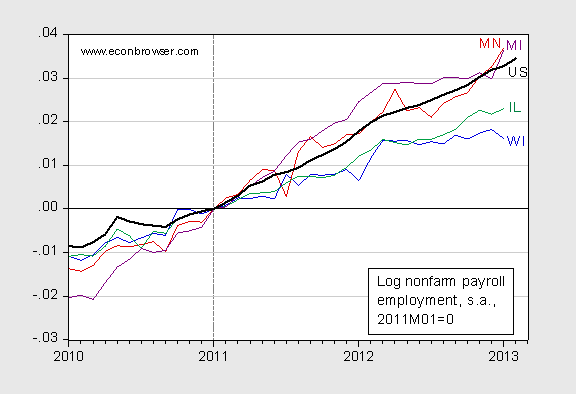
They point to an economic lethargy among upper Midwest states as an explanation for our poor performance. All these states have large manufacturing sectors, which have been underperforming, thus things are bad. Yet, as this chart from UW-Madison economist Menzie Chinn shows, our Midwest neighbor states have outperformed Wisconsin.

Next, the Journal goes back to another well-worn (false) explanation - structural unemployment - the skills mismatch. The Wisconsin unemployment rate is hovering around 7 percent. One percentage point of that may be structural, but the majority of our unemployment is not. And, this is normally the case, even in a recession (although structural unemployment may increase slightly toward the 1.5 percentage point range). Structural unemployment can exist, but it's not the majority of our unemployment, thus is does not explain, nor provide the prescription for, unemployment. UWM professor Marc Levine recently released his own study debunking this skills mismatch meme the Journal continually tries to push.
The Journal then points out that construction and its ancillary jobs are down and they imply they don't think they'll be coming back. Hello?! Housing bust? Great Recession? Now, I don't think they'll come back to the housing bubble numbers (that's why it's called a bubble), but they will no doubt recover and stabilize as the economy does the same. We'll always need windows, doors and construction.
"Should we hold Walker responsible? Of course. He's the one who promised that 250,000 private-sector jobs would be created during his first term - a pledge that he is far from fulfilling. But politicians always get too much blame when the economy is weak and too much credit when it is strong. We think that's the case here," the article hedges. Talk about having your cake and eating it, too. So, yeah, he's kinda responsible, but can he really do that much anyway? He's trying, that's all that matters. Lets just stick our collective head in the sand and move on. It almost seems this article merely used the 'whose to blame?' question as a springboard for a rant about pet projects and policy prescriptions favored by Walker and the Journal Sentinel.
Now, the Journal turns back to another of their favorite "development" ideas - venture capital. To believe such is a panacea, we must ignore, "Josh Lerner, of Harvard, has found the number of exceptional venture capitalists is very small. Harold Bradley, of the Kaufmann Foundation, believes venture capitalists have plenty of money, but allocate it very inefficiently, and therefore should not be receiving additional public dollars with the hope of boosting a local economy. Bradley and Carl Schramm, in an article for Business Week, write that the current focus on fees has promoted start-up flipping rather than nurturing." Scott Walker and the Journal Sentinel want venture capital to be a centerpiece, a major investment, of our economic development playbook. This disregards the fact that venture capital, overall, has been a bad/subpar return on investment. And, when it has been successful, only a very select few were rewarded.
Plus, we're just exiting an economic downturn caused by speculation and gambling - casino capitalism. We've seen how destructive this can be. Scott Walker, Alberta Darling, and the Journal Sentinel's answer to this is to double-down and speculate with venture capital (supported with public dollars).
The article closes with a buzz-word bonanza and one more debunked idea - young companies are the answer, they create new jobs. As I've written before, "The pace of hiring may be strong in young companies, but what they also fail to mention is that the pace of firing is also higher amongst younger companies."
So, whose fault is it anyway? It's largely Scott Walker's. But the Journal Sentinel also bears responsibility for supporting his election and for pushing his debunked ideas. And, all this does matter.
So, right off the bat, since it is the subheader to their article, if they're so concerned with boosting long-term economic prospects, why did the Journal support Scott Walker's refusal of nearly a billion dollars in federal aid for a train which, when completed, would have better connected a crucial economic mega-region - Minneapolis, Madison, Milwaukee and Chicago?
I guess if I were partially responsible for such an generation-altering economic blunder I wouldn't want to focus on fault, blame, or finger-pointing either.
Hilariously, the Journal believes the only two choices for fault are either: 1) it's Walker's fault or 2) it's the recall election organizers fault. No responsibility for the largest newspaper in the state? Nope. As the public keeper-of-record, the watchdog, our fourth estate, they have no responsibility in presenting truth, what works and what doesn't, what is right or wrong? Hmmm, how about it's mostly Walker's fault, but he couldn't have done all the damage he has without the support and endless articles, apologies and endorsements from the Journal Sentinel.
Their obfuscation tour continues, "But his political finger-pointing is pointless. Not that Walker doesn't deserve responsibility - he's the governor. But the problems facing the state's economy go far beyond the power of a single person to solve." This seems like a much different tone from the newspaper than when it was endorsing Walker during his campaigning. We were going to be "open for business" and the Journal agreed. But now that we're not open for business, the Journal feels its "pointless" for the public to remember who steered them wrong.
At this point the article veers off into the Journal 'buzz-words as policy' section. They talk of "entrepreneurial," "risk-takers," "research," and "venture capital." Here, again, they stump for a state-funded venture capital fund. Another Scott Walker-supported idea that has fizzled and proven unimpressive elsewhere. Again, ideas - whose were they? Were they successful? Right? Wrong? This will be another one of those ideas Walker and the Journal push for, but when it fails (doesn't produce anywhere near the results they expect), they would like us all to forget whose idea it was.
They point to an economic lethargy among upper Midwest states as an explanation for our poor performance. All these states have large manufacturing sectors, which have been underperforming, thus things are bad. Yet, as this chart from UW-Madison economist Menzie Chinn shows, our Midwest neighbor states have outperformed Wisconsin.
Next, the Journal goes back to another well-worn (false) explanation - structural unemployment - the skills mismatch. The Wisconsin unemployment rate is hovering around 7 percent. One percentage point of that may be structural, but the majority of our unemployment is not. And, this is normally the case, even in a recession (although structural unemployment may increase slightly toward the 1.5 percentage point range). Structural unemployment can exist, but it's not the majority of our unemployment, thus is does not explain, nor provide the prescription for, unemployment. UWM professor Marc Levine recently released his own study debunking this skills mismatch meme the Journal continually tries to push.
The Journal then points out that construction and its ancillary jobs are down and they imply they don't think they'll be coming back. Hello?! Housing bust? Great Recession? Now, I don't think they'll come back to the housing bubble numbers (that's why it's called a bubble), but they will no doubt recover and stabilize as the economy does the same. We'll always need windows, doors and construction.
"Should we hold Walker responsible? Of course. He's the one who promised that 250,000 private-sector jobs would be created during his first term - a pledge that he is far from fulfilling. But politicians always get too much blame when the economy is weak and too much credit when it is strong. We think that's the case here," the article hedges. Talk about having your cake and eating it, too. So, yeah, he's kinda responsible, but can he really do that much anyway? He's trying, that's all that matters. Lets just stick our collective head in the sand and move on. It almost seems this article merely used the 'whose to blame?' question as a springboard for a rant about pet projects and policy prescriptions favored by Walker and the Journal Sentinel.
Now, the Journal turns back to another of their favorite "development" ideas - venture capital. To believe such is a panacea, we must ignore, "Josh Lerner, of Harvard, has found the number of exceptional venture capitalists is very small. Harold Bradley, of the Kaufmann Foundation, believes venture capitalists have plenty of money, but allocate it very inefficiently, and therefore should not be receiving additional public dollars with the hope of boosting a local economy. Bradley and Carl Schramm, in an article for Business Week, write that the current focus on fees has promoted start-up flipping rather than nurturing." Scott Walker and the Journal Sentinel want venture capital to be a centerpiece, a major investment, of our economic development playbook. This disregards the fact that venture capital, overall, has been a bad/subpar return on investment. And, when it has been successful, only a very select few were rewarded.
Plus, we're just exiting an economic downturn caused by speculation and gambling - casino capitalism. We've seen how destructive this can be. Scott Walker, Alberta Darling, and the Journal Sentinel's answer to this is to double-down and speculate with venture capital (supported with public dollars).
The article closes with a buzz-word bonanza and one more debunked idea - young companies are the answer, they create new jobs. As I've written before, "The pace of hiring may be strong in young companies, but what they also fail to mention is that the pace of firing is also higher amongst younger companies."
So, whose fault is it anyway? It's largely Scott Walker's. But the Journal Sentinel also bears responsibility for supporting his election and for pushing his debunked ideas. And, all this does matter.
Thursday, February 21, 2013
The Mythological Skills Gap
Beyond the anecdotes of local employers, the Wisconsin and Milwaukee labor markets show no statistical evidence of a skills shortage:
Wages: If Wisconsin employers were encountering a shortage of skilled labor, wages would be going up, but in Wisconsin real wages have declined since 2000. By contrast, in states such as North Dakota and Wyoming, where there really is demand for and a shortage of skilled labor, caused by a boom in the energy sector, real wages have jumped by double digits since 2000. Wisconsin wage "growth" also lags the national rate, another sign that there is no labor shortage here.
Hours: In contrast to states with tight labor markets such as North Dakota, there is no evidence that Wisconsin employers are adding hours to their existing workforce, to compensate for an alleged skilled labor shortage. Average weekly hours worked in Wisconsin are down 4.3 percent compared to 2000.
Occupational Projections: Although promoters of the skills gap idea claim that the skills requirements of future jobs will vastly outstrip the skills and education of Wisconsin workers, occupational projections for the state reveal that 70 percent of projected openings through 2020 will be in jobs requiring a high school diploma or less.
Underemployment and Workforce Overqualification: In reality, Wisconsin and Milwaukee suffer from the opposite of a skills gap: an economy that generates too few quality jobs and a labor market that is characterized by the underemployment and overqualification of skilled and educated workers. 25 percent of Milwaukee's retail salespersons hold college degrees (up from 11 percent in 2000); 60 percent of Wisconsin's parking lot attendants have had some post-secondary education. The "job gap" has created a skills mismatch of sorts in the Wisconsin and Milwaukee labor markets, but it is the inverse of the one commonly put forward: it is a mismatch of too many highly educated workers chasing too few "good jobs."
Rising Human Capital: Contrary to skills gap rhetoric, educational attainment has increased dramatically in Wisconsin and Milwaukee over the past decades. Nearly 90 percent of Milwaukee's adult population holds a high school diploma (up from 50 percent in 1970), and 31 percent hold at least a bachelor's degree (up from 11 percent in 1970). Gains in UW-Milwaukee The Skills Gap and Unemployment in Wisconsin 6 educational attainment have occurred for all racial and ethnic groups. All data point to consistently rising human capital formation in Wisconsin and Milwaukee.
Sunday, February 3, 2013


Saturday, January 12, 2013
Training, Skills, & Other Fairy Tales
Time for Wisconsin to get a new playbook. I haven't heard a single innovative idea for economic development from any of the supposed experts being quoted in the media, nor from our development agencies. Just more regurgitation of development hucksterism. And, if what we hear from the Walker administration is any indication of our current state of development, we're still stuck in the '80s.
Research parks, stadiums, venture capital, etc. Why are we continuing with proposals that have already either run their course or been proven ineffective?
Here we go again.
As I wrote back in May 2009:
Gordon Lafer, associate professor at the University of Oregon, in his expansive and definitive work on job training, The Job Training Charade, states, “Job training has served primarily as a form of political diversion. At both the federal and local levels of government, the rhetoric of job training has encouraged a discourse about poverty and unemployment which minimizes the public’s expectations of government. If poverty were viewed largely as the result of a shortage of jobs, and the government were held responsible as employer of last resort, scores of mayors and governors would have been thrown out of office in response to the dislocations of the past two decades. By instead promoting a view of poverty as largely rooted in the educational, cultural, and moral failings of poor communities, the assumptions underlying training policy suggest that the government could not be expected to provide more than marginal assistance toward solving this problem.The article (Gov. Walker May Be Poised To Reorganize Job Training) also declares "the state's skills mismatch" as one of the reasons to reorganize job training. Two disproven ideas in one article, now that's efficiency. Job training is pointless unless there are actual jobs available (that pay a commensurate wage for the skills). And, skills mismatch is a clever rebranding for what is actually just low wages.
As noted in this review of Gordon Lafer’s work, “The commonsense idea that there are plenty of jobs to go around if only the unemployed and the poor had the motivation and the skills to fill them…The number of decently-paid jobs that were available over the last twenty years has never been more than a fraction of the number needed to raise the poor beyond the poverty level…Except for certain professional positions that require specialized and highly controlled education and that compromise a very small portion of the labor market, variables such as gender, age, race, and whether or not workers are unionized, are more important determinants of the levels of employment and wages than are the levels of education.”
David Howell, professor at Milano The New School for Management and Urban Policy, observes, “In short, employers in the 1980s responded to increased competitive pressures by taking a low-road human resource strategy, one aimed above all at reducing current labor costs…In a great many industries, workers learned new skills to work with more advanced production technologies – but their higher productivity was not reflected in higher wages…In the 1980s, higher skills have simply not led to higher wages. In industry after industry, average educational attainment rose while wages fell.”
Low Wages, Not Skills Mismatch
More evidence from Catherine Rampell invalidating the skills mismatch story.
Are There Really No Good Job Applicants Out There?
What’s especially odd about these survey responses is that if employers are having trouble finding qualified workers, they should be bidding up wages to attract the few qualified workers who are out there. But that’s not what the data show.
Average hourly earnings in the private sector fell over the period that businesses reported having increased trouble finding qualified workers (December 2009 to September 2012). Perhaps this means businesses are having trouble finding qualified workers precisely because they’re unwilling to pay new hires enough money.
Sunday, June 17, 2012
The Skills Mismatch Myth
Dave Altig, Atlanta Fed, The Skills Gap: Still Trying To Separate Myth From Fact:
"We have yet to find much evidence that problems with skill-mismatch are more important postrecession than they were prerecession. We'll keep looking, but—as our colleagues at the Chicago Fed conclude in their most recent Chicago Fed Letter—so far the facts just don't support skill gaps as the major source of our current labor market woes."
"We have yet to find much evidence that problems with skill-mismatch are more important postrecession than they were prerecession. We'll keep looking, but—as our colleagues at the Chicago Fed conclude in their most recent Chicago Fed Letter—so far the facts just don't support skill gaps as the major source of our current labor market woes."
For Further Reading:
Saturday, May 5, 2012
Weekend Reading
Don't Let Business Lobbyists Kill The Post Office
Drivers Pay Secret Road Tax In $15 Billion For Car Repair
Four Fiscal Charts
Let's Just Say It: The Republicans Are The Problem
Retirement, Slipping Farther And Farther Away
Taxed By The Boss
Taxes And Employment
Tax Me, For F@%&'s Sake!
Worker Skills And Job Quality
Drivers Pay Secret Road Tax In $15 Billion For Car Repair
Four Fiscal Charts
Let's Just Say It: The Republicans Are The Problem
Retirement, Slipping Farther And Farther Away
Taxed By The Boss
Taxes And Employment
Tax Me, For F@%&'s Sake!
Worker Skills And Job Quality
Subscribe to:
Posts (Atom)