Monday, October 8, 2012


Saturday, October 6, 2012
Romney's 10 Most Baseless Claims
"And these businesses -- many of them have gone out of business. I think about half of them, of the ones have been invested in, they’ve gone out of business." – Mitt Romney, Oct. 3 Presidential Debate
Businesses that got government clean energy loans failed at a rate of about 1.4 percent at the end of 2011, according to The Washington Post.
"My plan is not to put in place any tax cut that will add to the deficit." – Mitt Romney, Oct. 3 Presidential Debate
Romney's tax plan would cost the country $4.8 trillion over the next 10 years, according to Tax Policy Center data, cited by NBC News.
"You never balance the budget by raising taxes." – Mitt Romney, Oct. 3 Presidential Debate
President Bill Clinton managed to balance the budget during his time in office with a tax boost for those in the top 2 percent of earners, according to Duke professor William Chafe.
"The president has a view very similar to the view he had when he ran four years ago, that a bigger government, spending more, taxing more, regulating more -- if you will, trickle-down government would work." – Mitt Romney, Oct. 3 Presidential Debate
President Obama's proposed budget is estimated to cut about $1.1 trillion over the next 10 years and, so far, Obama has signed $2 trilion worth of spending cuts into law, according to Democratic Party Pollster Bernard Whitman.
"Up to 20 million people will lose their insurance as Obamacare goes into effect next year." – Mitt Romney, Oct. 3 Presidential Debate
Some workers may switch from their employer-provided health plans, according to the Congressional Budget Office, but that number is more likely to be closer to between 3 and 5 million per year between 2019 and 2022.
Obamacare "puts in place an unelected board that’s going to tell people, ultimately, what kind of treatments they can have." – Mitt Romney, Oct 3 Presidential Debate
Though Obamacare does create an independent board, the law prohibits the board from making recommendations to "ration health care," or "otherwise restrict benefits or modify eligibility,” according to Bloomberg.
"The idea of cutting $716 billion from Medicare to be able to balance the additional cost of Obamacare is, in my opinion, a mistake." – Mitt Romney, Oct. 3 Presidential Debate
The indirect effects of Obamacare have yet to be determined, since the law has yet to be implemented. But as the law is written now, Obamacare doesn't cut seniors' benefits as part of its plan to curb health care costs, according to USA Today.
Obama's healthcare law would curb benefits to health care providers and insurers, but doesn't directly cut seniors' benefits. Critics allege however, that the cuts in payments would have the unintended consequence of hurting seniors because doctors would stop accepting Medicare patients, according to USA Today.
"It's hurt the housing market because Dodd-Frank didn't anticipate putting in place the kinds of regulations you have to have. It's not that Dodd-Frank always was wrong with too much regulation. Sometimes they didn't come out with a clear regulation." – Mitt Romney, Oct. 3 Presidential Debate
The Dodd-Frank regulations aim to prevent another housing crash like the one that helped to cause the 2008 financial meltdown by banning high-risk lending practices, according to CBS News. In addition, the housing market has been on a slow rebound since Obama took office.
If anything, it may be banks that are holding back the housing recovery. Many are slow to lend because they're concerned Fannie Mae and Freddie Mac will make them take back any bad loans, the Wall Street Journal reports.
"I just don't know how the president could have come into office, facing 23 million people out of work, rising unemployment, an economic crisis at the -- at the kitchen table, and spend his energy and passion for two years fighting for Obamacare instead of fighting for jobs for the American people. It has killed jobs." – Mitt Romney, Oct. 3 Presidential Debate
The Congressional Budget Office estimates that healthcare reform will reduce the health care industry's workforce by only about 0.5 percent, largely because workers will decide to retire early or work fewer hours. And if Romney's Massachusetts health care reform law is any indication, job loss won't be a big problem; employment trends in the state have mirrored national trends since Romneycare took effect.
"The president said he’d cut the deficit in half. Unfortunately, he doubled it.” – Mitt Romney, Oct. 3 Presidential Debate
When Obama took office in 2009, the deficit was projected to be $1.2 trillion during that year, and it ultimately turned out to be $1.4 trillion, according to Congressional Budget Office data cited by The New York Times. The deficit is expected to be $1.1 trillion for fiscal year 2012.
Businesses that got government clean energy loans failed at a rate of about 1.4 percent at the end of 2011, according to The Washington Post.
"My plan is not to put in place any tax cut that will add to the deficit." – Mitt Romney, Oct. 3 Presidential Debate
Romney's tax plan would cost the country $4.8 trillion over the next 10 years, according to Tax Policy Center data, cited by NBC News.
"You never balance the budget by raising taxes." – Mitt Romney, Oct. 3 Presidential Debate
President Bill Clinton managed to balance the budget during his time in office with a tax boost for those in the top 2 percent of earners, according to Duke professor William Chafe.
"The president has a view very similar to the view he had when he ran four years ago, that a bigger government, spending more, taxing more, regulating more -- if you will, trickle-down government would work." – Mitt Romney, Oct. 3 Presidential Debate
President Obama's proposed budget is estimated to cut about $1.1 trillion over the next 10 years and, so far, Obama has signed $2 trilion worth of spending cuts into law, according to Democratic Party Pollster Bernard Whitman.
"Up to 20 million people will lose their insurance as Obamacare goes into effect next year." – Mitt Romney, Oct. 3 Presidential Debate
Some workers may switch from their employer-provided health plans, according to the Congressional Budget Office, but that number is more likely to be closer to between 3 and 5 million per year between 2019 and 2022.
Obamacare "puts in place an unelected board that’s going to tell people, ultimately, what kind of treatments they can have." – Mitt Romney, Oct 3 Presidential Debate
Though Obamacare does create an independent board, the law prohibits the board from making recommendations to "ration health care," or "otherwise restrict benefits or modify eligibility,” according to Bloomberg.
"The idea of cutting $716 billion from Medicare to be able to balance the additional cost of Obamacare is, in my opinion, a mistake." – Mitt Romney, Oct. 3 Presidential Debate
The indirect effects of Obamacare have yet to be determined, since the law has yet to be implemented. But as the law is written now, Obamacare doesn't cut seniors' benefits as part of its plan to curb health care costs, according to USA Today.
Obama's healthcare law would curb benefits to health care providers and insurers, but doesn't directly cut seniors' benefits. Critics allege however, that the cuts in payments would have the unintended consequence of hurting seniors because doctors would stop accepting Medicare patients, according to USA Today.
"It's hurt the housing market because Dodd-Frank didn't anticipate putting in place the kinds of regulations you have to have. It's not that Dodd-Frank always was wrong with too much regulation. Sometimes they didn't come out with a clear regulation." – Mitt Romney, Oct. 3 Presidential Debate
The Dodd-Frank regulations aim to prevent another housing crash like the one that helped to cause the 2008 financial meltdown by banning high-risk lending practices, according to CBS News. In addition, the housing market has been on a slow rebound since Obama took office.
If anything, it may be banks that are holding back the housing recovery. Many are slow to lend because they're concerned Fannie Mae and Freddie Mac will make them take back any bad loans, the Wall Street Journal reports.
"I just don't know how the president could have come into office, facing 23 million people out of work, rising unemployment, an economic crisis at the -- at the kitchen table, and spend his energy and passion for two years fighting for Obamacare instead of fighting for jobs for the American people. It has killed jobs." – Mitt Romney, Oct. 3 Presidential Debate
The Congressional Budget Office estimates that healthcare reform will reduce the health care industry's workforce by only about 0.5 percent, largely because workers will decide to retire early or work fewer hours. And if Romney's Massachusetts health care reform law is any indication, job loss won't be a big problem; employment trends in the state have mirrored national trends since Romneycare took effect.
"The president said he’d cut the deficit in half. Unfortunately, he doubled it.” – Mitt Romney, Oct. 3 Presidential Debate
When Obama took office in 2009, the deficit was projected to be $1.2 trillion during that year, and it ultimately turned out to be $1.4 trillion, according to Congressional Budget Office data cited by The New York Times. The deficit is expected to be $1.1 trillion for fiscal year 2012.
Republicans Angry Economy Improving
As the USA Today reported, regarding Republicans accusations and conspiracies over the latest jobs report:
"Bollocks,"' Wharton School economist Justin Wolfers said. "Once you understand how the numbers are collected and processed, you understand that it's literally impossible to fool with the numbers.''
Manipulating the unemployment rate would require the cooperation of thousands of people -- not to mention violating federal laws.
The unemployment rate is based on a survey of 60,000 households, conducted at the middle of each month because holidays, which can result in short-term hiring or layoffs, are usually at the beginning or end of a month, said Karen Kosanovich, an economist at the U.S. Bureau of Labor Statistics who works on the survey.
About 1,500 Census workers gather the data, and the survey dates back to 1940, Kosanovich said.
"Bollocks,"' Wharton School economist Justin Wolfers said. "Once you understand how the numbers are collected and processed, you understand that it's literally impossible to fool with the numbers.''
Manipulating the unemployment rate would require the cooperation of thousands of people -- not to mention violating federal laws.
The unemployment rate is based on a survey of 60,000 households, conducted at the middle of each month because holidays, which can result in short-term hiring or layoffs, are usually at the beginning or end of a month, said Karen Kosanovich, an economist at the U.S. Bureau of Labor Statistics who works on the survey.
About 1,500 Census workers gather the data, and the survey dates back to 1940, Kosanovich said.
The Romney Files
The Federal Bailout That Saved Mitt Romney
The Hiring Of The President
History Shows Business Experience Doesn't Make A Good President
Impacts Of The Romney Budget Proposals
Inside Romney's Tax-Dodging Schemes
The Meaning Of Mitt
Mitt Romney
Mitt Romney & The Fantasy Budget
Romney's Budget Proposals Necessitate Large Cuts
The Romney Plan
Romney's Private Equity Magic Trick
Transaction Man
The True Story Of Mitt Romney & Bain Capital
The Hiring Of The President
History Shows Business Experience Doesn't Make A Good President
Impacts Of The Romney Budget Proposals
Inside Romney's Tax-Dodging Schemes
The Meaning Of Mitt
Mitt Romney
Mitt Romney & The Fantasy Budget
Romney's Budget Proposals Necessitate Large Cuts
The Romney Plan
Romney's Private Equity Magic Trick
Transaction Man
The True Story Of Mitt Romney & Bain Capital
Top 10 Beer City: Milwaukee
10 Best Beer Cities In The World
What to See: With a baseball team called the Brewers, is it any surprise Milwaukee is so crazy for beer? Milwaukee was once home to the "Big Four:" Pabst, Schlitz, Miller, and Blatz. Now the city houses a sophisticated craft-beer scene that builds on its rich brewing heritage. You can still visit the MillerCoors brewery, which features a free walking tour, but don't miss the Sprecher and Lakefront microbreweries. (While most tours promise a frosty draft only at the end, Lakefront offers you a beer—and a souvenir pint glass—the minute you walk in the door.)
Where to Drink: Insiders say that Sugar Maple, in Milwaukee's hip Bay View neighborhood, caters to the serious beer geek—and with more than 60 beers to sample, a soup menu, and a retro environment in which to enjoy both, we agree. Draft Magazine names nearby Palm Tavern one of America's best bars for its 250-some artisan beers, including a few rare brews.
What to See: With a baseball team called the Brewers, is it any surprise Milwaukee is so crazy for beer? Milwaukee was once home to the "Big Four:" Pabst, Schlitz, Miller, and Blatz. Now the city houses a sophisticated craft-beer scene that builds on its rich brewing heritage. You can still visit the MillerCoors brewery, which features a free walking tour, but don't miss the Sprecher and Lakefront microbreweries. (While most tours promise a frosty draft only at the end, Lakefront offers you a beer—and a souvenir pint glass—the minute you walk in the door.)
Where to Drink: Insiders say that Sugar Maple, in Milwaukee's hip Bay View neighborhood, caters to the serious beer geek—and with more than 60 beers to sample, a soup menu, and a retro environment in which to enjoy both, we agree. Draft Magazine names nearby Palm Tavern one of America's best bars for its 250-some artisan beers, including a few rare brews.
Since The Great Recession
The Economy Has Been Growing, Since Mid-2009 [CBPP]

Private Payroll Employment Has Grown For 31 Months


Unemployment Would Even Be Lower If...
...Republican governors hadn't slashed public employment over the past few years and Republicans in Congress didn't obstruct all the jobs bills put before them.
Suzy Khimm reports, "Overall, about 600,000 government jobs have been lost since the beginning of the recession."
And, as Mark Gongloff states, "Had Congress passed the American Jobs Act last year instead of letting it die, there might have been an extra 1.3 million to 1.9 million new jobs created this year, according to estimates by Macroeconomic Advisers and Moody's Analytics, respectively. If you simply divide those estimates up by quarters -- an unscientific approach, admittedly -- you could guesstimate that the AJA would have produced an extra 975,000 to 1.4 million jobs through the first three quarters of the year (i.e., through September). Let's call it a million, just for funsies. Assuming no change in the labor force, and just subtracting that million people from the 12 million unemployed in September, you get the unemployment rate down to 7.2 percent from 7.8 percent. On top of that, you could add the 575,000 government jobs that have been cut since Obama took office in January 2009. Had the federal government not shed workers and cut off aid to the states, it's theoretically possible -- arguably, would have been preferable -- that the government could have added jobs, or at least not cut any. That extra 575,000 workers -- again, assuming no change in the labor force -- gets unemployment down to 6.8 percent. We haven't seen 6.8 percent unemployment since November 2008."
Republicans got us into this mess. Rather than seeking justice against the perpetrators, Republicans turned the blame for all of America's problems onto the backs of teachers, firefighters, and all public workers. Nevermind the bankers and Wall Street, nothing to see there, move along.
Republicans have obstructed any attempt to get us out of this financier-induced mess. They've decided, instead, to use the public as pawns in their power struggle; allowing millions to remain unemployed in a lagging economy in the hopes of winning the election by blaming the President. It's a sick and cynical politics the Republicans are practicing.
Suzy Khimm reports, "Overall, about 600,000 government jobs have been lost since the beginning of the recession."
And, as Mark Gongloff states, "Had Congress passed the American Jobs Act last year instead of letting it die, there might have been an extra 1.3 million to 1.9 million new jobs created this year, according to estimates by Macroeconomic Advisers and Moody's Analytics, respectively. If you simply divide those estimates up by quarters -- an unscientific approach, admittedly -- you could guesstimate that the AJA would have produced an extra 975,000 to 1.4 million jobs through the first three quarters of the year (i.e., through September). Let's call it a million, just for funsies. Assuming no change in the labor force, and just subtracting that million people from the 12 million unemployed in September, you get the unemployment rate down to 7.2 percent from 7.8 percent. On top of that, you could add the 575,000 government jobs that have been cut since Obama took office in January 2009. Had the federal government not shed workers and cut off aid to the states, it's theoretically possible -- arguably, would have been preferable -- that the government could have added jobs, or at least not cut any. That extra 575,000 workers -- again, assuming no change in the labor force -- gets unemployment down to 6.8 percent. We haven't seen 6.8 percent unemployment since November 2008."
Republicans got us into this mess. Rather than seeking justice against the perpetrators, Republicans turned the blame for all of America's problems onto the backs of teachers, firefighters, and all public workers. Nevermind the bankers and Wall Street, nothing to see there, move along.
Republicans have obstructed any attempt to get us out of this financier-induced mess. They've decided, instead, to use the public as pawns in their power struggle; allowing millions to remain unemployed in a lagging economy in the hopes of winning the election by blaming the President. It's a sick and cynical politics the Republicans are practicing.
Thursday, October 4, 2012
Master Debater
So...if President Obama chooses to fill the next debate with lies, will the media consider him the winner?
Saying what the people wanted to hear, being spectacularly vague and, mostly, just lying seems to have many in the media declaring Mitt Romney the winner of the first debate.
For Further Reading:
Mitt Romney's 5 Biggest Lies
Romney's Poor Command Of Facts
Romney's Successful Debate Plan: Lying
Romney's 10 Most Baseless Claims
10 Most Shameless Romney Debate Lies
Top 6 Romney Lies
Saying what the people wanted to hear, being spectacularly vague and, mostly, just lying seems to have many in the media declaring Mitt Romney the winner of the first debate.
For Further Reading:
Mitt Romney's 5 Biggest Lies
Romney's Poor Command Of Facts
Romney's Successful Debate Plan: Lying
Romney's 10 Most Baseless Claims
10 Most Shameless Romney Debate Lies
Top 6 Romney Lies
Wednesday, October 3, 2012
The Unemployment Rate
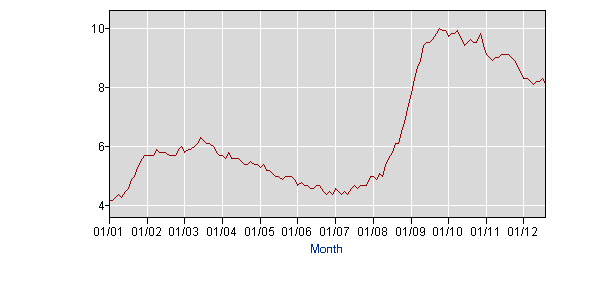
Republicans are pointing out that unemployment was 7.8 percent when Barack Obama took office.
It's now 8.1 percent.
See, that proves Obama is performing poorly. Obama has presided over an 4% increase in the unemployment rate.
As the graph shows, unemployment was steadily increasing since the spring of 2008, under the direction of George W. Bush.

As you can see from this graph, when George W. Bush took office, the unemployment rate was 4.2 percent. Bush and the Republicans presided over an 86 percent increase in the unemployment rate. [If we only look at Bush's first term, which ended with a 5.7% rate, the unemployment rate increased 36 percent.]
 [source]
Obama hasn't been able to make a dent in the unemployment rate, but he has held it at bay. We're no longer losing 750,000 jobs per month, as we were when George W. Bush handed over the reins. And, all this has been done despite the fact that the Republicans have opposed and obstructed every piece of legislation the Obama administration has proposed.
Aside:
Bill Clinton entered office with a 7.3% unemployment rate. Leaving office with a 4.2% rate, he presided over a decline of 43 percent in the unemployment rate.
It's now 8.1 percent.
See, that proves Obama is performing poorly. Obama has presided over an 4% increase in the unemployment rate.
As the graph shows, unemployment was steadily increasing since the spring of 2008, under the direction of George W. Bush.

As you can see from this graph, when George W. Bush took office, the unemployment rate was 4.2 percent. Bush and the Republicans presided over an 86 percent increase in the unemployment rate. [If we only look at Bush's first term, which ended with a 5.7% rate, the unemployment rate increased 36 percent.]

Obama hasn't been able to make a dent in the unemployment rate, but he has held it at bay. We're no longer losing 750,000 jobs per month, as we were when George W. Bush handed over the reins. And, all this has been done despite the fact that the Republicans have opposed and obstructed every piece of legislation the Obama administration has proposed.
Aside:
Bill Clinton entered office with a 7.3% unemployment rate. Leaving office with a 4.2% rate, he presided over a decline of 43 percent in the unemployment rate.
Saturday, September 29, 2012
A Note On Milwaukee County Parks
Great vision and leadership were on display when Milwaukee County Executive Chris Abele addressed concerns that wealthier neighborhoods' parks are better maintained, "It's not hard to find parks in the inner city that haven't gotten much love in a while. It's a lot easier for parks in the suburbs or the North Shore to have friends groups," said Abele.
Yes, rich people have more money and thus more resources for parks. Truly inspired insight.
As County Executive, part of the job is gathering and redirecting resources where they are needed most in the community to ensure a good quality of life.
Yet, as Dan Cody shows, "When Milwaukee County took over the parks system in 1983, they allocated $41.6 million [$96.2 million in 2012 dollars] to the parks operating budget. The proposal this year: $42 million."
Of the 40 largest parks systems in the U.S., ParkScore ranked Milwaukee County Parks 16th. Spending per resident is $59.54.
For Further Reading:
2011 City Park Facts Report
Yes, rich people have more money and thus more resources for parks. Truly inspired insight.
As County Executive, part of the job is gathering and redirecting resources where they are needed most in the community to ensure a good quality of life.
Yet, as Dan Cody shows, "When Milwaukee County took over the parks system in 1983, they allocated $41.6 million [$96.2 million in 2012 dollars] to the parks operating budget. The proposal this year: $42 million."
Of the 40 largest parks systems in the U.S., ParkScore ranked Milwaukee County Parks 16th. Spending per resident is $59.54.
For Further Reading:
2011 City Park Facts Report
Thursday, September 27, 2012

Paul Ryan: Wimp
If you (Paul Ryan) are unwilling to debate your opponent (Rob Zerban), to allow your constituents (and your opponent) to question you and to hear your views, you shouldn't even be allowed to run for public office.
Tommy Thompson: Liar
There they go again.
In their continuous effort to lie and mislead, the Republicans (on behalf of Tommy Thompson) are experiencing cognitive dissonance and also using completely debunked talking-points. In a new television ad for Thompson, they are purporting that Tammy Baldwin wants to cut Medicare by $716 billion and that the Republicans are the party that wants to save Medicare.
OK, first, the $716 billion "cut" is actually savings. This is the government not paying for useless procedures, snuffing out fraud, and not reimbursing ridiculous rates. Medicare isn't shrinking, nor are its recipients benefits decreasing, the amount merely refers to savings from controlling waste and fraud.
Second, Republicans want to end Medicare (not to mention Social Security). They are the ones coming up with plans to eliminate eligible recipients, to increase the eligible age, and to turn Medicare into a voucher program (which is a fancy way of saying you'll have to pay more).
It should be unlawful to broadcast such blatant lies...especially when it concerns electing public officials. (I believe Canada actually has such a policy.) But, as should be evident by now, lies are all the Republicans have to offer.
In their continuous effort to lie and mislead, the Republicans (on behalf of Tommy Thompson) are experiencing cognitive dissonance and also using completely debunked talking-points. In a new television ad for Thompson, they are purporting that Tammy Baldwin wants to cut Medicare by $716 billion and that the Republicans are the party that wants to save Medicare.
OK, first, the $716 billion "cut" is actually savings. This is the government not paying for useless procedures, snuffing out fraud, and not reimbursing ridiculous rates. Medicare isn't shrinking, nor are its recipients benefits decreasing, the amount merely refers to savings from controlling waste and fraud.
Second, Republicans want to end Medicare (not to mention Social Security). They are the ones coming up with plans to eliminate eligible recipients, to increase the eligible age, and to turn Medicare into a voucher program (which is a fancy way of saying you'll have to pay more).
It should be unlawful to broadcast such blatant lies...especially when it concerns electing public officials. (I believe Canada actually has such a policy.) But, as should be evident by now, lies are all the Republicans have to offer.
Monday, September 24, 2012
Saturday, September 22, 2012


Friday, September 21, 2012
Monday, September 17, 2012


Those Pesky Electrocution Rules
Walker Administration Target Electrical Safety Codes
"Mandatory requirements designed to detect fire-causing conditions, stop electric shocks and keep children from sticking foreign objects into electrical outlets have been targeted for removal from the state code."
"Mandatory requirements designed to detect fire-causing conditions, stop electric shocks and keep children from sticking foreign objects into electrical outlets have been targeted for removal from the state code."

Romney Uncensored
"There are 47 percent of the people who will vote for the president no matter what. All right, there are 47 percent who are with him, who are dependent upon government, who believe that they are victims, who believe the government has a responsibility to care for them, who believe that they are entitled to health care, to food, to housing, to you-name-it. That that's an entitlement. And the government should give it to them. And they will vote for this president no matter what…These are people who pay no income tax. Romney went on: "[M]y job is is not to worry about those people. I'll never convince them they should take personal responsibility and care for their lives."
Sunday, September 16, 2012
We're Broke?
State gives $5 million to BMO Harris Bradley Center for repairs.
Yes, we are so broke.
Unless the already well-to-do and well-connected want millions for their private playgrounds.
Yes, we are so broke.
Unless the already well-to-do and well-connected want millions for their private playgrounds.
Saturday, September 15, 2012
Stock Update
The stock market has shown steady improvement over President Obama's first term.
Republicans are supposedly worried about the economy and businesses. (Just let them run the show again - they know how to create jobs!)
How can they claim the President is hurting business?
When you slam President Obama as being a socialist and for hating business, and when you obstruct all of his legislation, it's impossible to contort yourself around to then claim you're responsible for the things actually getting done. Republicans haven't supported anything the Democrats have proposed, but the right-wing is somehow responsible for the good outcomes?
The accused socialist and business-hater is good for business!
Corporate profits are at all-time highs. The Dow Jones is as high as it's been since 2008 (see chart below).
Yet, business doesn't like the President?
They don't appreciate the growth and the steady economic hand Barack Obama has demonstrated in helping the economy out of the ditch the Republicans drove it into?
Why? Oh, that's right...politics. Perpetuating the adult conversation we're not having. Thanks, Republicans.

[Source]
For Further Reading:
Barack's Increasing Stock
The Auto Industry And Labor Productivity
General Motors had $150.28 billion in revenues in 2011. General Motors has 202,000 employees. That's $743,960 revenue per employee. As David Leonhardt wrote, "The average GM, Ford and Chrysler worker receives compensation – wages, bonuses, overtime and paid time off – of about $40 an hour. Add in benefits such as health insurance and pensions and you get to about $55." If we use this $55 per hour number (for total compensation), which would gross roughly $114K per year, the typical GM worker only receives 16 percent of his revenue productivity.
People complain about taxes. But this is a direct example of how labor is taxed. In this case, at 84 percent! (And Republicans complain about 30, 20, and even 10 percent taxation?)
2011 Ford Revenues: $136.26 billion.
2011 Ford Employees: 164,000.
2011 Ford Revenue Per Employee: $830,854.
Labor Tax: 84%
2011 Chrysler Revenues: $55 billion.
2011 Chrysler Employees: 51,623.
2011 Chrysler Revenue Per Employee: $1,065,416.
Labor Tax: 89%.
Seeing as how the Republicans are so concerned with the average Joe and fair taxation, I know we'll be hearing from them any minute now about how we must obtain more just compensation for our auto workers.
People complain about taxes. But this is a direct example of how labor is taxed. In this case, at 84 percent! (And Republicans complain about 30, 20, and even 10 percent taxation?)
2011 Ford Revenues: $136.26 billion.
2011 Ford Employees: 164,000.
2011 Ford Revenue Per Employee: $830,854.
Labor Tax: 84%
2011 Chrysler Revenues: $55 billion.
2011 Chrysler Employees: 51,623.
2011 Chrysler Revenue Per Employee: $1,065,416.
Labor Tax: 89%.
Seeing as how the Republicans are so concerned with the average Joe and fair taxation, I know we'll be hearing from them any minute now about how we must obtain more just compensation for our auto workers.
Thursday, September 13, 2012
Crumbling Roads, Crumbling Democracy
Why is the economy continuing to only plod along? [But, yes, it is indeed better than it was 4 years ago.]
Why is unemployment looming stubbornly near 8 percent?
Paul Krugman explains:
"For future reference. In a depressed economy, with the government able to borrow at very low interest rates, we should be increasing public investment — the true cost of the resources is negligible, so the rate of return is very high, not to mention the desirability of creating jobs.
Here’s what has actually happened, as measured by the sum of state, local, and federal nondefense investment:
Doing it wrong."
And, yes, Republican obstruction of all Obama's and the Democrat's jobs legislation has a lot to do with this.
According to Republicans, borrowing is bad, even though the cost of money is about as cheap as it gets. There isn't a better time to invest our infrastructure - mass transportation, water and sewer ways, the electric grid, the greening of public buildings, repairing bridges and roads, etc.
Also, according to Republicans, government-induced demand is a bad thing, although no one else (I'm looking at you, private sector) is willing to spend any money at the moment. Yes, for those of you being foreclosed upon, losing your job, already out of work, behind on your bills, you're just going to have to tough it out until the market decides you're worthy of saving.
Why is unemployment looming stubbornly near 8 percent?
Paul Krugman explains:
"For future reference. In a depressed economy, with the government able to borrow at very low interest rates, we should be increasing public investment — the true cost of the resources is negligible, so the rate of return is very high, not to mention the desirability of creating jobs.
Here’s what has actually happened, as measured by the sum of state, local, and federal nondefense investment:
Doing it wrong."

And, yes, Republican obstruction of all Obama's and the Democrat's jobs legislation has a lot to do with this.
According to Republicans, borrowing is bad, even though the cost of money is about as cheap as it gets. There isn't a better time to invest our infrastructure - mass transportation, water and sewer ways, the electric grid, the greening of public buildings, repairing bridges and roads, etc.
Also, according to Republicans, government-induced demand is a bad thing, although no one else (I'm looking at you, private sector) is willing to spend any money at the moment. Yes, for those of you being foreclosed upon, losing your job, already out of work, behind on your bills, you're just going to have to tough it out until the market decides you're worthy of saving.
Whose Worse Off? U.S. or Europe?
Conservative Americans love to drone on and on about how the European welfare state is bankrupting them. As the story goes, their too-generous "entitlement" policies are dragging down the entire economy. Thus, we here in the U.S. must also eviscerate our "entitlements" and welfare policies, or we shall face the shame dire consequences.
As usual, with Republicans, nuance, context, and the better part of reality are left out the analysis.
"There's a strong tendency to think of it as having a lot to do with the fundamental inequalities in overall productivity and economic development between euro members — backward, semideveloped countries like Greece or Portugal (not my view, but what you often hear) awkwardly tied to powerhouses like Germany. So it comes as something of a shock to look at Eurostat data on real gross domestic product per capita (or productivity, which look similar). Sure, Greece and Portugal are relatively poor, with G.D.P. per capita of 82 and 77 percent, respectively, of the European Union average; this means roughly 76 and 71 percent of the euro zone average, since the euro countries are a bit richer than the E.U. as a whole. Meanwhile, Germany is at 120 percent of the E.U. average, or 112 percent of the euro zone average. But it's no different, really, than the situation in the United States. According to data from the Bureau of Economic Analysis, Alabama is at 74 percent of the average, Mississippi at 67 percent, with New England and the Middle Atlantic States at 118 and 116 percent. In other words, as far as underlying economic inequalities are concerned, the euro zone is no worse than the United States," as Paul Krugman details.


As usual, with Republicans, nuance, context, and the better part of reality are left out the analysis.
"There's a strong tendency to think of it as having a lot to do with the fundamental inequalities in overall productivity and economic development between euro members — backward, semideveloped countries like Greece or Portugal (not my view, but what you often hear) awkwardly tied to powerhouses like Germany. So it comes as something of a shock to look at Eurostat data on real gross domestic product per capita (or productivity, which look similar). Sure, Greece and Portugal are relatively poor, with G.D.P. per capita of 82 and 77 percent, respectively, of the European Union average; this means roughly 76 and 71 percent of the euro zone average, since the euro countries are a bit richer than the E.U. as a whole. Meanwhile, Germany is at 120 percent of the E.U. average, or 112 percent of the euro zone average. But it's no different, really, than the situation in the United States. According to data from the Bureau of Economic Analysis, Alabama is at 74 percent of the average, Mississippi at 67 percent, with New England and the Middle Atlantic States at 118 and 116 percent. In other words, as far as underlying economic inequalities are concerned, the euro zone is no worse than the United States," as Paul Krugman details.


Times are tough all around. These "worse off" hysterics are counterproductive and miss the point. We should be focusing on putting people back to work and not pointing fingers or worrying about whom is better off. A high debt as a percentage of GDP is nothing new. It's not optimal, but it's nothing new. We got ourselves out of this situation before by investing and putting people back to work. That same prescription will work again.
Are We "Printing Money"?
Conservatives have a talking-point about the Federal Reserve printing money. The U.S. is (supposedly) continually printing money, running up debt and fanning the flames of inflation. This is debasing the dollar and leading us, in general, toward calamity.
But the real problem is unemployment and its effects on economic growth and, thus, debt reduction. We have a demand-side problem, not a supply-side problem. The longer we go leaving millions without work and wasting their potential, the more we hurt not only them but the entire economy.
"One of the themes I’ve hit on many times is the fact that the crisis and slump have been a testing ground for economic doctrines. People came into this mess with very different views about how the economy works, and the crisis in effect provided natural experiments that tested those views. Most notably, what we got was a test of demand-side versus supply-side stories about the nature of depressions. Demand-siders like me saw this as very much a slump caused by inadequate spending: thanks largely to the overhang of debt from the bubble years, aggregate demand fell, pushing us into a classic liquidity trap. But many people — some of them credentialed economists — insisted that it was actually some kind of supply shock instead. Either they had an Austrian story in which the economy’s productive capacity was undermined by bad investments in the boom, or they claimed that Obama’s high taxes and regulation had undermined the incentive to work (of course, Obama didn’t actually impose high taxes or onerous regulations, but leave that aside for now). How could you tell which story was right? One answer was to look at the behavior of interest rates; the other was to look at inflation. For if you believed a demand-side story, you would also believe that even a large monetary expansion would have little inflationary effect; if you believed a supply-side story, you would expect lots of inflation from too much money chasing a reduced supply of goods. And indeed, people on the right have been forecasting runaway inflation for years now. Yet the predicted inflation keeps not coming," notes Paul Krugman.
Krugman also states, "What’s wrong with the idea that running the printing presses is a giveaway to plutocrats? Let me count the ways. First, as Joe Wiesenthal and Mike Konczal both point out, the actual politics is utterly the reverse of what’s being claimed. Quantitative easing isn’t being imposed on an unwitting populace by financiers and rentiers; it’s being undertaken, to the extent that it is, over howls of protest from the financial industry. I mean, where are the editorials in the WSJ demanding that the Fed raise its inflation target? Beyond that, let’s talk about the economics. The naive (or deliberately misleading) version of Fed policy is the claim that Ben Bernanke is “giving money” to the banks. What it actually does, of course, is buy stuff, usually short-term government debt but nowadays sometimes other stuff. It’s not a gift. To claim that it’s effectively a gift you have to claim that the prices the Fed is paying are artificially high, or equivalently that interest rates are being pushed artificially low. And you do in fact see assertions to that effect all the time. But if you think about it for even a minute, that claim is truly bizarre. I mean, what is the un-artificial, or if you prefer, “natural” rate of interest? As it turns out, there is actually a standard definition of the natural rate of interest, coming from Wicksell, and it’s basically defined on a PPE basis (that’s for proof of the pudding is in the eating). Roughly, the natural rate of interest is the rate that would lead to stable inflation at more or less full employment. And we have low inflation with high unemployment, strongly suggesting that the natural rate of interest is below current levels, and that the key problem is the zero lower bound which keeps us from getting there. Under these circumstances, expansionary Fed policy isn’t some kind of giveway to the banks, it’s just an effort to give the economy what it needs. Furthermore, Fed efforts to do this probably tend on average to hurt, not help, bankers. Banks are largely in the business of borrowing short and lending long; anything that compresses the spread between short rates and long rates is likely to be bad for their profits. And the things the Fed is trying to do are in fact largely about compressing that spread, either by persuading investors that it will keep short rates at zero for a longer time or by going out and buying long-term assets. These are actions you would expect to make bankers angry, not happy — and that’s what has actually happened.
As Dean Baker explained, "In normal times, the economy is, at least partially, supply-constrained. Collectively, we want more goods and services than the economy is capable of producing.... In our demand-constrained economy, how- ever, there is no problem of inflation. The economy can produce more of almost anything right now. The reason that we are not doing it is simply the lack of demand."
Krugman elaborates, "Surely we don’t mean to identify money with pieces of green paper bearing portraits of dead presidents. Even Milton Friedman rejected that, more than half a century ago. For one thing, a lot of those pieces of green paper are pretty much inert — sitting outside the United States, in the hoards of drug dealers and such. For another, checking accounts are clearly a close substitute for cash in hand. Friedman and Schwartz dealt with this by proposing broader aggregates –M1, which adds checking accounts, and M2, which adds a broader range of deposits. And circa 1960 you could argue that those aggregates were good enough. But now we have a large shadow banking system, in which things like repo serve much the same function as deposits; M3 used to capture some of that, but the Fed discontinued it, in part I think because it wasn’t clear which repo belonged there, and data on repo not involving primary dealers is scattered. Whatever. The truth is that these days — with credit cards, electronic money, repo, and more all serving the purpose of medium of exchange — it’s not clear that any single number deserves to be called “the” money supply. Intellectually, this isn’t a problem; nor is there necessarily a problem maintaining monetary policy even if there isn’t any single thing you’re willing to call money. Mike Woodford has been writing about this stuff for years. But if you’re determined to view economic affairs through a sort of paleo-monetarist lens, focused on the evils of “printing money”, you’re going to have a hard time in the modern world, where the definition of money is increasingly vague."
We still have a world more than willing to buy U.S. debt (the dollar is still the world currency and the preferred store of value) and inflation is nowhere in sight.
Here, again, we have the Republicans bloviating to justify their own interests, their discredited worldview, and to enable policies benefiting their cronies. But none of their ideas have anything to do with reality. Yet another talking-point of the right-wing which you would be wise to ignore.
But the real problem is unemployment and its effects on economic growth and, thus, debt reduction. We have a demand-side problem, not a supply-side problem. The longer we go leaving millions without work and wasting their potential, the more we hurt not only them but the entire economy.
"One of the themes I’ve hit on many times is the fact that the crisis and slump have been a testing ground for economic doctrines. People came into this mess with very different views about how the economy works, and the crisis in effect provided natural experiments that tested those views. Most notably, what we got was a test of demand-side versus supply-side stories about the nature of depressions. Demand-siders like me saw this as very much a slump caused by inadequate spending: thanks largely to the overhang of debt from the bubble years, aggregate demand fell, pushing us into a classic liquidity trap. But many people — some of them credentialed economists — insisted that it was actually some kind of supply shock instead. Either they had an Austrian story in which the economy’s productive capacity was undermined by bad investments in the boom, or they claimed that Obama’s high taxes and regulation had undermined the incentive to work (of course, Obama didn’t actually impose high taxes or onerous regulations, but leave that aside for now). How could you tell which story was right? One answer was to look at the behavior of interest rates; the other was to look at inflation. For if you believed a demand-side story, you would also believe that even a large monetary expansion would have little inflationary effect; if you believed a supply-side story, you would expect lots of inflation from too much money chasing a reduced supply of goods. And indeed, people on the right have been forecasting runaway inflation for years now. Yet the predicted inflation keeps not coming," notes Paul Krugman.
Krugman also states, "What’s wrong with the idea that running the printing presses is a giveaway to plutocrats? Let me count the ways. First, as Joe Wiesenthal and Mike Konczal both point out, the actual politics is utterly the reverse of what’s being claimed. Quantitative easing isn’t being imposed on an unwitting populace by financiers and rentiers; it’s being undertaken, to the extent that it is, over howls of protest from the financial industry. I mean, where are the editorials in the WSJ demanding that the Fed raise its inflation target? Beyond that, let’s talk about the economics. The naive (or deliberately misleading) version of Fed policy is the claim that Ben Bernanke is “giving money” to the banks. What it actually does, of course, is buy stuff, usually short-term government debt but nowadays sometimes other stuff. It’s not a gift. To claim that it’s effectively a gift you have to claim that the prices the Fed is paying are artificially high, or equivalently that interest rates are being pushed artificially low. And you do in fact see assertions to that effect all the time. But if you think about it for even a minute, that claim is truly bizarre. I mean, what is the un-artificial, or if you prefer, “natural” rate of interest? As it turns out, there is actually a standard definition of the natural rate of interest, coming from Wicksell, and it’s basically defined on a PPE basis (that’s for proof of the pudding is in the eating). Roughly, the natural rate of interest is the rate that would lead to stable inflation at more or less full employment. And we have low inflation with high unemployment, strongly suggesting that the natural rate of interest is below current levels, and that the key problem is the zero lower bound which keeps us from getting there. Under these circumstances, expansionary Fed policy isn’t some kind of giveway to the banks, it’s just an effort to give the economy what it needs. Furthermore, Fed efforts to do this probably tend on average to hurt, not help, bankers. Banks are largely in the business of borrowing short and lending long; anything that compresses the spread between short rates and long rates is likely to be bad for their profits. And the things the Fed is trying to do are in fact largely about compressing that spread, either by persuading investors that it will keep short rates at zero for a longer time or by going out and buying long-term assets. These are actions you would expect to make bankers angry, not happy — and that’s what has actually happened.
As Dean Baker explained, "In normal times, the economy is, at least partially, supply-constrained. Collectively, we want more goods and services than the economy is capable of producing.... In our demand-constrained economy, how- ever, there is no problem of inflation. The economy can produce more of almost anything right now. The reason that we are not doing it is simply the lack of demand."
Krugman elaborates, "Surely we don’t mean to identify money with pieces of green paper bearing portraits of dead presidents. Even Milton Friedman rejected that, more than half a century ago. For one thing, a lot of those pieces of green paper are pretty much inert — sitting outside the United States, in the hoards of drug dealers and such. For another, checking accounts are clearly a close substitute for cash in hand. Friedman and Schwartz dealt with this by proposing broader aggregates –M1, which adds checking accounts, and M2, which adds a broader range of deposits. And circa 1960 you could argue that those aggregates were good enough. But now we have a large shadow banking system, in which things like repo serve much the same function as deposits; M3 used to capture some of that, but the Fed discontinued it, in part I think because it wasn’t clear which repo belonged there, and data on repo not involving primary dealers is scattered. Whatever. The truth is that these days — with credit cards, electronic money, repo, and more all serving the purpose of medium of exchange — it’s not clear that any single number deserves to be called “the” money supply. Intellectually, this isn’t a problem; nor is there necessarily a problem maintaining monetary policy even if there isn’t any single thing you’re willing to call money. Mike Woodford has been writing about this stuff for years. But if you’re determined to view economic affairs through a sort of paleo-monetarist lens, focused on the evils of “printing money”, you’re going to have a hard time in the modern world, where the definition of money is increasingly vague."
We still have a world more than willing to buy U.S. debt (the dollar is still the world currency and the preferred store of value) and inflation is nowhere in sight.
Here, again, we have the Republicans bloviating to justify their own interests, their discredited worldview, and to enable policies benefiting their cronies. But none of their ideas have anything to do with reality. Yet another talking-point of the right-wing which you would be wise to ignore.
Sunday, September 9, 2012

The "Uncertainty" Myth
Medicare & Social Security
Let's clear up some false claims (by Republicans) regarding two popular government programs - Medicare and Social Security.
According to Republicans, both are insolvent and headed for destruction. Republicans simply want to funnel this public money to Big Insurance and Wall Street - private insurance and 401Ks - the privatization of medical care and retirement.
Although, reality actually shows use that Medicare has controlled health care costs more than the private sector. And, Social Security has provided a more stable retirement than 401Ks.
Medicare has long-term solvency issues. But this is not because of some inherent problem with the program itself. It has to do with the fact that our health care is incredibly expensive and inefficient. We pay twice as much as the next country, and we don't get better results. This means controlling costs, clamping down on fraud, removing Big Pharma's grasp on overpriced medicine, and preventing unnecessary procedures and testing.
 [source]


Social Security (as Dean Baker has exhaustively detailed in repeated articles) is, comparatively speaking, fine. The program is solvent for decades, even if we do nothing. Then, decades down the road, the program (if nothing is done) will still be able to pay 80 percent of promised benefits. Republicans claim, because so many baby boomers are retiring, increasing retirees will bankrupt the system. Again, it seems, the arithmetic is too difficult for Republicans.
First, this increase in the number of retirees was addressed by an increased payroll tax put in place in the 1980s. Second, workers today are more productive and also earn more. Thus, we don't need the same number of workers to support each retiree. Less workers can support more retirees. Removing the cap on taxable income in itself would solve any supposed shortfall.
So, if we remove the private sector (the fraud, the unnecessarily high costs) from medical care, much of the bloated and wasteful spending disappears and, thus, Medicare's long-term solvency greatly improves. And, the idea, being pushed by Republicans, that anything, at this time, needs to be done to Social Security is merely scare tactics.
Don't let Republican lies, greed and scare tactics destroy two of Government's greatest achievements - Medicare and Social Security.
According to Republicans, both are insolvent and headed for destruction. Republicans simply want to funnel this public money to Big Insurance and Wall Street - private insurance and 401Ks - the privatization of medical care and retirement.
Although, reality actually shows use that Medicare has controlled health care costs more than the private sector. And, Social Security has provided a more stable retirement than 401Ks.
Medicare has long-term solvency issues. But this is not because of some inherent problem with the program itself. It has to do with the fact that our health care is incredibly expensive and inefficient. We pay twice as much as the next country, and we don't get better results. This means controlling costs, clamping down on fraud, removing Big Pharma's grasp on overpriced medicine, and preventing unnecessary procedures and testing.


[source]

[source]

[source]
Social Security (as Dean Baker has exhaustively detailed in repeated articles) is, comparatively speaking, fine. The program is solvent for decades, even if we do nothing. Then, decades down the road, the program (if nothing is done) will still be able to pay 80 percent of promised benefits. Republicans claim, because so many baby boomers are retiring, increasing retirees will bankrupt the system. Again, it seems, the arithmetic is too difficult for Republicans.
First, this increase in the number of retirees was addressed by an increased payroll tax put in place in the 1980s. Second, workers today are more productive and also earn more. Thus, we don't need the same number of workers to support each retiree. Less workers can support more retirees. Removing the cap on taxable income in itself would solve any supposed shortfall.
So, if we remove the private sector (the fraud, the unnecessarily high costs) from medical care, much of the bloated and wasteful spending disappears and, thus, Medicare's long-term solvency greatly improves. And, the idea, being pushed by Republicans, that anything, at this time, needs to be done to Social Security is merely scare tactics.
Don't let Republican lies, greed and scare tactics destroy two of Government's greatest achievements - Medicare and Social Security.
Jobs: Bush Versus Obama
From Think Progress, "Private sector job creation under President Obama has far exceeded private sector job creation under President Bush. 40 months into his presidential term, there are currently more private sector jobs in the economy than when Obama came into office. At the same point in President Bush’s term, the total number of private sector jobs was still down 1.7 percent from where it began.
The numbers are even starker when measuring each president’s record from the moment job creation returned. Private sector job creation returned in February of 2010, the 13th month of President Obama’s term. Since then, the economy has added 4.3 million private sector jobs, a 4 percent increase.
Under President Bush, the economy stopped shedding private sector jobs in July of 2003, fully 30 months into his administration. From that point until May of 2004, the economy added just 1.5 million private sector jobs, an increase of only 1.4 percent."


The numbers are even starker when measuring each president’s record from the moment job creation returned. Private sector job creation returned in February of 2010, the 13th month of President Obama’s term. Since then, the economy has added 4.3 million private sector jobs, a 4 percent increase.
Under President Bush, the economy stopped shedding private sector jobs in July of 2003, fully 30 months into his administration. From that point until May of 2004, the economy added just 1.5 million private sector jobs, an increase of only 1.4 percent."

Andrew Leonard notes, "But the real eye-opener comes when we compare Obama’s numbers to George W. Bush’s. In Bush’s first term, the economy shed 913,000 private sector jobs! 913,000! The only thing that saved Bush’s first term from being a complete economic disaster, in terms of employment, was robust public sector growth: The economy added 900,000 government jobs. One wonders: Without the massive growth in the public sector during Bush’s first term, would he have been reelected?"
The only thing that didn't make Bush's first term job creation numbers a complete disaster was the growth of public workers - the government. Obama accomplished much better total job growth in his first term, even with an unprecedented decline in the number of public workers.

And, in general, the economy creates more jobs under Democrats - 42 million during Democratic administrations versus 24 million during Republican administrations.
Whichever period we choose to dissect, we can see the country is better off under the Democrats. Plus, the idea that President Obama has performed poorly is highly misguided. No doubt, we'd all rather see more robust job creation, to bring the unemployment rate down toward a more respectable 5 or 6 percent. But, if the millions of jobs created in Obama's first term is some colossal failure, then the nonexistent job growth during Bush's first term is the absolute worst performance we've ever seen. This is surely not an endorsement for giving the White House back to the Republicans whom have performed so comparatively poorly.
So, if the economy is the important issue we all should be focused on during this election (as Republicans seem to indicate), based on their past performance versus the current President's performance, the only choice is Barack Obama.
Saturday, September 8, 2012
Monday, September 3, 2012
Saturday, September 1, 2012
The Mitt Romney Story
The Colbert Report
Get More: Colbert Report Full Episodes,Political Humor & Satire Blog,Video Archive
Get More: Colbert Report Full Episodes,Political Humor & Satire Blog,Video Archive
The Colbert Report
Get More: Colbert Report Full Episodes,Political Humor & Satire Blog,Video Archive
Get More: Colbert Report Full Episodes,Political Humor & Satire Blog,Video Archive
Ayn Rand & Paul Ryan
The Colbert Report
Get More: Colbert Report Full Episodes,Political Humor & Satire Blog,Video Archive
Get More: Colbert Report Full Episodes,Political Humor & Satire Blog,Video Archive
Friday, August 31, 2012
Out With Seniors & The Sick
I recently referred to Christian Schneider (Journal Sentinel, WPRI hack) as the Journal's latest version of Pat McIlheran (right-wing windbag whom left the Journal to work for conservative kook, Wisconsin Senator Ron Johnson) - the guy spouting right-wing talking-points and nonsense ad nauseam.
For roughly the past year or so, the Republican echo chamber has been cheerleading for Paul Ryan. Other Republican-friendly politicos, pundits, and newspaper columnists all jumped on board the Very Serious Person label for Paul Ryan.
He has a budget. He likes policy. He gets things done.
But then people actually took a look at Ryan's record. As it turns out, his budget stinks, his policies don't do what he claims they do, and his record is somewhere between nonexistent to abysmal.
A lot of folks, over the course of all this, got off the 'Paul Ryan: Very Serious Person' train.
Along comes Christian Schneider with the same debunked right-wing talking points bestowing Paul Ryan as a man of Big Ideas. In fact, according to Schneider, Ryan makes this a campaign about ideas.
Let's start with the fact that the Big Idea Schneider loves most about Ryan is that he wants to end Medicare and Social Security.
From the article, "Ryan said he believed it's not important enough just for a Republican to win in 2012 but to win by discussing entitlement reform so there's a mandate for change when the new administration begins." In the Romney/Ryan world, as far as health care and retirement are concerned, you're on your own. What a refreshing idea...suck it seniors!
Near the end of Schneider's love letter for Paul Ryan, he opines, "Obama now has a liberal record that he has to defend, and Romney has a running mate with a bold plan rooted firmly in conservatism."
What is this "liberal" record he has to defend against? That he killed bin Laden or that he passed the Affordable Care Act in the hopes of providing health care to the majority of Americans? We used to call this governing. Today, for Republicans, citizens being able to see a doctor is a treacherous liberal plot. Let the market decide whether you live or die!
And, is the right-wing declaring that being firmly conservative is about making retirement more difficult and pushing health care further out of reach? I know that Republican policies generally screw over the majority of the population, but they usually don't openly admit this is what they truly want. Work until you're dead, and if you get sick, die quickly.
For Republicans, our "entitlements" are just too much. Luckily, we have Mr. Big Ideas to think up the notion of transforming these programs right out of existence. Now, let's cut more taxes for the rich. And, with the taxes we do collect, we'll use those to finance the "job creators" in all their lucratively downward- tricklingschemes initiatives. Amen.
For roughly the past year or so, the Republican echo chamber has been cheerleading for Paul Ryan. Other Republican-friendly politicos, pundits, and newspaper columnists all jumped on board the Very Serious Person label for Paul Ryan.
He has a budget. He likes policy. He gets things done.
But then people actually took a look at Ryan's record. As it turns out, his budget stinks, his policies don't do what he claims they do, and his record is somewhere between nonexistent to abysmal.
A lot of folks, over the course of all this, got off the 'Paul Ryan: Very Serious Person' train.
Along comes Christian Schneider with the same debunked right-wing talking points bestowing Paul Ryan as a man of Big Ideas. In fact, according to Schneider, Ryan makes this a campaign about ideas.
Let's start with the fact that the Big Idea Schneider loves most about Ryan is that he wants to end Medicare and Social Security.
From the article, "Ryan said he believed it's not important enough just for a Republican to win in 2012 but to win by discussing entitlement reform so there's a mandate for change when the new administration begins." In the Romney/Ryan world, as far as health care and retirement are concerned, you're on your own. What a refreshing idea...suck it seniors!
Near the end of Schneider's love letter for Paul Ryan, he opines, "Obama now has a liberal record that he has to defend, and Romney has a running mate with a bold plan rooted firmly in conservatism."
What is this "liberal" record he has to defend against? That he killed bin Laden or that he passed the Affordable Care Act in the hopes of providing health care to the majority of Americans? We used to call this governing. Today, for Republicans, citizens being able to see a doctor is a treacherous liberal plot. Let the market decide whether you live or die!
And, is the right-wing declaring that being firmly conservative is about making retirement more difficult and pushing health care further out of reach? I know that Republican policies generally screw over the majority of the population, but they usually don't openly admit this is what they truly want. Work until you're dead, and if you get sick, die quickly.
For Republicans, our "entitlements" are just too much. Luckily, we have Mr. Big Ideas to think up the notion of transforming these programs right out of existence. Now, let's cut more taxes for the rich. And, with the taxes we do collect, we'll use those to finance the "job creators" in all their lucratively downward- trickling
Sunday, August 26, 2012
Plummeting Wages

Monopoly Utilities
Bruce Murphy, in Monopoly Greed, uncovers:
- A new study by the state Public Service Commission (PSC) shows electric rates are now 21 percent higher than other Midwestern states and 10 percent higher than the national average.
- Wisconsin utilities have been allowed to jack up electric rates by 55 percent from 2002-2010, during a period when inflation rose by just 20 percent.
- A study by the UW-Milwaukee Employment & Training Institute found that the average cost of heat and electricity for city of Milwaukee renters, all customers of We Energies, nearly doubled in just six years, rising from $1,318 in 2000 to $2,227 in 2006.
- These ever-higher rates have helped drive profits for We Energies: year after year the company has reaped profits of 10 to 12 percent.
- Wisconsin utilities had the second-highest profit margin among 26 states studied.
- Those generous profits, in turn, help pay for huge bonuses for We Energies executives, which amounted to $77 million over the last three years, according to annual reports it files with the PSC.
- Those profits have also been good for the company’s stock price, which has risen by 17 percent year-to-date (33% over the past calendar year).
- We Energies would like to see more increases in the years to come. Company officials are requesting an annual increase of 3.6 percent for both 2013 and 2014, though the estimated rate of inflation for those years is 2.2 percent and 2.3 percent respectively.
The Republican Political Fantasy World
The Journal Sentinel gave space to Gary Kraeger, appraiser from Wind Lake, to defend put-upon business owners from that big meanie, Barack Obama.
I guess Gary didn't want to actually put the President's comments into context. Nope. Instead, he just decided to pile on and continue misrepresenting the actual point the President was trying to make. Pretty much par for the course, as far as Republicans are concerned.
The President's point wasn't that no one starts his/her own business. He was simply reminding everyone, in this time of government bashing, that government does a lot of good for everyone - business owners included - such as: building roads, bridges, schools, etc.
The idea that Obama was criticizing business owners is a figment of the Republicans' imagination. The whole concept is merely another nefarious political ploy of the Republican party. Obama hates job creators, he's a socialist, and on and on.
Gary starts off assuming, "Of course no one claims he or she built all the roads or that roads aren't important. Everyone recognizes necessary symbioses. Everyone knows that lots of people are smart and work hard."
When is the last time you actually heard a Republican admit the importance of anything the government does? Do they really recognize the symbioses? Do they really think lots of people are smart and work hard?
I only hear stuff about government being the problem, how the private sector can do everything more efficiently, and how so many of our fellow citizens are moochers, free-loaders, and pay nothing in taxes.
Next, Gary then, playing into this false idea that Obama was knocking business owners, tries to create the idea that Obama was picking on business owners because that will "play well" with his voting bloc. "If he can establish that private-sector success is wholly dependent on government, he can make the case that no amount of taxation can ever be too much, and that really plays to those blocs." Yes, because President Obama has been increasing taxes across the board. Oh wait, he actually hasn't.
Gary then makes the false equivalence between firefighters, teachers, minorities, welfare recipients, versus business owners. See, Obama was picking on the latter and letting his voting bloc off the hook. The Republicans and Gary have taken Obama out of context, now they are inventing all the motivations and true meanings behind such a fantasy scenario. The only problem with this whole comparison Gary is imagining is that the firefighters and teachers actually do understand society's interconnectedness. They aren't the ones demonizing government and continually asking for lower taxes.
Then, things start coming off the rails (even more so) when Gary opines, "He didn't say that business people paid their share for the roads and teachers. He didn't point out how those same roads, police and teachers are there for Bill Gates as they are for the guy playing video games and drinking, the guy in prison or the people who fail in business." Yes, because the guy in prison, the guy playing video games, et al have benefited from society's institutions at the same level as Bill Gates.
When you ignore the reality that Warren Buffet's secretary has to pay more taxes (as a percentage of her total earnings) than Mr. Buffet has to, you can continue with the fantasy scenario that businesses and the rich are paying their fair share. And, one can spin on and on with endless falsehoods based on these faulty foundations.
President Obama's grand theme of his speech was that - the Walmarts and Exxons of the world have made more and more, while paying less and less in taxes, and continually attempting to pay even less, all while demonizing the government and all the good things it does, even though they have benefited enormously from those efforts and continue to benefit greatly. Is it really that hard for Republicans to grasp the simple concept - based on fairness - that those whom are doing extremely well have benefited from schools, roads, courts, police protection, and clean water, and should, therefore, give a more little back?
You've been gaining more and more income year after year based on the contractual obligations our courts uphold, based on the resources and routes our military protects, based on the roads our police patrol and the buildings our fire fighters protect, based on the knowledge and labor the workers - trained in the public schools - provide. You've been gaining more and more and paying less and less...we think you should give back a little more. Socialism!!!
In the Republican fantasy world, one can simply make up stuff, imagine what bad things their opponents are doing, misrepresent positions, and slander and lie about anything and everything taking place on the planet. The Truth has now become a Republican construct.
What a lovely day it will be when we can actually start having honest policy discussions based on reality again. Sadly, the Republicans are doing everything in their power to prevent such from happening.
I guess Gary didn't want to actually put the President's comments into context. Nope. Instead, he just decided to pile on and continue misrepresenting the actual point the President was trying to make. Pretty much par for the course, as far as Republicans are concerned.
The President's point wasn't that no one starts his/her own business. He was simply reminding everyone, in this time of government bashing, that government does a lot of good for everyone - business owners included - such as: building roads, bridges, schools, etc.
The idea that Obama was criticizing business owners is a figment of the Republicans' imagination. The whole concept is merely another nefarious political ploy of the Republican party. Obama hates job creators, he's a socialist, and on and on.
Gary starts off assuming, "Of course no one claims he or she built all the roads or that roads aren't important. Everyone recognizes necessary symbioses. Everyone knows that lots of people are smart and work hard."
When is the last time you actually heard a Republican admit the importance of anything the government does? Do they really recognize the symbioses? Do they really think lots of people are smart and work hard?
I only hear stuff about government being the problem, how the private sector can do everything more efficiently, and how so many of our fellow citizens are moochers, free-loaders, and pay nothing in taxes.
Next, Gary then, playing into this false idea that Obama was knocking business owners, tries to create the idea that Obama was picking on business owners because that will "play well" with his voting bloc. "If he can establish that private-sector success is wholly dependent on government, he can make the case that no amount of taxation can ever be too much, and that really plays to those blocs." Yes, because President Obama has been increasing taxes across the board. Oh wait, he actually hasn't.
Gary then makes the false equivalence between firefighters, teachers, minorities, welfare recipients, versus business owners. See, Obama was picking on the latter and letting his voting bloc off the hook. The Republicans and Gary have taken Obama out of context, now they are inventing all the motivations and true meanings behind such a fantasy scenario. The only problem with this whole comparison Gary is imagining is that the firefighters and teachers actually do understand society's interconnectedness. They aren't the ones demonizing government and continually asking for lower taxes.
Then, things start coming off the rails (even more so) when Gary opines, "He didn't say that business people paid their share for the roads and teachers. He didn't point out how those same roads, police and teachers are there for Bill Gates as they are for the guy playing video games and drinking, the guy in prison or the people who fail in business." Yes, because the guy in prison, the guy playing video games, et al have benefited from society's institutions at the same level as Bill Gates.
When you ignore the reality that Warren Buffet's secretary has to pay more taxes (as a percentage of her total earnings) than Mr. Buffet has to, you can continue with the fantasy scenario that businesses and the rich are paying their fair share. And, one can spin on and on with endless falsehoods based on these faulty foundations.
President Obama's grand theme of his speech was that - the Walmarts and Exxons of the world have made more and more, while paying less and less in taxes, and continually attempting to pay even less, all while demonizing the government and all the good things it does, even though they have benefited enormously from those efforts and continue to benefit greatly. Is it really that hard for Republicans to grasp the simple concept - based on fairness - that those whom are doing extremely well have benefited from schools, roads, courts, police protection, and clean water, and should, therefore, give a more little back?
You've been gaining more and more income year after year based on the contractual obligations our courts uphold, based on the resources and routes our military protects, based on the roads our police patrol and the buildings our fire fighters protect, based on the knowledge and labor the workers - trained in the public schools - provide. You've been gaining more and more and paying less and less...we think you should give back a little more. Socialism!!!
In the Republican fantasy world, one can simply make up stuff, imagine what bad things their opponents are doing, misrepresent positions, and slander and lie about anything and everything taking place on the planet. The Truth has now become a Republican construct.
What a lovely day it will be when we can actually start having honest policy discussions based on reality again. Sadly, the Republicans are doing everything in their power to prevent such from happening.
Subscribe to:
Posts (Atom)