Showing posts with label debt as percent of GDP. Show all posts

Friday, June 28, 2013

Long-Term Budget Picture

Our New Look At The Long-Term Budget Picture

Since we issued our previous long-termprojections in early 2010, the projected debt-to-GDP ratio in 2040 has shrunk by half — from 218 percent of GDP to 99 percent. The long-term “realistic baseline” of the Committee for a Responsible Federal Budget (CRFB), a nonpartisan fiscal watchdog,paints a similar picture, with a projected debt-to-GDP ratio of 108 percent in 2040. (CRFB issued its projection before the Medicare and Social Security trustees released their 2013 reports, which slightly improve the outlook.) The Center for American Progress’s recent long-term forecast is also similar.

Thursday, September 13, 2012

Whose Worse Off? U.S. or Europe?

Conservative Americans love to drone on and on about how the European welfare state is bankrupting them. As the story goes, their too-generous "entitlement" policies are dragging down the entire economy. Thus, we here in the U.S. must also eviscerate our "entitlements" and welfare policies, or we shall face the shame dire consequences.

As usual, with Republicans, nuance, context, and the better part of reality are left out the analysis.

"There's a strong tendency to think of it as having a lot to do with the fundamental inequalities in overall productivity and economic development between euro members — backward, semideveloped countries like Greece or Portugal (not my view, but what you often hear) awkwardly tied to powerhouses like Germany. So it comes as something of a shock to look at Eurostat data on real gross domestic product per capita (or productivity, which look similar). Sure, Greece and Portugal are relatively poor, with G.D.P. per capita of 82 and 77 percent, respectively, of the European Union average; this means roughly 76 and 71 percent of the euro zone average, since the euro countries are a bit richer than the E.U. as a whole. Meanwhile, Germany is at 120 percent of the E.U. average, or 112 percent of the euro zone average. But it's no different, really, than the situation in the United States. According to data from the Bureau of Economic Analysis, Alabama is at 74 percent of the average, Mississippi at 67 percent, with New England and the Middle Atlantic States at 118 and 116 percent. In other words, as far as underlying economic inequalities are concerned, the euro zone is no worse than the United States," as Paul Krugman details.


Times are tough all around. These "worse off" hysterics are counterproductive and miss the point. We should be focusing on putting people back to work and not pointing fingers or worrying about whom is better off. A high debt as a percentage of GDP is nothing new. It's not optimal, but it's nothing new. We got ourselves out of this situation before by investing and putting people back to work. That same prescription will work again.

Friday, July 27, 2012

Debt, Investment & America's Future

Debt, as a percentage of GDP, hasn't been this high since the Great Depression.

And?

Television personalities, pundits, supposed-experts, and other talking-heads are going on and on about how U.S. debt is dooming America.

Over the period following the Great Depression we heavily indebted ourselves to expand infrastructure, educate citizens, and to invest in our future...ending the Depression and moving America forward. From this period, with those large investments, the U.S. saw it's greatest period of prosperity and growth in our history. And, let me add, an income convergence. The middle class was created. The economy as a whole buzzed along, but rather than a select few taking most of the gains (like today), we enjoyed a shared prosperity where one breadwinner could support a family with a decent middle-class lifestyle (the American Dream); the boss made more, but not exponentially so, and the U.S. lifestyle and society were the envy of the world.

Schools, roadways, subdivisions, waterways, electrical grids, sewer systems, bridges ... almost every infrastructure, structural, and institutional entity embodying our national fabric - a majority of the things we now consider "the U.S." - were a direct result of those investments that were made to get out of the Depression.

[graph]

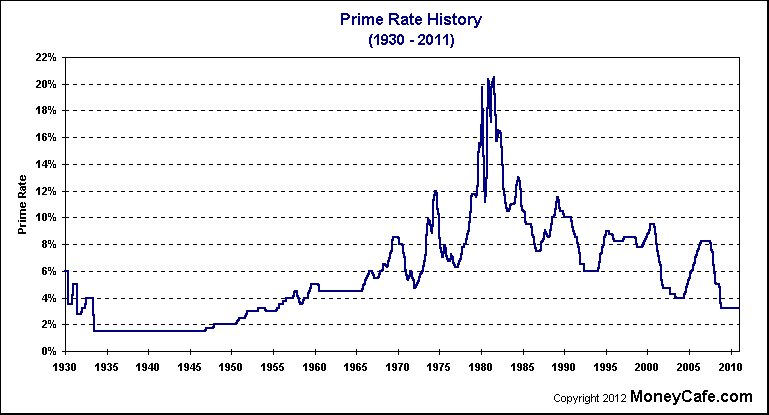
Interest rates are at historic lows. There is no better time to make infrastructure investments to propel us into another half-century of prosperity.


Tuesday, February 21, 2012

The U.S, Debt & Households

In the media, when trying to practice "The Sky Is Falling" journalism (which is often), you'll see it said that the U.S. should act like a household. They shouldn't be in debt. They should balance their budget. They can't spend more than they take in. If the U.S. doesn't heed these warnings, Armageddon isn't far away.

Inspirational fear mongering aside, most U.S households don't to any of these prescriptions.

67% of U.S. homeowners have a mortgage. The median value for a home in the U.S. is $171,000. Per capita income is $26,000. So, let's assume the typical household with two adults is earning $52,000 per year. With a mortgage on eighty percent of the median home value, this is indebtedness of 2.6 times annual household earnings. And, this is just the house. Most households also have car, credit card, and medical debt.

The United States has a $15 trillion dollar economy. U.S debt is also estimated at $15 trillion. As a whole, the country is breaking even. Now a surplus would be nice, but compared to the typical U.S. household (in debt at least 2.6 times more than they earn, on average), breaking even seems pretty nice.


Sunday, August 7, 2011

The Spending Boogeyman

U.S. spending is slightly higher now than the late 70s, early 20s and 80s, and much less than the mid-to-late 40s - a period that coincided with the creation of the American middle-class and the greatest period of economic growth this country has ever seen.

Government spending increases (hopefully) during a recessionary period. This helps the economy recover. Economic suffering of citizens/business is minimized.

Based on historical evidence and the magnitude of our current recession, we should be investing (spending) more on our country and it's citizens.

Tuesday, April 19, 2011

Here's To Your Health

Allowing the Bush tax cuts to expire solves our most immediate budget problems. Health care costs pose the long-term dilemma if allowed to inflate along the current path. But, with unemployment hovering near 9 percent, this is not the time to worry about debt or inflation. Nor is it the time to attempt to debilitate our current health care reform which is aiming to control costs and cover more people. Peoples lives depend on us not worrying about asset prices right now. Getting people healthy and back to work will take care of price appreciation.

90 percent of American households have less than $10,000 in stocks. Thus, of those with a 401K or a similar retirement package (whose solvency is contingent on the up-and-downs of the market) most have less than $10,000 in that account. This isn't an adequate amount to retire on. The majority of the population is better off with affordable health care and the allowance of the expiration of the Bush tax cuts. They need a job and health care! They can't even contemplate retirement at this point.

The master revisionists have hoodwinked the American people yet again. Republicans have transformed Wall Street's follies into a government-caused catastrophe. Budget problems, in their narrative, are the fault of public workers. The reality is that continual tax cuts and ever-increasing health care costs are the culprits in a steadily decreasing American quality of life for the majority of citizens.

Health care cost inflation has steadily outpaced salary increases. Factoring in general inflation, alongside these increasing health care costs, workers have been losing ground for decades. We've heard a lot lately about entitlements and workers needing to pay more for their health care and retirement. The truth is that workers have been paying more for health care. And, for too many its been too much. Burdensome health care costs are the largest cause of bankruptcy.

Compound this with the fact that the U.S. spends nearly $2,500 more per person than the next country (Norway) on health care and its clear that our managed health care system is very inefficient and needs reform. Almost half of health care spending treats only 5 percent of the population. Just under a quarter of all spending treats only 1 percent of the population.

For all of the health care dollars we spend, the U.S. is among the worst in infant mortality and deaths from medical errors, and among the lower half in life expectancy. The percentage of health care that is publicly financed in the U.S. is also among the lowest among OECD countries. Nearly 45 percent of health care is financed publicly in the U.S.. The average for the other OECD countries is 73 percent. The only other country to publicly spend less than 50 percent is Mexico.

The average OECD country spends 9 percent of its GDP on health care. The U.S. spends the most - 16 percent of our GDP goes toward health care. Poor to mediocre results, limited coverage, and explosive costs - the hallmarks of U.S. health care - are what we get for almost one-fifth of our GDP. Americans should consider this an international embarrassment. That we allow so many to go without health care, whilst simultaneously allowing others to egregiously profit off health care misfortune or necessity, Americans should be ashamed and want our health care system improved.

President Obama's health care reform was a good step in the right direction. But until we remove the middleman - insurance companies - from the equation, or at the very least, more heavily regulate what they do (service provision requirements and cost controls), we will see waste and inefficiency. Nevertheless, there are many admirable reforms in the health care plan which deserve proper implementation to gauge efficiencies. The adopted health care reform is projected to save money over the next decade, cover more citizens, and would actually cost millions to repeal.

Now is not the time for austerity. We are merely making the poor, working and middle classes suffer needlessly on the cross of the free marketeers with continual budget cuts for education, transit, local aid, environmental protection, regulation, and other efficient public services that benefit all taxpayers. Voters electing Republicans with the hopes of tax cuts leading to a wonderland of worker-prosperity are biting off their own noses to spite their faces. The Reagan-era of deregulation and tax cuts has decreased our quality of life - stagnating wages, destabilizing retirement, and increasing inequality.

It's time for the government to provide the health care, jobs, and retirement security that the private sector just can't seem to accomplish. Ratings agencies, insurance companies, and other tax cut zealots be damned!

For Further Reading:

Sunday, April 17, 2011

Ending Bush Tax Cuts Would Repair All Budgets

The Bush tax cuts are the largest contributor to our budget deficits. The next most responsible culprit is the Great Recession. Deficits would be cut in half over the next decade by just letting the Bush tax cuts expire. Plus, once the economy is again operating near it's potential, revenues will increase accordingly, wiping out much of the rest of the deficit.


It should be no surprise that the top 1 percent has captured a disproportionate amount of the income gains over time. We've basically told the majority to go without wage increases, health care, or solid retirement accounts, so that a select few could garner more and more of our economic pie. And, it's not just a coincidence that this redistribution has occurred alongside the decline of unionization. As our majority (those not in the uber wealthy 1 percent) has lost a strong collective voice fighting for better wages and benefits, the majority of us have been steadily losing ground.

Although I may disagree with some of the bailouts, low-interest loans, and preferential treatment to banks and insurance companies, the economy under Obama has steadily improved. Our GDP has increased and the private sector has been adding jobs for fifteen consecutive months. And, although government spending was necessary to fill the gap left by the lack of private sector demand, our spending and revenues (though still facing a gap) are converging, slowly, as the economy improves, making their way back into balance.


Sunday, May 16, 2010

Gyro Meat

The Right, never missing an opportunity to take the low-road, is trying to give inertia to a "talking point" connecting a nanny state and the debt/insolvency problems of Greece (along with some other European countries: Italy, Ireland, Portugal, and Spain). As usual, reality doesn't support this privatized, market-humping meme.

The problem primarily stems from these countries following a laissez-faire, highly speculative, highly leveraged, American economic model. A consumption-based growth, fueled by easy credit. Buy now, pay later. And, of course, Wall Street was pulling strings behind the curtain.

With easy money allowing everyone to live beyond their means, purchasing an unsustainable lifestyle, on credit. Thus, giving the illusion of prosperity. The whole global system is in jeopardy. We have spent the last few decades spending on iPhones and SUVs, rather than on sewage systems, public transportation, and energy alternatives. This is a problem of priorities and tax avoidance, not of overly compensated public workers.

As Peter Boone and Simon Johnson assert, "The main problem that Portugal faces, like Greece, Ireland and Spain, is that it is stuck with a highly overvalued exchange rate when it is in need of massive fiscal adjustment." Doug Henwood saw the 'EU problem' in 1998 when the European Union, and a single currency among its member countries, was being created.

Unemployment in the EU's highly indebted countries is: Spain 20%; Ireland 14%; Greece 10%, Portugal 9%; and Italy 8.7%. As of this writing U.S. unemployment is 9.9%.

Public debt as a percent of GDP is: Greece 124.9; Italy 116.7; Portugal 84.6; Ireland 82.9; Spain 66.3. Presently, the U.S. public debt is 67.1 % of GDP. (In Japan it's 105%; Germany 70%; and France 67%.)

Luckily, as Paul Krugman explains, the U.S. is not Greece. He also, like Boone and Johnson, concludes that, "If Greece still had its own currency, it could restore competitiveness through devaluation."

Concerning other talking points regarding Greece, some data needs to be introduced into the discussion. The average Greek worker logs the second highest hours per year among 33 OECD countries. The average age of retirement in Greece is 61.4 years, slightly higher than the European average of 61.1 years. And, the average Greek pension is $990 per month. The average pension in other EU countries: Spain $1,176; Ireland $2,105; Belgium $3,466; and the Netherlands $3,962. Civil servants in Greece represent 22.3% of the total workforce, in France its 30%, in Sweden 34%, and in the Netherlands 27%. "As a result of cuts carried out since 1990...the total real income of civil servants has fallen by 30%."

Those numbers don't indicate Greece is a bunch of lazy, spoiled loafers.

Class warfare, as always, is alive and well.