Saturday, February 16, 2013

Walker's Boondoggle Emporium

Jason Stein and Patrick Marley, of the Journal Sentinel, recently wrote, "Scott Walker wants to invest nearly $100 million to build a faster system to track jobs data, tie technical school and university funding to filling high-demand professions and require nearly 76,000 people to train for work to collect food stamps."

Don't we already have job tracking systems? Employment-wanted ads? Guidance counselors? Advisors? Internships? Consultants? Private headhunters? Employment centers? Or does this have more to do with Walker wanting to have his own [duplicitous] metric(s) for job tracking so he can [falsely] claim he is actually creating jobs?

Will professions (and the degrees related to such) deemed to not be "high demand" simply no longer be taught? Also, how can schools (and their curriculum) possibly predict the exact worker-skill needs of the mobile, evolving, ever-changing economy (and the many sectors and businesses in it)?

During this period of high unemployment, Walker really wants to get tough on food stamp users? Yes, this exorbitant gravy-train must stop. And, what exactly does he plan on training them for? If there were jobs available, they'd be working. Yet another solution looking for a problem.

Surely some training responsibility must fall onto the actual employer (as was common practice until the job training and workforce development shams were implemented in the 1980s). What ever happened to businesses training their own workers? Or, how about just telling the businesses to pay prevailing wage rates to attract workers to the jobs?

Walker's proposals (as highlighted by the article) sound seemingly laudable, but they are so vague that they are realistically just meaningless rhetoric.
For state universities, Walker is proposing awarding $20 million for programs that help the economy, develop a skilled workforce and make higher education more affordable...
Walker's budget would also seek to increase the number of doctors and dentists in Wisconsin.
Yes, an educated, skilled workforce is a good thing. And, more doctors and dentists sound good, too. But we actually need citizens with insurance and/or money who can actually go to a doctor or a dentist. Plus, this would also mean more students would need to be able to afford medical and dental school.

For a guy that supposedly wants smaller government, Walker sure does like creating new committees and/or departments. As part of his Wisconsin educational system overhaul, Walker would like to, "Create a four-person state Office of Skills Development to coordinate the scattered worker-training systems of the state and adapt them to the needs of employers."

How much better would the job prospects (and future) of Wisconsin be if Scott Walker hadn't refused over $800 million in funding for upgrading the Hiawatha train? Now, for needed upgrades to the line (plus possible Talgo lawsuit claims), rather than being covered by the $800+ million Federal grant, it could cost the State of Wisconsin over $100 million.
Taken together, state taxpayers' share of the Hiawatha capital costs that would have been covered by the federal grant could total as much as $99 million, significantly more than the $30 million they would have paid for 20 years of operating costs on the Milwaukee-to-Madison segment.
The platitudes and bromides Walker (and Republicans, in general) spews are just that, sweeping generalizations which are too loosely operationalized to be actionable and/or too idiotically simplistic to be taken seriously as well-planned, thoughtful proposals.

For Further Reading:
Government Spends More On Corporate Welfare Than Social Welfare
Employers Whose Workers and Their Dependents are Using State Health Insurance ProgramsWalmart Is The Largest Food Stamp Recipient

Weekend Reading: U.S Postal Service

Background On The $15.9 Billion Loss By The Postal Service
Do We Really Want To Live Without The Postal Service?
Why We Must Rescue The U.S. Postal Service From The Brink Of Death

Weekend Reading

The Hoax Of Entitlement Reform
How Effective Is The Safety Net?
Minnesota's Mining Not An Economic Panacea
No, Marco Rubio, Government Did Not Cause The Housing Crisis 
Privatizing Roads, Bridges, Schools and Energy Grids?
U.S. Corporations Squeezing Even More Money Out Of Employees

Weekend Reading: Sport Subsidies

Enjoy The Super Bowl! After All, You're Footing The Bill
Money-Wise, Stadiums & Super Bowls Don't Benefit Cities
The Sports-Industrial Complex Is Bleeding America Dry

Saturday, February 9, 2013

There Is No Alternative

Should we just go ahead and pencil in the Republicans (again) as being against aid for New Englanders, which will most assuredly be needed after the most recent storm?

'Behemoth' Storm Leaves 650K Without Power In New England

And, I'm sure this is one of those times where a certain "thing," which is happening as we speak, isn't the most opportune time to discuss said topic. Climate changing, not the time to talk about climate change. Rash of gun violence, not the time to talk about guns. Natural occurrences shutting down whole regions of a supposedly advanced nation, not the time to talk about those utilities, transportation systems, and other basic infrastructure.

It would be too easy, and simple, to just employ a large public works program to alleviate our unnecessarily high unemployment whilst simultaneously upgrading infrastructure, modernizing utilities, greening public buildings, improving public transportation entities and options, burying power lines, implementing more sustainable energy sources, and numerous other upgrades, long overdue in the U.S.  

Sadly though, no. Not going to happen.

Tax cuts to the rescue! 

Sigh.

State/Local Versus Private-Sector Workers

State/Local Versus Private Sector Workers 
Putting aside job security, the calculations show that state/local benefits nearly offset the private sector wage premium, but compensation in the public sector is 4 percent less than that in the private sector
Key findings:
  • State and local workers have a wage penalty of 9.5 percent.
  • Pension contributions and retiree health insurance help close the gap.
  • Total compensation for public sector workers is about 4 percent less than that in the private sector.
Update:

Just wondering why these studies (like the one above) - the ones where academics actually look at the numbers and report on such - rarely are discussed in the Milwaukee Journal Sentinel. Every anecdotal story and "gut" feeling was paraded out in their reporting during Scott Walker's vilifying of public workers. The claims of excessive pay, overly generous benefits, etc. This was all reported as a given, a known fact.

It was, and is, nothing of the sort. Studies refuted it then, and they still refute it now.

Public workers are a bargain. Private workers doing the same work would cost you (at least) 4% more.

'Sconi

Sunday, February 3, 2013

Beware Of The Economic Development Hucksters

It's really tough keeping track of all the debunked and disproven economic development ideas the power-brokers of Wisconsin keep trying to sell the public.

Delta Center Needs To Be Expanded Soon To Compete With Other Cities

The list of investment black-holes proposed for Wisconsin is growing - charter school expansion, venture capital, stadiums, convention centers, etc.

Heywood Sanders' research regarding convention centers has found:
To cities the lure of the convention business has long been the prospect of visitors emptying their wallets on meals, lodging, and entertainment, helping to rejuvenate ailing downtowns.

However, an examination of the convention business and city and state spending on host venues finds that:

The overall convention marketplace is declining in a manner that suggests that a recovery or turnaround is unlikely to yield much increased business for any given community, contrary to repeated industry projections. Moreover this decline began prior to the disruptions of 9-11 and is exacerbated by advances in communications technology. Currently, overall attendance at the 200 largest tradeshow events languishes at 1993 levels.

Nonetheless, localities, sometimes with state assistance, have continued a type of arms race with competing cities to host these events, investing massive amounts of capital in new convention center construction and expansion of existing facilities.Over the past decade alone, public capital spending on convention centers has doubled to $2.4 billion annually, increasing convention space by over 50 percent since 1990. Nationwide, 44 new or expanded convention centers are now in planning or construction.

Faced with increased competition, many cities spend more money on additional convention amenities, like publicly-financed hotels to serve as convention "headquarters." Another competitive response has been to offer deep discounts to tradeshow groups. Despite dedicated taxes to pay off the public bonds issued to build convention centers, many—including Washington, D.C and St. Louis—operate at a loss.
Ronald Wertz, writing for the Federal Reserve Bank of Minneapolis, discovered:
Current research indicates that stadiums and arenas have a particularly bad track record when it comes to delivering on promises of community economic windfalls...
"As market size decreases, the strength of that [economic development] argument becomes shaky," Kaatz said, mainly because smaller markets often do not draw a significant number of visitors from outside the region. Nonetheless, smaller markets continue to use the argument, which Kaatz said "is a reflection of the fact that the whole [convention center] phenomenon has been generated from larger cities, and the argument has filtered down to smaller cities."
A University of Wisconsin-Milwaukee (UWM) Center For Economic Development study explained:
Whatever the original economic folly of Miller Park and the Midwest Airlines Center, what’s done is done: both facilities exist and will certainly operate for the foreseeable future. For the purposes of this study, there is no point in reopening a historical debate about whether public dollars should have been spent on these facilities. However, down the road, as part of a city strategy to build a chimerical tourist industry in Milwaukee, taxpayers once again may be called upon to provide public funding for an expanded convention center, or perhaps a new arena for a local professional sports team. Such expenditures should be scrupulously avoided: tourism has been a losing economic development strategy for Milwaukee as a whole, and for the inner city, tourism investments have represented a huge “opportunity cost’ of funds that could have been invested in inner city economic renewal.
Marc Levine, UWM professor, wrote in the Journal Sentinel:
In that vein, consider Milwaukee's signature initiatives over the past decade: Miller Park, the Midwest Airlines convention center, the Grand Avenue mall make-over and the "Initiative for a Competitive Milwaukee."
All were heavily promoted by the MMAC and GMC, which lobbied for massive public spending on these projects chiefly on the grounds that they would be prodigious job generators. 
Well, the results are in - and Milwaukee's employment decline over the past decade speaks volumes on the job-generating efficacy of the business community's pet projects. 
What's more, these projects soaked up millions in public dollars that could have been devoted to more productive, employment-generating investments.

False Choice

The usual suspects are out stumping for expanding school choice and vouchers.

Instead Of Lifting Residency Requirement, Let's Expand School Choice

Walker Presses Case For Expanding School Choice
School choice includes voucher programs, in which the government helps pay for tuition at private schools, including religious schools.
Tough Decisions Lie Ahead For Wisconsin's School Voucher Program
Voucher advocates have long desired an increase to the $6,442 per-pupil allotment taxpayers spend on children in participating private schools; they want at least equal funding to public charter schools, which receive $7,775 per-pupil. MPS state aid is $7,723, but with local funding the per-pupil amount is closer to $10,000, according to MPS Chief Accountability and Efficiency Officer Bob DelGhingaro.
Bringing the voucher schools into an accountability system that systematically identifies and weeds out perennially low performers is something that has gotten more attention lately. The new state report card system for Wisconsin's public schools was not obligated to include the 112 private voucher schools, and the data systems those schools use (or in some cases, don't have) do not jibe with the systems used by public schools that report to the Department of Public Instruction.
If we actually look at the data, we find that there is little difference between voucher school students and Milwaukee Public School students. Researchers at the University of Arkansas found, "City property taxes go up for each student who uses a voucher, compared to what would be the case if that student went to MPS, while state income taxes go down, as do property taxes in most of the rest of the state."

Diane Ravitch, lead debunker of all things voucher-related, elaborated in The Myth of Charter Schools:
Known as the CREDO study, it evaluated student progress on math tests in half the nation’s five thousand charter schools and concluded that 17 percent were superior to a matched traditional public school; 37 percent were worse than the public school; and the remaining 46 percent had academic gains no different from that of a similar public school. The proportion of charters that get amazing results is far smaller than 17 percent.Why did Davis Guggenheim pay no attention to the charter schools that are run by incompetent leaders or corporations mainly concerned to make money? Why propound to an unknowing public the myth that charter schools are the answer to our educational woes, when the filmmaker knows that there are twice as many failing charters as there are successful ones? Why not give an honest accounting?
According to University of Washington economist Dan Goldhaber, about 60 percent of achievement is explained by nonschool factors, such as family income. So while teachers are the most important factor within schools, their effects pale in comparison with those of students’ backgrounds, families, and other factors beyond the control of schools and teachers. Teachers can have a profound effect on students, but it would be foolish to believe that teachers alone can undo the damage caused by poverty and its associated burdens...
It bears mentioning that nations with high-performing school systems—whether Korea, Singapore, Finland, or Japan—have succeeded not by privatizing their schools or closing those with low scores, but by strengthening the education profession. They also have less poverty than we do. Fewer than 5 percent of children in Finland live in poverty, as compared to 20 percent in the United States. Those who insist that poverty doesn’t matter, that only teachers matter, prefer to ignore such contrasts.
Most recently, Ravitch wrote in the Journal Sentinel:
Milwaukee's choice program is a failure. There are now three separate systems - the public schools, with about 80,000 students; the voucher schools, with about 23,000 students, and the charter schools, with about 20,000 students. There is very little difference among the three sectors in terms of student achievement...
19% of the students in the Milwaukee Public Schools have disabilities, compared to somewhere between 7% and 14.5% in the voucher schools.
It is inefficient to run three separate school systems. Not only does it triplicate costs, but it divides civic energy. All the people of Milwaukee should work together to build a school system that meets the needs of all the children. 
Twenty years of experience with choice in Milwaukee demonstrates that it is not effective or efficient to run three school systems. It does not meet the needs of children.
For Further Reading:
Vouching For Delusion
The Myth of The Milwaukee Miracle
Charter School Riddles

Weekend Reading

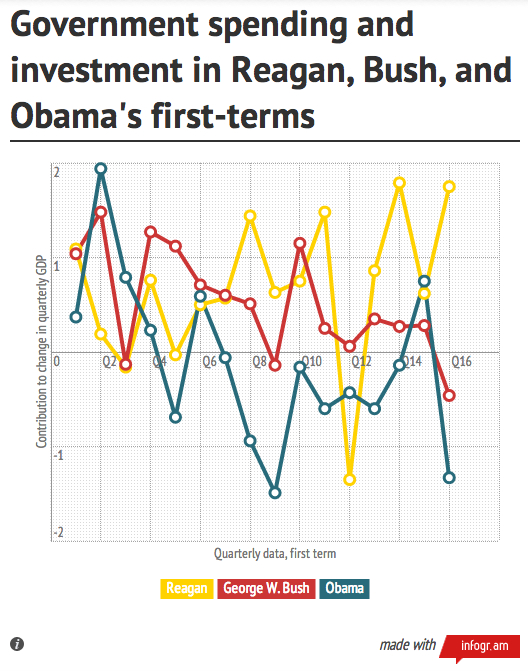
What If Obama Spent Like Reagan?


Sunday, January 27, 2013

While You Were Gone ...

... The Republicans decided to remove your ability to fairly elect your direct representative in government. Republicans are scumbags. They can't win an election fairly any longer (because they're controlled by chauvinistic, racist, homophobic, neanderthals), so they've decided to go all-in on sleaziness, cheating, and fraud, in an embarrassing attempt to hold onto political power. When all you ever had to offer was bullshit, and the people are no longer buying that, all you've really got left to offer is more bullshit. Bravo, Republicans, you are true sewer rats.

How Gerrymandering Helped GOP Keep The House
How Ridiculous Gerrymanders Saved The House Republicans Majority
How The GOP Will Gerrymander It's Way Back
Now That's What I Call Gerrymandering
Virginia Case Highlights Need To Stop GOP Gerrymandering

Democratic House candidates winning the popular vote

Since Obama


Saturday, January 26, 2013

Peeling Back The Scales

The "Grill Hillary" theatrics of the Republican party perfectly encapsulates why, without the help of gerrymandering, they can no longer win elections.


Their smoke screens aren't working any more.

The conservative game used to be misdirecting voters with distractions and wedge issues, whilst simultaneously ramming through negligent legislation. Their moral absolutism and folksy noble facade, all wrapped in an American flag, persuaded many to vote against their own interests, believing that anyone with such strong character (which we knew because of their strong positions taken on "common sense" issues) must have the purest of intentions.

Funny how bread and butter issues, like high unemployment, can suddenly bring the truly important issues into focus. Political theatrics no longer equate with good policy making.

The Benghazi witch hunt is yet more wails and woes of a dying political strategy. [All the Republicans can do now is cheat.]

No Longer Fit For Service

Time to relieve this man of his duties as a law enforcement & public safety official.

Sheriff's radio ad says 911 not best option, urges residents to take firearms classes

Win, Lose, Or Redraw


In 2012, the GOP lost the presidency, they lost the Senate, they lost the vote count in the House of Representatives by a combined 1.1 million votes. Republicans haven't gotten an ass paddling like that since D.C. shut down Madame Kink's Rump Dungeon. If it's Wednesday, ask for the "trickle down".

And it is getting so bad, that to win the presidency next time, some are saying that Republicans might have to change their messaging, or change their policies, or change the constituencies that they serve. Now thankfully, there's a better answer, and it brings us to tonight's Word: Win, Lose, or Redraw.

Yes, even though they lost the popular combined vote, the GOP kept control of the House by a 33-seat margin. And they did it without watering down the Republican Party platform. ("Rape Is So Misunderstood.") 
Now, just how did the Republicans do it? (Missionary Style?) They did it with a little thing I call gerrymandering. (Named for Gerald Mander, The Third) You see, back in 2010, Republican state legislatures across the nation redrew Congressional districts to make them a lock for the GOP. And in some cases, just to send a message to the Democrats. 
Because that's the beauty of gerrymandering. Instead of voters getting to pick their leaders, leaders get to pick their voters. (Me, The People) And I say, why not? We should trust our leaders. After all, we voted them in. (Once, Back in the 70's.) 
Well, now that the GOP has its gerrymandering game down, they are ready to take it to the next level. Republican legislators in the key swing states of Michigan, Wisconsin, Pennsylvania, and Virginia, are lining up behind proposals that would allocate presidential electoral college votes by congressional district. As a supporter of this idea, Pennsylvania state senator Dominic Pileggi argues, "the current winner-take-all system is inherently unfair because the losing party... gets no credit in the electoral count". 
Yeah, the losing party never gets to pick the President. This legislation just allows Republicans to level the playing field. (And Turn It Into A Golf Course) Because folks, here's the great part. If you applied this plan to the 2012 election, even though 5 million more people voted for the Democrat, the Republican would've won the presidency by 22 electoral votes. [source]
Also: Scott Walker: Electoral Vote Proportional Allocation An Interesting Idea

Union Membership & Middle Class Decline

Under the privatized HMO system, health care costs were rising. The privatized retirement system, the 401K, has made retirement more volatile. Wages, for the majority of workers, have been stagnating for decades.

Union membership has steadily been on the decline alongside all of these factors.

Coincidence?


Everybody Knows

Paul Krugman states
"It’s hard to turn on your TV or read an editorial page these days without encountering someone declaring, with an air of great seriousness, that excessive spending and the resulting budget deficit is our biggest problem. Such declarations are rarely accompanied by any argument about why we should believe this; it’s supposed to be part of what everyone knows.
This is, however, a case in which what everyone knows just ain’t so...
It’s true that right now we have a large federal budget deficit. But that deficit is mainly the result of a depressed economy — and you’re actually supposed to run deficits in a depressed economy to help support overall demand. The deficit will come down as the economy recovers: Revenue will rise while some categories of spending, such as unemployment benefits, will fall. Indeed, that’s already happening."
Right now, our policy concern should not be deficits. This austerity push is actually slowing the economy. We should be concerned with spending [infrastructure] and getting people back to work.

Fisching For Answers

What makes Rebecca Kleefisch a suitable Lieutenant Governor? Just wondering. In all the upheavals Wisconsin has seen over the last few years, I was just realizing that Kleefisch has hardly been mentioned, interviewed, or discussed anywhere.

A former television personality ... that's a qualification for running a state? She was a reporter in Rockford, Illinois and Milwaukee, Wisconsin. As Wikipedia details, "Kleefisch's first attempt at politics began when she ran for Lieutenant Governor in 2010. She declared her candidacy live via webcam from her kitchen table, expressing concern for the future of her children and touting her 'kitchen table common sense.'"

Since Scott Walker has taken office, we've barely heard a word from Kleefisch. What does she do? What are her opinions? What are her priorities? Does she have any pet projects? What are her goals? Is there anything she specifically wants to accomplish in her role?

As citizens and voters (and this question primarily is for the right-wingers whom voted for the Walker/Kleefisch ticket) what about Kleefisch made you feel she was good Lieutenant Governor material? Governor material? Does she have an area of expertise? She's a UW-Madison graduate with a degree in journalism and mass communication. This seems appropriate for a television news personality, but Lieutenant Governor?

[Yes, there are many unqualified and, what would appear, uninterested political operatives participating in public service. These same doubts and suspicions can be leveled at them.]

Walker's opinions, although I feel they are reckless and uninformed, are at least somewhat well-known. (And, at least Walker started out as an state assemblyman, working his way up the political ladder.) Sure, Kleefisch is a Republican. I understand she'll parrot the party-line. But what else do we know about any of her positions? Has she ever spoken at length, showing actual in-depth knowledge, regarding specific policies?

Take a look at her State website. There's practically nothing there. Why even bother having the website? The site is completely absent of information and substance. With a yearly salary near $77,000, most would expect a clearer set of job duties, alongside more frequent public appearances, for a lieutenant governor.

The more I think about Kleefisch's sudden rise to the second most powerful position in Wisconsin, the more perplexing it gets.

Phil Needs A Mulligan

Phil Mickelson, a man who makes millions playing golf, is upset that he may have to pay more in taxes.
"If you add up all the federal and you look at the disability and the unemployment and the Social Security and the state, my tax rate's 62, 63 percent," he said. "So I've got to make some decisions on what I'm going to do."
First of all, lets get what is obviously wrong out of the way - Mickelson doesn't pay 63 percent of his income back in taxes. I think all that sun on those beautiful golf courses must be burning Phil's brain.


Sadly, the article goes along with this 63% fantasy. This is a common mistake in tax reporting - differentiating tax incidence (the amount of total earnings paid in taxes) versus marginal tax rate (the portion of earned income and the tax rate which applies to that portion). If one is going to write an article about some millionaire bitching about the taxes he/she pays, at least do the leg-work and find the actual tax rate.

"There are going to be some drastic changes for me because I happen to be in that zone that has been targeted both federally and by the state and, you know, it doesn't work for me right now," he said. "So I'm going to have to make some changes."
Yes, this poor man. He'll have to wait on that 9th home and 6th BMW.

We're in the second worst depression in the history of the country and Mickelson has the nerve to complain about not being as big of a millionaire? People are out of work and losing their homes, but Mickelson can't get that 5,000 square foot addition on his 4th home and that's equivalent and just as important.

According to Wikipedia, "Although ranked second on the 'all-time money list' of tournament prize money won, Mickelson earns far more from endorsements than from prize money. According to one estimate of 2011 earnings (comprising salary, winnings, bonuses, endorsements and appearances) Mickelson was then the second-highest paid athlete in the United States, earning an income of over $62 million, $53 million of which came from endorsements."

As Len Burman (Professor of Public Affairs at the Maxwell School of Syracuse University) commented, "Please stop whining and give thanks for being able to earn a fabulous living playing a game and selling golf clubs (even after tax). 99.999% of people would never have that option, no matter how hard they worked on their swing." [Burman also estimates, "In net, Mickelson will owe about 52% of his marginal* earning in federal and state taxes."]

Update:
Phil's agent and public relations people must have told him what a douche his comments make him look like. He's begun the apology tour.

*Marginal tax rate: tax payers are divided into tax brackets or ranges, which determine which rate taxable income is taxed at. As income increases, earnings will be taxed at a higher rate than the first dollar earned.

Going The Wrong Way

In the article State Surplus To Reach $485 Million; Revenues To Miss Projections, the Republican co-chairs of the Legislature's Joint Finance Committee, Sen. Alberta Darling of River Hills and Rep. John Nygren of Marinette, commented, "The revenue numbers prove we are moving in the right direction. Moving forward on the budget, we will continue to work in a cautious and conservative manner to make sure that taxpayers' funds are spent wisely."

Yet, actually, all the numbers show is that Wisconsin has decreased spending (demand) during a recession. Exactly the opposite of what economics teaches. And, which is why Wisconsin ranks 42nd in job growth among the states over the last year.

To use the Republicans' (misplaced) household analogy, if a household was debt-free but unemployed, would the members of that household feel they were on the right track? We've cut programs and credits to the poor, cut education funding, and gave back $800 million in transportation money, to name a few.  Based on Wisconsin's job growth ranking, most would conclude we're going the wrong way.

I'm not sure Republicans really know which way "the right direction" is.

Thursday, January 24, 2013

Republican House Majority Due To Gerrymandering


"But I just have to say one other really important point, because I made a mistake over the past month talking about how Republicans have also won a majority in the House," he continued. "We actually got a minority of votes nationwide in House races."
 "It was just gerrymandering from 2010 that gave us the majority."
A post-election analysis by Think Progress' Ian Millhiser determined that House Democrats actually received almost 1.4 million more votes than House Republicans in 2012, but thanks to partisan gerrymandering, Democrats would have needed to win by 7.25 percentage points to take back control of Congress.
Scarborough on Republicans Winning House Majority: 'It Was Just Gerrymandering'

The Untouchables: How Wall Street Escaped Prosecution


Watch The Untouchables on PBS. See more from FRONTLINE.

Thursday, January 17, 2013

The Platinum Coin


Visit NBCNews.com for breaking news, world news, and news about the economy

Paul Ryan's Video Diary

The NFL: A Bad Lip Reading

Wayward Walker

During these recessionary times, with stubbornly high unemployment, Scott Walker wants to increase the requirements for providing unemployment benefits. (Whilst simultaneously reducing regulations on business.)

Scotty rode into town claiming (like all Republicans) he would create jobs and fix anything and everything else that might be broken. Tax cuts, deregulation, and privatization (again) was the answer (again) to all our problems.

Walker hasn't created anywhere near the jobs he promised during his campaigning. Which isn't much of a surprise since most of the legislation he has proposed has been payback to cronies or ideological chest-thumping to impress his base.

But this just seems punitive and wrong. Making it harder for people whom are already down on their luck to get unemployment benefits? Does Scotty not realize that this would further depress the economy? Has there been an explosion of unemployment benefit fraud sweeping Wisconsin? Does Walker realize there is only 1 job opening for every 3.3 persons looking? Should people be punished for not finding the job that isn't there?

If we're looking to cut costs/spending, shouldn't we first be looking at reducing the benefits (or increasing the tax rates) for those doing the best, rather than taking away the crumbs for those at the bottom?

Sunday, January 13, 2013

Residency Requirements

Much (in the last year) talk about ending the residency requirement for City of Milwaukee (especially for police and firefighters) has been bandied about. Primarily by persons whose motives, and interest in this topic, are unclear. The residency requirement has been in place since 1930. Why is the state interfering with a City of Milwaukee employment policy?

Recently, Gary Kraeger, a Wind Lake appraiser, weighed in - The Principles Of The Residency Rule. He opines, "Milwaukee is everyone's business in the state, especially since Milwaukee is very dependent on state money [state aid to Milwaukee has actually plummeted]... On a third hand, Milwaukee is the fourth-poorest big city in America [not sure where this number comes from, Kraeger doesn't say], at last word, and I suspect it might move up a bit if we dump the residency rule. In which case, I expect Milwaukee to need even more of our money. On another hand, it sounds sensible that if you want taxpayers to pay your salary in a community, you should be one of them. In that way, if your compensation benefits from high taxation, at least you're pulling the cart, too. Also, normally you care more about the community you live in."

Kraeger states, "On principle, however, the residency rule should be lifted and lifted by Milwaukee itself." Um, yeah, so if it should be up to Milwaukee, why are so many people outside of Milwaukee concerning themselves with Milwaukee governance?

"The biggest hand of all is the principle of freedom," claims Kraeger. When it comes down to it, Americans should be able to do what they want, when they want, and where they want. No rules, no questions.

Kraeger continues on describing how removing the requirement could hurt property values in the City. So, he has laid out numerous economic examples of why the residency requirement is in place. Numerous reasons why it should be there. But he then concludes that it should be ended. Why? Freedom.

If the ultimate rationale for an argument one poses is "freedom," one really doesn't have much of an argument or a rationale.

The residency requirement is a pretty simple, straight-forward policy - as a public worker, you should live in the city that employs you. The economic idea of "leakage" is addressed by such a policy. Much of the dollars earned by these public employees will be spent back within the community. Which also addresses the economic multiplier effect - money earned and spent in the same area, thus percolating and rippling throughout the local economy, over and over. As opposed to City of Milwaukee tax dollars funding a Milwaukee Police Officer who now lives in Waukesha and spends most of his/her money there.

There are 2,697 City of Milwaukee fire and police employees. The average police employee earns $65,649; for fire it's $67,554. This a potential $177 million dollars of earnings "leaking" out of the city, including property taxes, sales taxes, and other spending.

The possible loss of property taxes, spending at local businesses, and neighborhood stability are more than sufficient reasons for maintaining the requirement. The economics behind the requirement make it a no-brainer.

Governing is a set of rules. If you want to live or participate in certain communities you have to follow their rules. Some subdivisions make homeowners have 5-acre lots. Others require certain facades or materials be similar amongst the homes. If you don't like those rules, you go somewhere else. That's freedom. Freedom isn't doing away with things one doesn't like.

Saturday, January 12, 2013

Again We Rise


Milwaukee Rocks!

Sylosis, Hatebreed, In Flames, and Lamb of God visited Milwaukee on November 9, 2012. In the interview (below), Josh Middleton, of Sylosis, mentions Milwaukee (about 3 minutes in) as one of the best places they played during their whole tour. Keep up the good work, Milwaukee metal-heads!

The Great Pretender

Confirming my belief that Republicans are out of ideas:

Gov. Scott Walker Proposes Cutting Income Taxes
Gov. Scott Walker pledged Thursday to cut income taxes in the state budget he signs this summer, calling it the best way to spark the economy. But he also said the reduction would be phased in over a number of years.
Tax cuts, the best way to stimulate the economy?

As much as Republicans would like to forget George W. Bush's entire time in office, his two terms were recent historical proof of the fact that tax cuts do not spark the economy.

"In Bush’s first term, the economy shed 913,000 private sector jobs! 913,000! The only thing that saved Bush’s first term from being a complete economic disaster, in terms of employment, was robust public sector growth: The economy added 900,000 government jobs," recalls Andrew Leonard.

Ronald Brownstein adds, "On every major measurement, the Census Bureau report shows that the country lost ground during Bush's two terms. While Bush was in office, the median household income declined, poverty increased, childhood poverty increased even more, and the number of Americans without health insurance spiked. By contrast, the country's condition improved on each of those measures during Bill Clinton's two terms, often substantially."

Do Republicans believe in any policies that actually work in reality?

Training, Skills, & Other Fairy Tales

Time for Wisconsin to get a new playbook. I haven't heard a single innovative idea for economic development from any of the supposed experts being quoted in the media, nor from our development agencies. Just more regurgitation of development hucksterism. And, if what we hear from the Walker administration is any indication of our current state of development, we're still stuck in the '80s.

Research parks, stadiums, venture capital, etc. Why are we continuing with proposals that have already either run their course or been proven ineffective?

Here we go again.


As I wrote back in May 2009: 
Gordon Lafer, associate professor at the University of Oregon, in his expansive and definitive work on job training, The Job Training Charade, states, “Job training has served primarily as a form of political diversion. At both the federal and local levels of government, the rhetoric of job training has encouraged a discourse about poverty and unemployment which minimizes the public’s expectations of government. If poverty were viewed largely as the result of a shortage of jobs, and the government were held responsible as employer of last resort, scores of mayors and governors would have been thrown out of office in response to the dislocations of the past two decades. By instead promoting a view of poverty as largely rooted in the educational, cultural, and moral failings of poor communities, the assumptions underlying training policy suggest that the government could not be expected to provide more than marginal assistance toward solving this problem.

As noted in this review of Gordon Lafer’s work, “The commonsense idea that there are plenty of jobs to go around if only the unemployed and the poor had the motivation and the skills to fill them…The number of decently-paid jobs that were available over the last twenty years has never been more than a fraction of the number needed to raise the poor beyond the poverty level…Except for certain professional positions that require specialized and highly controlled education and that compromise a very small portion of the labor market, variables such as gender, age, race, and whether or not workers are unionized, are more important determinants of the levels of employment and wages than are the levels of education.”

David Howell, professor at Milano The New School for Management and Urban Policy, observes, “In short, employers in the 1980s responded to increased competitive pressures by taking a low-road human resource strategy, one aimed above all at reducing current labor costs…In a great many industries, workers learned new skills to work with more advanced production technologies – but their higher productivity was not reflected in higher wages…In the 1980s, higher skills have simply not led to higher wages. In industry after industry, average educational attainment rose while wages fell.”
The article (Gov. Walker May Be Poised To Reorganize Job Training) also declares "the state's skills mismatch" as one of the reasons to reorganize job training. Two disproven ideas in one article, now that's efficiency. Job training is pointless unless there are actual jobs available (that pay a commensurate wage for the skills). And, skills mismatch is a clever rebranding for what is actually just low wages.

Walker's World: Our Dystopian Future

"The Wisconsin Economic Development Corp. (WEDC) said in its report that the money it invested affected a total of 218 businesses and 23,759 jobs in the state last fiscal year. WEDC made a total of $56.2 million available to businesses through 170 grants and loans, the report found...
But unlike nearly every other quasi-public authority at the state level, the corporation is not required by law to report yearly on its finances. It took nearly a year and a half for the agency's board to see comprehensive audited financial statements."
Got that? Unlike nearly every other quasi-public authority at the state level, the WEDC is not required by law to report yearly on its finances. 

Yes, they're only dealing with millions of public dollars. Why should they have to keep track of anything or explain their decisions and investments? Didn't Scotty talk about transparency a lot during his campaign? Hypocrisy seems to be a prerequisite for the Republican party. I guess that's just the beautiful evil genius of conservative arrogance. They're always railing the most about the things that they are the most guilty of doing. 

Sorry, but when someone establishes an quasi-public (i.e. private) authority and specifically write laws which exempt that organization from having to report on it's finances, one must conclude nefarious spending and accounting are taking place at that entity.

Keep it up, Scotty. Pretty soon it will be you facing the charges rather than just your underlings. 

Not only does Walker wants Illinois' jobs, he also wants their corrupt ways.

Health Spending By Age & Country


Health Spending By Age & Country

Tax Rates Since 1913


Weekend Reading

America's Staggering Defense Budget, In Charts
Another Dead End For Wisconsin Families
GOP's Motto: 'Grab All You Can'
Invest In MPS, Not Voucher & Charter
Michelle Rhee's Failing Report Card
Rising Cost Of State's Outside Contractors
Scott Walker: Liar
Social Security/Medicare VS Corporate Welfare
What's Inside America's Banks
Wisconsin's Rising Wealth Gap

Low Wages, Not Skills Mismatch

More evidence from Catherine Rampell invalidating the skills mismatch story.

Are There Really No Good Job Applicants Out There?
What’s especially odd about these survey responses is that if employers are having trouble finding qualified workers, they should be bidding up wages to attract the few qualified workers who are out there. But that’s not what the data show.
Average hourly earnings in the private sector fell over the period that businesses reported having increased trouble finding qualified workers (December 2009 to September 2012). Perhaps this means businesses are having trouble finding qualified workers precisely because they’re unwilling to pay new hires enough money.

Racing To The Bottom In Wisconsin

Wisconsin Republicans' Tax Plan Follows The Race To The Bottom

From the article:

"Vos proposes to reduce taxes on what he calls the “middle class,” but his definition leaves out nearly two-fifths of tax filers in the state — the 39 percent of households that earn less than $20,000 annually...

Figures from the national Institute for Tax and Economic Policy analyzed the total tax burden by state and found the bottom 20 percent of Wisconsinites pay 9.4 percent of their income in taxes. By contrast, the top one percent of Wisconsinites pay just 6.7 percent of their incomes in taxes...

Consider what the Republicans and Gov. Scott Walker did to taxes in their first legislative term. They passed $36 million in capital gain taxes and 46 percent of those breaks will go to the top 2 percent of earners in Wisconsin, according to the Legislative Fiscal Bureau. They also passed $49 million in tax breaks for those with Health Savings Accounts, again benefiting the well-to-do: the average income of someone with such an account is more than $100,000, according to the Government Accountability Office...

As for poor people, Walker and Republicans slashed the earned income tax credit. This provision was created under Republican Gov. Tommy Thompson and won bipartisan support as a way to reward work and help those whose wages were inadequate to support a family."

Saturday, January 5, 2013

Open For Business?

Golden Guernsey in Waukesha suddenly closes, sources say

Plain & Simple: This Is Class Warfare


Also: Battles Of The Budget

Suicide & Service

"More soldiers took their own lives than died in combat during 2012, new Department of Defense figures show. The Army's suicide rate has climbed by 9 percent since the military branch launched its suicide-prevention campaign in 2009."

Shale Gas Not As Clean As Thought

"Last February scientists from the National Oceanic and Atmosphere Administration (NOAA) and the University of Colorado, released the findings of a study that claimed that around four percent of methane was escaping into the atmosphere as natural gas was being extracted from a field in Denver.

Now that same group has studied the gas production techniques of a field in Utah and discovered that around nine percent of the methane gas extracted at the gas field was leaking into the air. Methane is one of the most potent greenhouse gases, far more so than CO2, and its escape during the production process of the natural gas now challenges the claims that burning natural gas produces far fewer emissions and is better for the environment than coal.

The shale boom has led to a huge increase in natural gas production and as prices have fallen significantly many utilities have been converting their coal power plants to run on cheap gas. The gas industry has claimed that this transition has helped cut US greenhouse gas emissions across the country because gas releases far fewer carbon emissions than coal.

It turns out that whilst burning the gas is cleaner than coal, the extraction process releases large amounts of dangerous greenhouse gases." ~ Study Finds Shale Gas Not As Clean As Thought

Tax Changes For 2013

[source, h/t The Big Picture]

World's Richest People

[source, h/t The Big Picture]

Also: World's Richest Added $241 Billion in 2012

Tuesday, January 1, 2013

Deficit Facts

"When President Obama took office in 2009 the deficit was already running at close to a record-setting pace. At the end of that fiscal year, it was $1.4 trillion. That’s “trillion” with a “T”. Ouch. Fiscal 2012 ended on Sept. 30. The final figures aren’t yet in, but at the moment the Congressional Budget Office projects the deficit will be ... (drum roll) $1.1 trillion. So smaller. Not doubled at all," reported Peter Grier.  Did Obama Really Double The Deficit?

"It's worth noting, then, that as of today, the U.S. federal budget deficit has shrunk -- a lot. Obama inherited a deficit of nearly $1.3 trillion from Bush/Cheney the moment he took the oath of office. This year, however, according to the official data published by the Treasury Department, the deficit was $1.089 trillion," explained Steve Benen.  U.S. Budget Deficit Shrinks

The Truth About Social Security (And Alan Simpson)