Sunday, December 29, 2024


Friday, November 13, 2020

Friday, January 20, 2017
Sunday, March 13, 2016
Stop Cryin' In Yer Beer
Now, I wanted a more liberal agenda pursued, but nonetheless, I'm not blind to the fact that Barack Obama has accomplished very, very big things.
Government is shrinking, deficits are declining, employment is improving, health care inflation is subsiding, infrastructure projects have been completed nationwide ...
For Further Enlightenment:
PRESIDENT OBAMA HAS DONE A LOT! A LIST OF 340 ACCOMPLISHMENTS SO FAR, WITH CITATIONS
Thursday, February 25, 2016
Republican Public Policy Does It Again (And It's Not Good)
- Slow job growth
- Budget deficits alongside giveaways and tax breaks for cronies
- Costing Wisconsin millions by refusing to expand health care under the Affordable Care Act; leading to less people having health care
- Increasing poverty
Wisconsin Is About To Make It Easier For Debt Collectors To Go After Consumers
Sunday, October 26, 2014
Scott Walker Made The WRONG Decision On Medicaid Expansion
Scott Walker made the right decision on Medicaid expansion, opines Brett Healy of the John MacIver Institute (a right-wing group of hacks similar to the Heritage Foundation or the American Enterprise Institute).
As usual, Healy and his closed-minded ilk are all wrong.
The state's Medicaid program, known as BadgerCare, covers about 782,000 people, most of them children. Costing state taxpayers about $4.6 billion, it is the second most-expensive item in the current two-year budget, accounting for 15 percent of total spending, behind only aid to schools.
Walker took a unique approach to the Medicaid issue, breaking from other Republican governors in states like Ohio, New Jersey, and Michigan, who accepted the Medicaid money.
Walker lowered Medicaid eligibility from those earning 200 percent of poverty to just 100 percent. The federal money would have paid for coverage for those earning up to 138 percent of poverty.
Instead, nearly 63,000 people lost Medicaid because he installed tighter income requirements — those earning less than $11,670 for an individual and $23,850 for a family of four qualified. If he had accepted the federal money, individuals earning up to $15,421 and families of four making up to $31,721 would have qualified.By refusing Medicaid Expansion, the White House estimates 120,000 Wisconsinites will go without coverage.

The 20 states choosing not to expand their Medicaid programs under the Affordable Care Act are forgoing billions of dollars in federal funds, while residents in their states are contributing to the cost of the expansions in other states, according to a new Commonwealth Fund study.Wisconsin will lose $1.848 billion, according to the study.
After taking into account federal taxes paid by state residents, states with the highest net losses include Texas, which will see a net loss of $9.2 billion in 2022; Florida, which will lose $5 billion; Georgia, which will lose $2.9 billion, and Virginia, which will lose $2.8 billion.
The Census Bureau found, "New data released by the U.S. Census Bureau’s American Community Survey shows that among the eleven major metropolitan areas with uninsured rates higher than the national average, seven of them are in states that have not expanded Medicaid under the Affordable Care Act."
"Harvard and CUNY researchers say death toll from 25-state ‘opt-out’ may be as high as 17,100 annually; hundreds of thousands more will be harmed by depression, untreated diabetes, and skipping mammograms and pap smears," said the Physicians for a National Health Program.
Here again, with regard to public policy, the Republicans are marching around the country misrepresenting reality and harming millions of Americans in the process. The same people they keep claiming their policies are helping. When will American voters learn - Republicans don't have your best interest at heart.
For Further Reading:
States forgo billions by opting out of Medicaid expansion
Rejection of Medicaid expansion costing Kansas, Missouri hospitals billionsStates Are Turning Down an Insane Amount of Free Money by Refusing to Expand MedicaidThe 23 States That Have Declined Medicaid Expansion Are Spending $152 Billion For Nothing
Sunday, February 16, 2014
Memo To Republicans: The ACA War Is Over
The top story in their Sunday Editorials & Opinion section was Life In The Land Of Make Believe by Kathleen Parker.
Another misconstruction from the right-wing completely misreading data points to claim, again, that the Affordable Car Act (aka Obamacare) is a failure and is destroying America. Anyone with the ability to do a google search, or if you just happen to get your news from somewhere other than FOX News, can quickly dismiss these false, incendiary claims.
Why did the Journal deem this article newsworthy?
Here's just two of Parker's debunked talking points:
Only about 3 million people have signed up for health insurance through the new marketplaces, well below expectations.Parker's 3 million signup number is only the private insurance plan signups. Including Medicaid and CHIP, the minimum estimate for total Affordable Care Act signups is 8.8 million, with a maximum of 14.4 million, thus far. The program got off to a rough start, yet signups are only marginally below expectations. Are Republicans unhappy that more people now have health insurance?
A Congressional Budget Office (CBO) report issued earlier this month estimates that by 2017, the workforce will be reduced by the equivalent of 2 million full-time jobs and 2.3 million by 2021 — because of Obamacare.
Destroying jobs is quite different from people having the choice of whether to work or to raise a family. People no longer need to stay at horrible job to have insurance. This actually opens up jobs for those looking for work.
As the Economic Policy Institute explains, "In December, the number of job seekers was 10.4 million (unemployment data are from the Current Population Survey and can be found here). Thus, there are 10.4 million job seekers and only 4.0 million job openings, meaning that there are only enough job openings for 38.5 percent of job seekers."
Based on their history of being all about the family-unit and saving our children, along with their supposed intense interest in helping the unemployed, one would think the Republicans would support a program that accomplishes both of these goals.
But, in fitting with their typical prescription, Republicans are more interested in power than policy. Facts be damned! There are actual specifics of the Act that can be improved, efficiencies to be gained, by working with Democrats and constructively analyzing and implementing adjustments and/or improvements to the program. But, instead, Republicans are still raging on, spinning fanciful yarns and lying through their teeth, in the (health care) war they've already lost.
For Further Reading:
Health, Work, Lies
Bette In Spokane Blogging
CBO Says Obamacare Will Raise Wages
Obamacare Attacks Failing
Saturday, July 28, 2012
The Good Government Does, Yet Another Example
The Affordable Care Act ("Obamacare") requires insurance companies to rebate part of the premiums it receives if it does not spend at least 85 percent of the premiums on health care services.
In this case, they only spent 84 percent, thus they have to rebate 1 percent of the total health insurance premiums paid the the employer and employees in the group health plan.
Yet another example of how President Obama's health reforms are actually working. Many would have preferred universal coverage - Medicare for all. But at least we're headed in the right direction.

The alternative is continuing to pay comparatively outrageous fees for our health care while receiving no better care, and also having to deal with the millions of citizens that otherwise would be without any health care coverage (other than emergency rooms, which cost even more).


What do Republicans want? What is their alternative, better plan? "Obamacare" seems to work. What are they opposed to?
Update:
Hmmm, so rising health care costs are the fault of Medicare/Medicaid, Health Maintenance Organizations, socialism, and the government, in general (according to a commenter).
How can nearly every other developed country in the world provide better quality health care, at half the cost, in what are much more "socialized" systems than ours? The answer isn't more "market," it's less. Medicare already controls costs better than the private sector. Removing private insurers and their greed from the equation would bring American health care costs in-line with the rest of the world.
Markets work nicely for socks and widgets, but not so much for health care. For you, "Anonymous," read and learn:
Why We Need An Individual Mandate For Health Care
Why Markets Can't Cure Health Care
Uncertainty & The Welfare Economics Of Medical Care
The Market For Lemons
Saturday, April 28, 2012
Weekend Reading
The Founding Father Backed Health Insurance Mandates
Inequality 101: The Picket Fence & The Staircase
The Old, White, Rich Men Who Are Buying This Election
Out Of Control Medicare Spending? Maybe Not
Venture Capital Is Sucking (Your Money)
Want To Cut Health Care Costs? Start Here
What Mitt Romney Learned From His Dad
Sunday, February 26, 2012
Sunday Reading
Decades Of Decline In Employer-Sponsored Health Insurance Coverage
Gary Oldman
Medicaid's Big Spenders, In One Chart
No Shortage Of Rental Housing, Rents Not Rising Rapidly
Representatives & Senators: Trends In Member Characteristics Since 1945
Right-Wing Plot To Undermine Science In Public Schools
SuperPAC-Men Playing For Big Payday
The 10 Worst Things About The Oscars
Universities In Innovation Networks
You're Not Paying The Tax Rate You Think You Are
Friday, January 20, 2012
Economic Indicators

Consumer Price Index: Fuel Oil and Other Fuels; Water, Sewer & Trash
Fuel prices started to spike around 2002-2003.

Consumer Price Index: Housing; Rent of Primary Residence

Consumer Price Index: Medical Care
Medical costs began their exponential rise during the mid-1980s.

Consumer Price Index: Transportation

Health Insurance: Not Covered

Home Prices

Light Weight Vehicle Sales

Manufacturing Durable Goods Sector: Output Per Hour
Output per hour has steadily increased.

Manufacturing Durable Goods Sector: Real Hourly Compensation

Resident Population: Milwaukee County

Nonfarm Business Sector: Labor Share; Output Per Hour

Nonfinancial Corporations Sector: Output Per Hour; Labor Share

Nonfinancial Corporations Sector: Profits; Real Hourly Compensation

Total Construction Spending: Residential; Commercial

Unemployment Rate: Milwaukee County

Monday, January 9, 2012
Wisconsin Economic Indicators

Health Insurance Coverage: Coverage Rate in Wisconsin (WIHICCOVPCT)

Home Ownership Rate for Wisconsin (WIHOWN)

Manufacturing Employment in Wisconsin (WIMFG)

Employees on Nonfarm Payrolls in Wisconsin (WINA)

Total Gross Domestic Product by State for Wisconsin (WINGSP)

Rental Vacancy Rate for Wisconsin (WIRVAC)

House Price Index for Wisconsin (WISTHPI)

Unemployment Rate in Wisconsin (WIUR)

Thursday, October 20, 2011
What We've Become
How can anyone in their right mind be as morally bankrupt as to support and vote for such a platform?
What kind of world are we living in? We are now cheering for the death, rather then the redemption, of our fellow men/women.
Update:
We can now add child labor to the list of atrocities Republicans will applaud.
The (Horrible) Reality of Walmart
For Further Reading:
Always the low-road strategy
Cudahy: Out of ideas
Purchasing power
Walmart subsidy report for Wisconsin
Saturday, March 5, 2011
Private Sector Piracy
As an example, the figure here shows the share of workers in the private sector and in state and local governments that have employer-provided health insurance where the employer pays at least a portion of the premium. In 1979, the earliest year of data available, the private, state, and local sectors were not far apart. (Then, as now, state and local employees tend to be older and have more education, two factors that are highly correlated with better pay and benefits.) Over the next 30 years, the health-insurance coverage rates remained essentially unchanged for state and local government workers. But, the share of private-sector workers with employer-provided health insurance fell more than 15 percentage points --from over 70 percent to just under 55 percent.
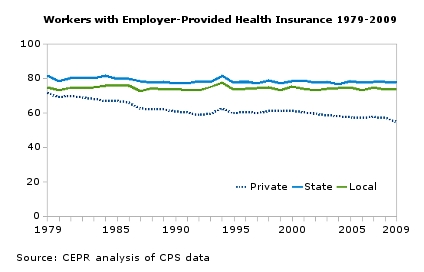
State and local workers have been much more successful at retaining their benefits than private-sector workers. They have made concessions, including paying a higher share of their premiums, higher deductibles, and higher copays. But they have largely been able to maintain coverage for themselves and for their families. Private-sector workers, however, have had the rug pulled out from under them --by private-sector employers.
The higher unionization rate in the public sector has undoubtedly played a role. Over one-third of public-sector workers are in a union, compared with only about seven percent in the private sector. But, the union role has primarily been to hold state and local governments --and the much smaller share of unionized private-sector employers-- to the standard that these employers met before the 30-year assault on the American middle class that began in the late 1970s."
Sunday, September 13, 2009
The Descent
Also, check out Daniel Gross' Sorry, Pal, but You're Not Rich.