Friday, January 31, 2014

Give Reality Back To Taxpayers

Lt. Gov. Rebecca Kleefisch took to the Journal Sentinel to boast about all Scott Walker has done for Wisconsin and to propose giving the budgetary "surplus" back to the taxpayers.

If you consider borrowing, increasing long-term debt, as a "surplus," then Scott Walker has really been on point. Yet, as most can see, this is merely kicking the can down the road. A bit of smoke and mirrors for Mr. Walker, so he can present the illusion of positive policy outcomes. But in reality, he's just burying Wisconsin is debt so he can advance his own political career.

To come up with her rosy picture, Kleefisch compares the Walker administration's tenure with the peak of the recession. One would expect improvement after hitting rock bottom. They could have taken office and done nothing and things would have shown some improvement. For a truer test, we need to see where we were at before the recession. To show real gains one would expect improvement above and beyond the norm, and improvements that rank near the best among states, especially if one is going to claim his or her policies are doing so much good.

Kleefisch crows about the improvement in the unemployment rate. "Four years ago, the state's unemployment rate was 9.2%. In fact, Wisconsin lost more than 133,000 jobs and lost 27,000 businesses during Democratic Gov. Jim Doyle's final term in office. After Gov. Walker and I were sworn in, we took aggressive action to get Wisconsin working again. Now, the unemployment rate is the lowest it has been in more than five years at 6.2%."

As you can see from the graph below, its awfully convenient to choose 2010 for comparison, rather than any other time before that. When we look back just a bit further, we see Wisconsin still has a way to go to reach full employment. Our current unemployment rate ranks us 22nd among the states. In 2011 and 2012, although we had higher unemployment rates (6.9 and 7.5), we ranked 19th among the states for both years. As far as the state is doing compared to others, we've actually gotten worse.


Kleefisch talks of turning a deficit into a surplus. "We also took necessary steps to get our fiscal house in order over the past few years. We inherited a $3.6 billion budget deficit when we took office and turned it into a $759 million surplus by the end of the 2011-'13 budget."

As Media Matters commented, "Fox News hyped Wisconsin Governor Scott Walker's economic record, claiming that the governor's economic plan generated a nearly $1 billion budget surplus while ignoring that the current surplus is built upon a projected structural deficit and that the state ranks 28th in the nation for job creation under Walker's tenure." From the same article, "The Legislative Fiscal Bureau: Under Walker's Budget, Wisconsin's Structural Deficit Would Grow To $725 Million. A non-partisan analysis of Walker's most recent budget concluded that the Governor's proposed tax cuts would increase the state's budget shortfall over the coming years. Walker's tax plan hyped by Fox would in fact cost the state $180 million and would ultimately turn the touted surplus into a deficit by 2017."

The Democratic Party of Wisconsin also notes, "When Scott Walker was running for governor, he promised to balance budgets Generally Accepted Accounting Principles (GAAP); however, the budget he claims as balanced is anything but when using GAAP. By gutting public education to the tune of $2.6 billion and slashing more than $500 million from public healthcare, along with skillfully kicking the can down the road with accounting tricks that pass debt onto future budgets, Walker has given the appearance of a balanced budget. But when using the GAAP that Walker promised to use, Wisconsin’s deficit will actually be more than $3 billion at the end of the biennium – a larger deficit than Walker inherited."

Kleefisch continues, "And some 100,000 jobs and nearly 13,000 new businesses have been created since we took office." Again, as we can see from the graph below, all this "job creation" has only gotten us back to 2004 levels. Oddly, I remember some politician promising 250,000 new jobs in his first term. 


Republicans always talk about "putting money back into taxpayers pockets." Although Kleefisch didn't mention it in her op-ed, lets take a look at the real median household income in Wisconsin. Are those wonderful Walker policies fattening your wallet? As the graph below shows, the median household actually has less now than they did during the peak of the recession. 

 [source]

Kleefisch and Walker are giving Wisconsin taxpayers a bigger debt burden, meaningless promises and a false reality. 

Sunday, January 26, 2014

One From The Vault

Bargaining Isn't To Blame

How does eliminating collective bargaining reduce deficits?

"States with no collective bargaining rights for any public employees saw an average budget shortfall of 24.8 percent in 2010 while states (including the District of Columbia) with collective bargaining for all public employees had an average budget shortfall of 24.1 percent."

For Further Reading:

Rusty!


Saturday, January 25, 2014

Weekend Reading

Oxfam Finds 85 Elites As Rich As 3.5 Billion People
Trickle-Down Economics Is The Greatest Broken Promise Of Our Lifetime
Here's Why The Idea Of A 'Traditional Marriage' Is Total Bullshit
25 Manners Everyone Needs
Health Care Spending Slows To Historically Low Rate
Income Growth Has Stalled For Most Americans
The Biggest Myths In Economics
No, Raising The Minimum Wage Won't Kill The Economy
8 Subconscious Mistakes Your Brain Makes Everyday

Oh! Big Surprise

Top wage earners get biggest benefit from Gov. Scott Walker's tax cuts
"People shouldn't be misled to think there's much in it for the bottom two-fifths of Wisconsin," Peacock said of Walker's latest plan. 
Reschovsky said the proposed property tax cut would be of some help overall to renters, since it would help to hold down rent increases. But it would also help state companies with Wisconsin parcels and well-to-do families with vacation homes, not just elderly homeowners struggling to pay their annual tax bills.
Top 5% of Wisconsin Residents Get 18% of Tax Cuts Proposed by the Governor
We’re primarily concerned that Governor Walker’s plan ignores holes in the current budget, and creates a deeper hole in the next one – boosting the structural deficit in 2013-15 to $825 million.

That said, many people have asked us about the distribution of the proposed tax cuts, and we asked the Institute for Taxation and Economic Policy (ITEP) to crunch the numbers for us. The ITEP analysis — which focused just on the two major changes in the Governor’s plan — found that the top 5% of Wisconsinites, who made $161,000 or more in 2013, will get 18% of the tax cuts. By contrast, the bottom 40% get just 15% of the benefit.

Sunday, January 5, 2014

The American Dream: The 7 Day Work Week

Glenn Grothman, Wisconsin GOP Senator, Fights For A Seven-Day Workweek
Wisconsin state Sen. Glenn Grothman (R) is attempting to roll back one of the state's progressive labor laws, arguing that workers should be allowed to work without a day off if they so choose. 
"Right now in Wisconsin, you're not supposed to work seven days in a row, which is a little ridiculous because all sorts of people want to work seven days a week," he told The Huffington Post in an interview.
Is it that people actually want to work 7 days a week? Or, is it, because so many of America's jobs are low-wage jobs, people now have to work 7 days a week to afford a manageable debt-level coinciding with Keeping Up With The Joneses. Maybe people are now forced to work 7 days a week just to try to maintain some semblance of an evermore elusive American Dream.

For Further Reading:

Majority of New Jobs Pay Low Wages, Study Finds
The Economy is "Recovering" By Creating More Low-Wage Jobs... Increasingly Filled By Graduates

Tuesday, December 31, 2013

Government Health Programs Save Everyone Money

Government Health Programs Save Everyone Money: Study
More and more it seems that, when the government subsidizes health insurance, patients' share of health care costs go down. 
The latest evidence: In the years immediately following the implementation of Medicare and Medicaid -- two programs that dramatically expanded government-sponsored health coverage -- patients’ share of out-of-pocket costs dropped by 40 percent, according to a December paper from Jeffrey Clemens, an economist at the University of California at San Diego. Out-of-pocket costs are what patients are responsible for paying on their own. In the case of insured patients, those costs can include copays and deductibles. Uninsured patients typically have to pay for all of their medical services “out-of-pocket.”
In the charts above, the dotted lines represent the share of various health-care costs paid out-of-pocket by patients, and the solid red lines represent the percent change in the share of out-of-pocket health care costs since 1960. 
The explanation for the precipitous drop in patient costs is somewhat obvious, said Clemens. 
"The period right around 1965 had such a large drop because a pretty substantial fraction of seniors basically didn’t have insurance against hospital episodes and office visits at that time," he said. "Covering that population just kind of mechanically meant that people were paying way less out of pocket when they had the need to go to hospital." 
As Medicaid became more comprehensive, patients' out-of-pocket costs continued to drop, Clements said, ultimately falling 90 percent from their 1960 levels by 1980
The study adds to a growing body of evidence that these government entitlement programs helped cut health-care cost burdens for struggling consumers. Just 16 percent of funding for personal health care came from out-of-pocket payments in 2003, down from 55 percent in 1960, according to a 2005 study from the Department of Health and Human Services. 
And Medicaid alone kept at least 2.6 million people out of poverty in 2010, according to a recent paper in the Journal of Health Economics. 
If the pattern holds, the Affordable Care Act, also known as Obamacare, could lead to even more cost savings. Out-of-pocket health-care costs will drop from $1,463 to just $34 per year in 2016 for the 11.6 million low-income Americans who are expected get health coverage as a result of the law’s expansion of Medicaid, according to an October RAND study.

Income Inequality


Also:

According to the best estimates, the income share of America’s top 10% probably crossed 50% in 2012 for the first time ever, and the 22% income share that went to the top 1% was exceeded only in 2007, 2006, and 1928. The incomes of America’s top 10% are two-thirds higher than those of their counterparts 20 years ago, while the incomes of the top 1% have more than doubled...
But, for everyone else – roughly 90% of the US population – there has been no jump in income share relative to ten or 20 years ago to offset what now looks to be a permanent lost decade. On the contrary, the bottom 90% has continued to lose ground.

Sunday, December 29, 2013

$18.30 Minimum Wage

Real value of the federal minimum wage, 1968–2013 and 2013–2016 under proposed increase to $10.10 by 2016, compared with its value had it grown at the rate of productivity or average worker wages (2013 dollars)
* Productivity and average wage projections from 2013 to 2016 do not include the Harkin-Miller proposal. [source]

"If the minimum wage had grown at the same rate as productivity, it would be $18.30 today," reports David Cooper of the Economic Policy Institute.

Thursday, December 5, 2013

The Minimum Wage

President Barack Obama, Pope Francis and the fight against income inequality
A small way to attack the chronic problem of wealth concentration is to modestly boost the federal minimum wage.
As Maura Stephens, of Alternet, reported, "If the minimum hourly wage had advanced with the cost of living and productivity from its high-water mark of 1968, it would have been $21.72 in 2012, according to a March 2012 study by John Schmitt for the Center for Economic Policy and Research." Over the past few decades, our economy has experienced an increasing rate of GDP per capita - a growing economy. Yet, this bounty hasn't found its way into the wages of most workers. Workers haven't shared in this growing prosperity. Here's a series of graphs that speaks volumes about the disparity between wages and general economic growth over the past few decades.


For Further Reading:
Why Does the Minimum Wage Have No Discernible Effect on Employment?

Saturday, November 30, 2013

Free The Market, Screw The Poor

Recently the Pope opined The Culture of Prosperity Deadens Us. He critiqued income inequality, our worship of money and objects, and the general disregard we seem to have for each other.

I'm no religious scholar (actually an atheist), but I do recall the Christian tenets being about helping those less fortunate, sharing and caring, and general goodwill and concern for our fellow beings.

In fact, to directly quote Jesus, "It is easier for a camel to go through the eye of a needle than for a rich man to get into heaven."

Yet:


Stuart Varney Admonishes Pope Francis

Do Republicans even know the teachings of Jesus? For guys who run around waving the flag and thumping the bible, they seem to have no clue about the religious teachings from which they claim their beliefs and motives originate.

For Further Reading:
Pope Francis: Unfettered Capitalism Is "Tyranny"; Economic Inequality "Kills."

Saturday, November 16, 2013

Walker Campaign, Conservative Groups Subpoenaed, Newspaper Reports

Walker campaign, conservative groups subpoenaed, newspaper reports
Gov. Scott Walker’s campaign and more than two dozen conservative groups were recently subpoenaed by a special prosecutor, the editorial page of the Wall Street Journal reported Friday.

Thursday, November 14, 2013

Big, Bold, and Beautiful City Halls


Milwaukee: With a design uniquely inspired by the Flemish Renaissance, Milwaukee’s City Hall is a breathtaking building both inside and out. Built in 1895 at a cost of $1 million, the City Hall has mosaic and marble flooring and was one of the first to feature an extensive open atrium. The building was completely renovated in 2008 at a cost of $66 million, and was declared a national historic landmark in 2004. (Photo: Wikimedia Commons) [source]

Saturday, November 2, 2013

U.S. Deficit Fell 37 Percent In 2013


From Neil Irwin, at the Washington Post:
The federal government's 2013 fiscal year ended Sept. 30, though most of us were so busy focusing on the government shutdown that accompanied the new fiscal year that there wasn't much time to reflect on the year that had passed. 
Now the Treasury and Office of Management and Budget is out with the final budget results. Surprise! The deficit fell quite a bit in 2013. The federal government took in $680 billion less revenue than it spent, or about 4.1 percent of gross domestic product. In 2012, those numbers were $1.087 trillion and 6.8 percent of GDP. That means the deficit fell a whopping 37 percent in one year. 
This is the first sub-$1 trillion and sub-5 percent of GDP deficit since the 2008 fiscal year, which ended the very month that Lehman Brothers fell and a deep crisis set in. 
What's behind it? 
Most of all, there was more revenue. Government receipts totaled $2.774 trillion, up $325 billion from 2012, and rising to 16.7 percent of GDP from 15.2 percent. That reflects in part a stronger economy that increased income and payroll taxes. It also includes the expiration of a payroll tax holiday that increased tax receipts, and higher rates for upper-income Americans agreed to for this calendar year. 
There was less spending, amid the drawdown of U.S. involvement in Afghanistan, lower unemployment insurance benefits due to an improving economy, and the enactment government enacted budget cuts called for in the 2011 debt ceiling deal, including the sequestration automatic spending cuts that began in March. Overall outlays were $3.454 trillion, the treasury said, falling $84 billion compared with the 2012 fiscal year. That fall moves government outlays from 22 percent of GDP to 20.8 percent. 
It remains true that there are longer-term challenges facing the U.S. government finances, particularly around rising health-care costs. But the reality is that much of the conversation around debt and deficits is missing this basic fact: Deficits are, for now, falling fast. If anything, too fast. Just Wednesday, the Federal Reserve concluded a policy meeting with a statement that asserted, as it has in the past, that "fiscal policy is restraining growth" and that its forecasts are "taking into account the extent of federal fiscal retrenchment over the past year." Independent economists outside the government have reached similar conclusions, and now worry that deficits will fall so fast as to undermine the recovery.

Corporate Profits

Correcting Health Care Myths


From Nicole Belle, at Crooks and Liars:
You hear it on the lips of every single one of the Republican talking heads on every single Sunday news show:President Obama promised that if you liked your healthcare, you could keep it and HE LIED!!! (cue sobbing) Millions of Americans found out that they've been dropped from their healthcare! (hand wringing commences) 
Color me skeptical that any conservative actually gives a flying fig to the healthcare woes of any average American, much less ones who had substandard policies. 
But David Gregory has never come across a Republican talking point that he didn't love, embrace and swallow up whole to faithfully regurgitate to the masses. So he dutifully confronts Blue Cross and Blue Shield of Florida CEO Patrick Geraghty about the news that 300,000 Floridians have found their policies dropped because they fall below the minimum standards of coverage set by Obamacare. Problem was, Geraghty wasn't going to play Gregory's gotcha game with people's healthcare:
“We’re not cutting people,” Geraghty said. “We’re actually transitioning people. What we’ve been doing is informing folks that their plan doesn’t meet the test of the essential health benefits; therefore, they have a choice of many options that we make available through the exchange. And, in fact, with subsidy, many people will be getting better plans at a lesser cost. This really is a transition. In fact, the 300,000 figure is the entire year. So it’s really 40,000 people for January 1, and we’re walking them through that transition.” 
Now, it's absolutely true that there will be a fraction of people who find that their costs have gone up, the specific number and amount is still up for debate. And if they don't qualify for subsidies, that will mean a higher out-of-pocket cost, at least in the short term. However, short-term partisan gains notwithstanding, the program will factor in long-term the inclusion of healthy, young people on the exchanges, which will help mitigate the ailing people who rushed for the initial coverage. Specifically, the re-insurance tax is being levied for the first three years is intended to help smooth that transition to allow for the long-term sustainability of the program. 
But why would NBC News be interested in actually informing their viewers of the realities of the program when they can have their newscasters "sell" a misleading partisan argument instead?

Wednesday, October 30, 2013

Pity The Poor Billionaires


A $13 billion penalty for being one of the major players in an $8 trillion housing bubble...seems like they're getting off easy. Especially since JP Morgan had already put aside $28 billion for liabilities and a 'rainy-day' settlement fund. The feigned outrage from these pundits, lackeys, and cronies is astounding. [The $13 billion penalty is .00163 percent of the $8 trillion lost in the housing bubble.]

Lets fight public assistance fraud, means-test Social Security and Medicare, and cut food stamps, but, by all means, we can't penalize billionaires when they blow up the world economy.

Addictive Liver Brain Poison The Way Your Grandfather Used To Order It

Sunday, October 27, 2013

Walker Happy To Keep His Boot On The Throat Of The Poor

The Journal Sentinel reports, Scott Walker Vows To Fight Public Aid Fraud.
Saying his actions will speak louder than his words, Gov. Scott Walker on Thursday vowed to step up oversight of public assistance programs, ordering the state health department to implement six strategies to combat fraud.
Sticking it to the poor is a recurring theme in the Journal Sentinel (and the media, in general). When the poor and near-poor manage to scrape a few extra slices of the economic pie (and undoubtedly sometimes this involves less than scrupulous tactics), the fourth estate and the privileged class crow on and on, vowing to stop this affront to the status quo.

The U.S. spends twice as much annually on corporate welfare than it does on social welfare programs. Why don't I hear the same fervor and passion from these people about corporate welfare? Right here in Milwaukee, the same people that drone on about how teachers make too much and food stamps must be cut, they're pounding the drum trying to whip up support for the public financing of another sporting arena.

Lets pay particular attention to Walker's epic hypocrisy as he bellows against public aid fraud while simultaneously enriching his cronies in a calculatingly obscure manner. As the Journal Sentinel also recently reported, Three More State Workers Got Raises After Phantom Job Transfers.
Gov. Scott Walker's administration used phantom job transfers this year to give double-digit pay raises to two employees and a smaller raise to a third, quickly switching them from one post to as many as three others and then back to their original jobs. 
The biggest pay increase — $14,416 a year — went to a longtime state economist who helped expose flaws in jobs statistics that were hurting the governor's recall election chances, a Journal Sentinel review has found.
Not only do we have underhanded embezzlement taking place, we have a governor rewarding his lackeys and sycophants for their dutiful (if not illegal, surely highly improper) service. This seems like quite a bit of fraud with public dollars. Doesn't this also conflict with Walker's transparency pledge?

The Latest Scott Walker Shenanigans

The figures released by Wisconsin's Legislative Fiscal Bureau show that Walker's proposals to cut property taxes and install worker training bills stand to add $180 million in costs. Implementation would swing a current surplus to a $725 million deficit for the 2015-2017 calendar period, according to the report.
What Washington Needs To Learn About Scott Walker 
As governor, Walker has cut 92,000 working Wisconsinites off their health care, slashed funding for public education at all levels by record amounts, while larding the wealthy and special interests with massive tax breaks and signed into law programs to reward politically connected but unqualified cronies with state tax dollars. 
The result has been that Wisconsin has significantly lagged the national and regional pace of job creation and economic recovery.
Mining Bill On Access Would Save Landowners Nearly $900,000
The owners of land that could become the site of a massive iron ore mine could avoid paying the state nearly $900,000 if legislators pass a bill that would allow the mine's developers to restrict public access to the property.
Scott Walker's Totalitarian Tendencies 
As Milwaukee County executive, he reduced bus service and fought defined bike and bus routes, opposed using available federal funds for Milwaukee Mayor Tom Barrett’s streetcar concepts, and blocked the KRM, a 35-mile train route with Metra links into Chicago. As governor, he and his minions even repealed the KRM funding mechanisms ,despite six years of deep planning by business and community leaders to elevate passenger and freight service in southeastern Wisconsin. 
Worse, after years of state planning and millions of dollars in preparation, Walker turned down President Barack Obama’s offer of $810 million in federal funding for higher-speed train service between Milwaukee and Madison. That project was intended as the opening round in a Minneapolis-St. Paul route through Wisconsin, and the building of a national train network with Wisconsin as a key player in spurring commerce and job growth thanks to its alternatives to highways. Wisconsin taxpayers have always provided the federal government more taxes than what’s spent within the state, so all Walker did was cheat them of federal largess, which was quickly grabbed by other states.
Under Scott Walker, Wisconsin Keeps Increasing Its Long-Term Borrowing
Under Walker’s 2013-15 budget, debt service will climb even higher, claiming 5.26% of general fund dollars in 2014 and 4.88% in 2015, according to WISTAX. The state’s historical debt level target has been 4%...
Walker has only added to the problem, some have argued, by rejecting $4.4 billion in federal Medicaid assistance, linked to Obamacare, over the next decade. 
Due to the increases, Medicaid expenditures now account for 15.1 percent of total state general fund spending. That’s a record high and up from an average of about 10 percent during 1985-2003. 
Conversely, K-12 school aids will comprise just one-third of general fund spending, the lowest percentage since 1996, a year before then Gov. Tommy Thompson committed to funding two-thirds of school costs in an effort to control local property taxes. 
In 1996, shared revenues to municipalities and counties accounted for 12.4 percent of spending but will be less than 6 percent by 2015, WISTAX found. 
While Medicaid accounts for the largest increase in spending, WISTAX notes that general fund dollars are also funding transportation, a relatively new phenomenon. 
The Walker budget shifts $213.7 million from the general fund and $44.5 million from the petroleum inspection fund to pay for transportation needs. It also pays for the debt service on another $200 million in transportation borrowing with general fund dollars.

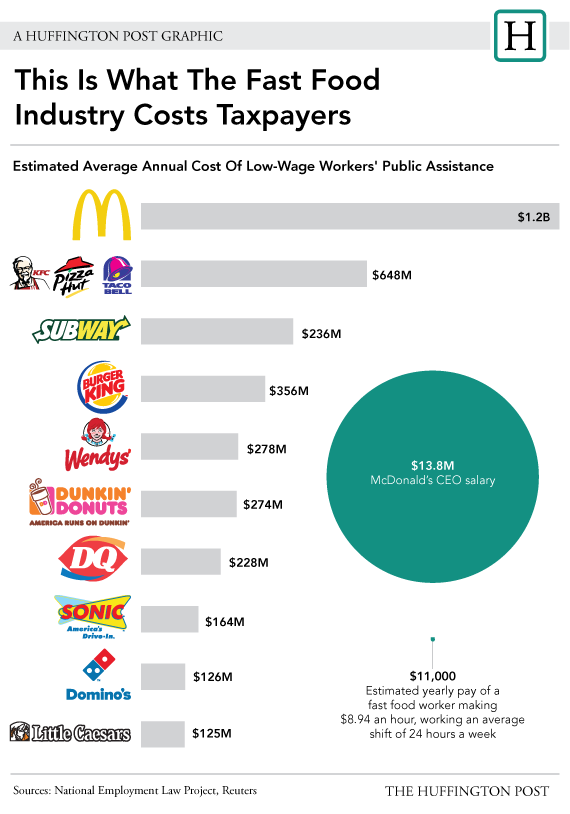
What The Fast Food Industry Costs Taxpayers


Thursday, October 24, 2013

The Failures of Privatized State Economic Development Agencies

Creating Scandals Instead of Jobs: The Failures of Privatized State Economic Development Agencies
“In 2007 we consolidated Wisconsin’s economic development efforts, including terminating a state-created private economic development entity, Forward Wisconsin, in order to reduce political favoritism and misuse of public funds,” said State Senator Mark Miller. “Unfortunately we reverted to old-style cronyism in 2011 with the creation of the Wisconsin Economic Development Corporation which has been plagued with predictable ethics improprieties and gross mismanagement.”

The report finds that:
  • The Wisconsin Economic Development Corporation (WEDC) was accused of spending millions of dollars in funds from the U.S. Department of Housing and Urban Development without legal authority, failed to track past-due loans, and hired an executive who owed the state a large amount of back taxes.
Based on this persistent pattern of abuses, the report concludes that the privatization of economic development agency functions is an inherently corrupting action that states should avoid or repeal. With the “economic war among the states” already dominated by corporate interests and bargaining dynamics made worse by a long-term drop in job-creation deals, taxpayers are best served by experienced public-agency employees who are fully covered by ethics and conflicts laws, open records acts, and oversight by auditors and legislators.

Heinous Hunters

James Rowen, of The Political Environment, is doing admirable work covering the shameful and monstrous Wisconsin wolf hunt.

For more on this barbaric practice, here's some of the links:
http://thepoliticalenvironment.blogspot.com/2013/10/feed-wolf-trap-wolf-shoot-wolf.html
http://thepoliticalenvironment.blogspot.com/2013/10/ten-days-of-wi-wolf-killing-exceeds.html
http://thepoliticalenvironment.blogspot.com/2013/10/blood-in-woods-wi-wolf-kill-hits-110.html
http://thepoliticalenvironment.blogspot.com/2013/10/wisconsins-state-sanctioned-wolf-hunt.html
http://thepoliticalenvironment.blogspot.com/2013/10/quickened-wi-wolf-kill-closing-in-on.html
http://thepoliticalenvironment.blogspot.com/2013/10/q-do-wolves-take-as-many-deer-as-some.html
http://thepoliticalenvironment.blogspot.com/2013/10/wi-wolf-kill-total-at-66.html
http://thepoliticalenvironment.blogspot.com/2013/10/wi-wolf-kill-to-turn-50-shades-of-red.html
http://thepoliticalenvironment.blogspot.com/2013/10/eight-wi-wolves-harvested-since-tuesday.html

Monday, October 21, 2013

Fantasy & False Equivalence

The Journal Sentinel editorialized:
But even though Ryan and his Senate counterpart, Patty Murray (D-Wash.), have agreed that a big deal involving tax revenues and structural changes to Medicare, Medicaid and Social Security is impossible for now, those are exactly the kind of reforms that lawmakers must eventually embrace. 
Entitlement spending, fueled by an aging America, is the primary reason that long-term projections of federal debt are so dismal. 
And both parties need to confront their own cherished beliefs. 
I'll go slow so the Journal Sentinel editorial board can understand.

Medicare, Medicaid, and Social Security are not one program. The deceptive, yet often used, phrase "entitlement spending" is overly simplified and highly misleading.

Medicare and Medicaid are health care programs. Our health care cost nearly twice as much as the next highest-spending country (more often than not, with worse results). Our overly costly health care is the primary reason for distress over long-term budget projections. If our health care spending were in-line with other developed nations, the U.S. wouldn't have a long-term budget concern.

As Dean Baker details, "If the US had the health care costs of Australia, we’d see public debt in 2022 fall from a projected 90 percent of GDP to a much more manageable 60 percent. Having the same costs as Canada and Germany would make that number only slightly higher, at around 64 percent of GDP."


Social Security presently has a surplus. If our economy performs abysmally in the coming decades, then, thirty years from now, forecasters predict Social Security will only be able to pay seventy to eighty percent of current payouts. This program is neither in crisis nor should it be associated with anything "dismal." Social Security keeps a majority of America's seniors from living in poverty. Plus, Social Security Does Not Contribute To The Deficit.

The Journal bemoans, "Democrats also need to let go of their sacred mysteries. Many Democrats cling to the notion that entitlement programs cannot be fundamentally changed. Medicare, Medicaid and Social Security are liberal icons, after all, untouchable."

Actually, Democrats (along with Republicans) have made changes to these programs in the past few decades. Democrats merely don't want to gut what are important and highly-supported programs. This false equivalence - the Democrats also do it - is a fiction. Republicans no longer negotiate; they, instead, hold the country hostage.

The editorial closes with of flourish of falsities and debunked right-wing talking points.
All three need an overhaul, starting with means testing for Medicare and probably Social Security and some means to ensure, in the case of Medicare, that recipients have a little more skin in the game. 
Democrats also resist the idea of tax reform, which to them sounds like more tax breaks for the wealthy and corporations. Yes, the wealthy can afford to pay a little more. But Democrats need to reconsider their reluctance to work with companies that employ millions of Americans on tax reform. The U.S. has one of the highest corporate tax rates in the world. What sense does it make to chase off business when business does not recognize national borders? Tax reform that aims for fewer loopholes and lower rates could encourage growth — and raise more money.
As Lynn Stuart Parramore wrote, "Means-testing is a back-door strategy for taking away benefits earned by hard-working Americans. In Washington-speak, “means-testing” is a scheme to deny or reduce Medicare and Social Security benefits for people who are “too wealthy” in the name of saving money."

U.S. corporations pay an effective tax rate of 12.6%. As James O'Toole reported, "U.S. companies face the highest official corporate tax rate in the world. But there's a big difference between the rates set out by law and the cash that's actually collected." Again, it seems, the Journal is purposefully trying to mislead readers and confuse issues.

From The Big Picture, “Twenty-six big US companies paid their CEOs more last year than they paid the federal government in tax...The study, by the Institute for Policy Studies, said the companies, including AT&T, Boeing and Citigroup, paid their CEOs an average of $20.4 million last year while paying little or no federal tax on ample profits, according to regulatory filings. Astonishingly, nearly all of the the companies received a net tax refunds of up to $1billion. Others had a tax bill of $0. On average, the 26 companies generated net income of more than $1 billion in the US, the study said.”

As Paul Buchheit stated, "In the past twenty years, corporate profits have quadrupled while the corporate tax percent has dropped by half. The payroll tax, paid by workers, has doubled."

To recap: 1) the Medicare and Medicaid programs are not the problem...it's the cost of our health care, 2) Social Security is fine, and 3) corporate taxes are not high nor are they hindering hiring.

There are not two sides to every story. We need the Journal Sentinel, and like-minded misinformants, to stop peddling these fantasies. Reality just doesn't jibe with their false equivalence and doomsday scenarios.

For Further Reading:
21 graphs that show America’s health-care prices are ludicrous

Sunday, October 20, 2013

Gerrymandering Reinforces & Enables Further Polarization

More revisionist fantasy was presented as reasoned analysis in a recent op-ed from Nolan McCarty, Keith Poole and Howard Rosenthal. The authors claim, Gerrymandering Didn't Cause America's Polarization.

They begin, "The right wing of the Republican Party has embraced a fundamentalist version of free-market capitalism and succeeded in winning elections."

The authors continue, "The "blame it on the gerrymanders" argument mistakenly assumes that because redistricting created more comfortable seats for each party, polarization became inevitable."

Conversely, as an example, which Bloomberg reported, "Michigan’s 14th congressional district looks like a jagged letter ’S’ lying on its side. From Detroit, one of the nation’s most Democratic cities, it meanders to the west, north and east, scooping up the black- majority cities of Southfield and Pontiac while bending sharply to avoid Bloomfield Hills, the affluent suburb where 2012 Republican presidential nominee Mitt Romney was raised. Its unusual shape is intentional. Michigan Republicans, seeking to maximize their political strength, drew the district lines -- and the residential patterns of Democratic voters made their job easier. Michigan’s 14th district underscores how Democrats across the U.S. are bunched in big metropolitan areas, resulting in the party’s House candidates often winning by wide margins on Election Day while Republicans capture more seats because their voters are spread out."

The Bloomberg reporters continue, "It’s a prime reason Democrats fell 17 seats short of winning a House majority in 2012, even as their congressional candidates drew about 1.4 million more votes than Republicans nationwide."

The only reason just a few extremists can polarize our politics is because of gerrymandering.

Ignoring what gerrymandering is - manipulating the boundaries of an electoral constituency to favor one party - the McCarty, et al. purport the myth that somehow this all happened naturally. People just sorted themselves geographically, ideologically and culturally. Yet, in the real world, gerrymandering is done to maintain power. Without manipulating the boundaries of electoral districts, Republicans would not be in power right now. They wouldn't be able to shut down government.

As Gary Giroux explains, "A majority of Americans disapprove of the Republicans in Congress, yet the odds remain in the party’s favor that it will retain control of the House. One big reason the Republicans have this edge: their district boundaries are drawn so carefully that the only votes that often matter come from fellow Republicans."

Next, for some odd reason, the authors use the Senate for an example, "Consider, for example, the rise of the mastermind of the government shutdown, Sen. Ted Cruz. The Texas Republican won his seat, as does every member of the Senate, in a statewide race, without any benefit from gerrymandering. The same is true for other tea party stalwarts in the Senate such as Rand Paul of Kentucky and Mike Lee of Utah." The only problem here, Democrats control the Senate!

"The number of politically safe seats in the House isn't fully explained by gerrymandering, either. Other, longer-term trends play a role, too," the authors claim.

Again, without such manipulation, Republicans wouldn't be able to shut down the government or obstruct the Affordable Care Act. If not for gerrymandering, the Republicans wouldn't have the House.

For Further Reading: 

Saturday, October 19, 2013

Hucksterism, WEDC-Style

Jim Villa, president and chief executive officer of the Commercial Association of Realtors Wisconsin (CARW), opined, WEDC the Right Model for Job Creation and Economic Development.

[How much weight should we give the insight of Mr. Vella? I don't remember the CARW mentioning anything about the housing bubble that cost our economy $8 trillion (and this is supposedly in their area of expertise). Thus, his prognostications and policy prescriptions should be taken with a heavy dose of salt.]

If you've been paying attention, you know that the Wisconsin Economic Development Corporation (WECD) is a disaster.

Villa opens with the ludicrous claim, "Wisconsin's economy has already made significant progress." Implying that since Scott Walker turned the Commerce Department into the quasi-private WEDC, Wisconsin's economy has been humming along. Yet Lisa Kaiser recently reported, "The new data showed that Wisconsin’s private sector added just 24,305 new jobs between March 2012 and March 2013, growing 1.1%, well below the 2% national job growth during that period."

Despite this reality, Villa declares, "CARW believes that the WEDC model is the right direction for growing Wisconsin's economy and job creation." If we're following this logic, pissing into the wind is also a fantastic idea.

Mr. Villa continues on explaining why the Commerce Department needed changes. They were "unable to focus." They needed to separate economic development programs from regulatory programs. The WEDC would "better serve the needs of the private sector job creators in a more accountable, efficient and effective manner."

As we've seen, WEDC has served the private sector with untraceable corporate welfare. Although, accountable and efficient are not the adjectives I'd use to describe such malfeasance. In fact, the WEDC has been anything but accountable and efficient.

Plus, doesn't it make sense that an agency monitor it's programs (including implementation and regulation)? Doesn't separating these activities into different entities create needless bureaucracy and inefficiencies?

Villa then trots out the 'just like Indiana' right-wing mantra. It's supposedly well-known that Indiana is a booming economy. [Tumbleweeds roll past]

As I wrote, back in December 2010,
Indiana is the 16th most populous state, it ranks 37th in per capita income. The unemployment rate in Wisconsin is 8.5%, it's 10.1% in Indiana... If we look at median household income, Indiana ranks 32nd and Wisconsin 21st. GDP change between 2006-2008 was -0.6 in Indiana (ranking 41st), -1.5 in and +0.7 in Wisconsin (ranking 27th). Indiana is primarily performing worse, yet we should follow their lead?
Indiana is instituting more crack-pot right-wing policies, but that hasn't translated to an economic paradise like the proponents claim.

Villa then admits, "There have been challenges during the transition." But he continues on, using WEDC numbers, to claim large investment and job creation due to WEDC. Yet, the Wisconsin Legislative Bureau found,
Government agencies have incomplete data on the impact of economic development programs they administer. 
In the 2007-'11 period, state agencies administered 196 economic development programs, according to the report. But state auditors said it was difficult to determine how many jobs actually had resulted from the programs.
Villa thinks WEDC will lead to "business expansion within the state." Yes, by having this untraceable slush fund, Walker and his right-wing cronies can provide corporate welfare without the public's knowledge. Ah, the not-so-free-market strategy of poaching. Using the untraceable WEDC funds to bribe businesses away from other states.

Mr. Villa closes stating, "Tremendous strides have been made since the formation of WEDC." Wisconsin improved two spots (from 42nd to 40th) in the latest Tax Foundation rankings. Tremendous!

This cabal of right-wing hucksters sure does stick together. Each using their platform to support and echo talking-points. We just need to make sure and take the time to burrow through these weeds and see their claims for what they really are - self-serving bullshit.

For Further Reading:
Rewarding Failure: The Wisconsin Economic Development Corporation
WEDC Not Good Model For Deploying Scarce Resources

Weekend Reading

Corporate Welfare Grows $154 Billion In Midst Of Government Cuts
How The NFL Fleeces Taxpayers
The Craft Beer Movement
401(K)s Are Replacing Pensions. That's Making Inequality Worse
Why The Level Of Government Debt May Not Matter
Inequality Is A Choice

Thursday, October 10, 2013

Business Tax Climate Bull

The Tax Foundation reported Wisconsin dipped to 43rd, among the 50 states, in its business tax climate ranking.
The Tax Foundation said Wednesday that the state's rating is likely higher than its analysis originally showed. 
"We received some feedback from reporters and legislators about Wisconsin's place in the index, and would like to make some clarifications about the state's ranking this year," the foundation said in a statement late Wednesday afternoon. It had released its index on Wednesday morning... 
State Rep. Dale Kooyenga (R-Brookfield) raised concerns about the ranking when it was released, arguing that with the tax law changes, there is no way the state's tax climate for business worsened.
Last year Wisconsin ranked 42nd. This year's revised ranking is 40th.
The top 10 states in 2014 are Wyoming, South Dakota, Nevada, Alaska, Florida, Washington, Montana, New Hampshire, Utah and Indiana.
Not really a murderers' row of dynamic economies. Plus, these 10 states only account for 13.6% of the United States population.

Matthew Yglesias looked at the correlation between employment, business friendly tax codes, and wages. 
There is a weak negative correlation between business friendly tax codes and wages. 
And a weak positive correlation between business friendly tax codes and employment-to-population ratio. 
In sum, it's a nothingburger. I note that this would confirm the results of a useful Thumbtack survey which found that licensing policies drive business-friendliness but taxes don't.
Scott Walker is a Republican hopeful for the 2016 presidential election (not to mention he also has to run for governor in 2014). The party can't allow one of their poster boys to have a record (yet again) demonstrating the failure of supply-side, trickle-down, tax-cutting, deregulatory policies.

To the conservative echo chamber. All hands on deck. Republicans need to make sure their water carriers look good in the media. They do this by making sure all the editorials, reports, and talk show appearances regurgitate the same manufactured storyline - cutting taxes and deregulation work. 

Enter the Tax Foundation. A right-wing, anti-tax, anti-regulation interest group masquerading as an unbiased think tank. Of its founders, two were General Motors executives, one was president of the Standard Oil Company. Funny how the policies the Tax Foundation support also happen to benefit the businesses of it's founders.

Thus, when bad news slips out, to the backtrack machine. Oops. Scott Walker is actually improving things. He's been such a lightning bolt, Wisconsin's business climate moved two whole spots! 

Business climate rankings have been found to be meaningless. The money and time involved in producing and propagandizing such could actually be put to productive use. 

Lastly, why are "business-friendly tax codes" a good thing? Corporate profits are at an all-time high, yet wages continue to stagnate. How much more business-friendly do we need to be? Where's the worker-friendly policy rankings?

For Further Reading:

Warren Gets Mad About Shutdown, Starts Naming Names


                                              [source]

The Sabotage Of Democracy

Saturday, October 5, 2013

The Toys Go Winding Down

James Causey, of the Milwaukee Journal Sentinel, is the latest to jump on the 'Milwaukee must build the Bucks a new basketball stadium or else' bandwagon. He opines, The clock is winding down for the Bucks.
Local taxpayers should not expect Kohl to foot the entire bill for a new or renovated facility. No owner will take on such a task. But, remember, taxpayers didn't pay for the Bradley Center. The facility was a $90 million gift from the late philanthropist Jane Bradley Pettit. And although everyone groaned about the stadium tax — that we all still pay — most of us are glad we have Miller Park.
"Everybody was bitching about the tax, but the stadium is pretty, so everything is OK." That's not a justification for spending millions of taxpayers' dollars.

Plus, most of the taxpayers probably never even go to a Brewers game. The majority of residents paying the stadium tax most likely never attend a game.

The Bucks averaged 15,035 people per home game last year. The five counties paying the stadium tax have a combined population (as of 2012) of 1,761,778. That's less than 1% of the five-county population per game attending a game. If we assume no person in the five-county area saw more than 1 game over the course of last season, based on last years attendance, that would still be less than 35% of the five-county population that went to a Bucks' game. [(15,035 * 41 home games)/1,761,778]

The Milwaukee Brewers' attendance in 2013 was the lowest its been since 2006. Miller Park is a lovely stadium...it should be, it was  built in 2001. The primary reason for increased attendance was not the new stadium, it was fielding a competitive team. Hence, the Brewers are back to their losing ways and less people are showing up.

In 2013, the Bucks had the 4th worst attendance and the 13th worst record. If the public must fund stadiums, can we at least have a clawback provision which assures that teams spend a certain amount on payroll? If they don't, they need to repay the subsidy. If we have to fork over cash to fund a private operation, we need some assurances that we'll be getting a competitive team (or at least a team trying to be competitive) for our investment.

Causey concedes stadiums are a low priority, "Milwaukee has a number of problems more pressing than a new sports arena. Our schools could use more funding, poverty is a very real problem and some of our roads and streets have so many potholes that you have to play dodge ball with your car. These issues will still exist with or without a new Bucks facility."

Or we could take the money to address those real problems instead of spending it on a sport stadium.

Yet, we really need this stadium?

For Further Reading:
Buck The System
Buck You
Big League Confusion
Stadium Swindle
More Bradley Center Bull
The Time Is Now?
Is There Anything A Stadium Can't Solve?
The Legalized Bribery That Is Sports Subsidization
It's A Scandal! It's A Outrage!
Bradley Center Boosters Keep Pounding That Drum
Overblown Bradley Center Impacts